The best thing about being in college is the independence that comes with it. As much as I love my familia loca and the Sazón seasoned food that they cook with amor, it feels so great to have some space from them. Just like many Latino families, they can be overly strict and judgemental–which at times is extremely annoying. And even though I didn’t have the best roommate situation once I got to school, it taught me how to deal with my own issues. I can genuinely say that I feel so much more like an adult and I deal with stress much more efficiently.
Since I dreaded being in my dorm room, I would barely spend time there. Other than wanting to get away from my roommates, I also wanted to explore NYU and find my study niches that would have the potential to become my procrastination and cooling sites. Ironically, the best place I found was a place right in my residential building. I found the library too crowded and other places not private enough. The quiet zone in Rubin Hall, my favorite studying place, had the individual desks with rollable walls. It was perfect to study in, make faces without anyone staring at me, become 100% comfortable, relieve stress, and most importantly, escape from anything and anyone. Once one has their niche in college, everything seems much easier and you can maintain faith that college is doable.
Another way I fulfill my independence at NYU is by going to Kmart. I know that Target and Walmart are on everyone’s preferred list on super shopping, but I literally live for Kmart. Not only do NYU students barely shop there, making it perfect for me to escape from the college environment, but I also get everything there for free. I am proud to be a Kmart/Shop your Way member. I am a student and it is crucial for me to seek all the discounts I can get. I can shop there for hours, take time out for me, all while leaving with free items.
When you’re independent, you focus on your mental health a lot more. Starting my own blog was one way that I genuinely became happier. After being persuaded by a few peers and giving a presentation about the lack of underrepresented voices in the media, I finally took the initiative to start my own blog. I went a while not having an audience and I can gladly and gratefully say that I have a small one now. Additionally, blogging allows me to say what I want in an unfiltered tone. Blogging allows me to illuminate my current feelings onto a site that is completely under my control. My blogs are a reflection of me, and rereading them makes me proud of the person I am. After hearing from my professor that writing daily leads to happiness, I wanted to take advantage of that. Although I don’t write daily, I can say for sure that I am a much happier person now that I write more often.
In my eyes, being independent in college means finding your physical comfort zone similar to Woolf’s vision of having a room of one’s own. Relieving stress and finding independence as a student is about finding your escape and that can include anything–like blogging! The majority of the time, you only have yourself to depend on, so, keeping your sanity while being alone goes a long way in adulthood.
By Tiana B.
Tiana is a sophomore at NYU concentrating on journalism and creative writing. She seeks to display the representation of African Americans and Latinos by providing her own experiences and illuminating marginalized issues in her own writing. When she’s free from her stressful college life, she likes to listen to rap music, binge watch on anime, splurge on Kmart deals, and cook her Hispanic cuisines. Tiana also runs another blog called True T which also highlights not only her personal experiences, but her genuine and unfiltered opinions on today’s matters.
For over 20 years, the Campus Clipper has been offering awesome student discounts in NYC, from the East Side to Greenwich Village. Along with inspiration, the company offers students a special coupon booklet and the Official Student Guide, which encourage them to discover new places in the city and save money on food, clothing and services.
At the Campus Clipper, not only do we help our interns learn new skills, make money, and create wonderful e-books, we give them a platform to teach others. Check our website for more student savings and watch our YouTube video showing off some of New York City’s finest students during the Welcome Week of 2015.
It’s no thought that high school consists of painful memories that include rude boys. Back then, I would often receive snarky comments about how skinny I was or about my short fragile hair. However, looking back, I was thankful that my dating fate did not consist of rude losers who only dated girls for their bodies because believe me, that was the sad image of my high school.
Fast forward to college and I feel much more confident in my looks. I’ve started wearing my natural hair more and I look delightful all on a budget. I even started gaining weight but in the right areas. Going into college, I wanted to experience a real relationship and not some hookup or temporary fling. I never had a boyfriend so I felt that college was an amazing opportunity to act on that desire considering everyone is older and much more mature.
When I actually got to college, though, I obviously found that this wasn’t the case. Many guys had immature personalities or just sought sex. I can’t act surprised because college is notorious for its hook-up culture especially in this day in age where Tinder dominates everything. However, I was still disappointed by the lack of charm these guys had. One guy I could have sworn liked me showed all the signs just to give up on me after three weeks. Usually when I like a person, I fantasize about my future with them just like a mad girl. But, this time I had the guts to actually talk to the guy, so when he showed signs of interest back, those fantasies continued to spur even if nothing was actually confirmed. So when I found out that his interest was no more, the rejection also struck my self-confidence a bit. Was I not pretty enough? When would my first relationship start? It sucked not experiencing the moments that many teenagers had already gone through.
I began to even ponder the fact that it must have had to be that I am a black woman. Black girls, especially those in darker skin tones, are less likely to marry, find dates, and are even viewed as the most unattractive compared to women of other races. So finding love with men of many cultures/races as a black woman in a predominantly white college is slim. On top of that, thinking about not having my first boyfriend did have me feeling like a loser at times. However, this mentality and the sting of rejection was only momentary. I try not to let negativity or any person consume my joy. I always end up loving myself the next day and consider myself the beauty that got away–his loss. I crazily appreciate my looks and intelligence, but definitely my fun personality because it undeniably me. Knowing how quickly I got over a dumb crush makes me hopeful that I will be strong for my first, but hopefully nonexistent heartbreak. I do still fantasize about my future husband and I do get a bit jealous when I see couples happily holding hands in Washington Square Park. I want that joy, but I will wait for it when the right time comes up. In the meantime, I have myself to love unconditionally and permanently.
Tiana is a sophomore at NYU concentrating on journalism and creative writing. She seeks to display the representation of African Americans and Latinos by providing her own experiences and illuminating marginalized issues in her own writing. When she’s free from her stressful college life, she likes to listen to rap music, binge watch on anime, splurge on Kmart deals, and cook her Hispanic cuisines. Tiana also runs another blog called True T which also highlights not only her personal experiences, but her genuine and unfiltered opinions on today’s matters.
For over 20 years, the Campus Clipper has been offering awesome student discounts in NYC, from the East Side to Greenwich Village. Along with inspiration, the company offers students a special coupon booklet and the Official Student Guide, which encourage them to discover new places in the city and save money on food, clothing and services.
At the Campus Clipper, not only do we help our interns learn new skills, make money, and create wonderful e-books, we give them a platform to teach others. Check our website for more student savings and watch our YouTube video showing off some of New York City’s finest students during the Welcome Week of 2015.
Her laughter would annoy me as she was approaching the door. I would be even more annoyed if there were a second laughter that harmonized with hers–she loved to bring friends over at night. These are just some of the complaints I had about my roommate, who I will name Tory. My other roommate, with the pseudonym of Ally, was fairly quiet. I remember hesitating as to whether or not I should live on campus because I already lived in NYC. My number one concern was having an awful roommate that I would be stuck with–and although Tory wasn’t necessarily terrible, I consider myself unlucky for being bombarded with an inconsiderate person. Despite her thoughtlessness, I established strict rules on drinking in the room–I had been admitted on a scholarship that stressed that any of its students caught drinking would have their scholarship confiscated. After all, a full scholarship is a sweet student deal and I’m all about student discounts.
Looking back, NYU was not strict at all when it came to room checks, but I don’t regret emphasizing that rule to my two roommates. I was only a freshman who wasn’t aware of NYU’s leniency, and I was simply looking out for myself and definitely my financial wellbeing. Speaking up was never an issue for me, but I didn’t want to seem like the mother of the room. Even though I had the right to peacefully speak up about certain factors such as cleaning the bathroom, keeping the noise down when guests come over, and not slamming doors in the morning, I didn’t want to overdo it. On the other hand, I can only keep my mouth shut for so long when it comes to living with someone. Tory had proposed a rule to me and Ally, called “sock on the door.” We all agreed on it, and Tory tested the system for the first sometime during the spring semester. I was with my friend when I saw Tory’s text and about an hour later, we went to check if the sock was still in place–of course, it was.
When I ran into Ally later that day, she admitted that she was also annoyed by the inconvenient timing of Tory’s occupying the room which went on for an hour and a half in the evening the day of a residential floor meeting. When the actual confrontation took place with Tory, Ally was silent as a mouse. I was the only one to speak up during the uncomfortable conversation. Although there was some tension in the room afterward, the situation passed. Some of our other issues with Tory still persisted, and I couldn’t rely on Ally to say anything because of how timid she was. There was always a competition as to who would take out the trash as it would pile day by day. Thank goodness I had my own trash can, my Zzzquil for those noisy nights, and my apartment nearby to help me keep my sanity. Still, we all got along for the most part and the living situation could have been much worse, because I know not everyone can tolerate me. I’m happily moving in with my best friend next year, and I know I might become annoyed by things she does, but I am proud to know that I have the guts to speak up about whatever issues may arise.
By: Tiana B.
Tiana is a sophomore at NYU concentrating on journalism and creative writing. She seeks to display the representation of African Americans and Latinos by providing her own experiences and illuminating marginalized issues in her own writing. When she’s free from her stressful college life, she likes to listen to rap music, binge watch on anime, splurge on Kmart deals, and cook her Hispanic cuisines. Tiana also runs another blog called True T which also highlights not only her personal experiences, but her genuine and unfiltered opinions on today’s matters.
For over 20 years, the Campus Clipper has been offering awesome student discounts in NYC, from the East Side to Greenwich Village. Along with inspiration, the company offers students a special coupon booklet and the Official Student Guide, which encourage them to discover new places in the city and save money on food, clothing and services.
At the Campus Clipper, not only do we help our interns learn new skills, make money, and create wonderful e-books, we give them a platform to teach others. Check our website for more student savings and watch our YouTube video showing off some of New York City’s finest students during the Welcome Week of 2015.
I can attest to the struggle of finding one’s footing upon entering the anxiety-filled halls of freshman year. I remember very clearly being incredibly excited to set out upon an adventure that I had imagined thousands of times through in my mind. However, that didn’t mean that I wouldn’t encounter trials and tribulations that I would learn from. This era was the time in my life when I began to see the most physical change my body had ever undergone. In many ways, were my choices both good and bad, healthy and unhealthy, mature and immature, etc. Sophomore year of college made me aware of how important it is to spend one’s time wisely, in taking action that will propel your entire life in a positive direction, because the time so quickly escapes you.
So what does it mean to wisely spend one’s time as a new college student, fresh blood upon the quads and campuses of universities that are dominated by more intelligent, more attractive, less awkward individuals, and push one’s life in a “healthy direction”? Well, having experienced my sophomore year living in a dorm over one hundred years old with one roommate and six other suite mates…and two bathrooms, I can attest that there is a necessity to be ever aware of three important aspects of one’s life: hygiene/healthy eating, time management, and prioritization of long-term goals. If these things are kept in mind, then it is much less likely that someone will arrive into a bedlam of their own. There will be difficult times, but one has to remember to always be maintaining your happiness and the sources of that for you. For me, being “happy”, or in a good mood, was always very influenced by the things I had recently eaten. And, if you are or ever have been a college student, you will understand that diet, what you are eating everyday, is one of, if not the, greatest influences on your overall well being and must be well maintained.
Saving money, snatching the best promos, having fun, or discovering one’s passions is always going to be on the mind of new college students. However, I found that this focus tends to detriment the decisions made about dieting, hygiene, and the general effort that is
directed toward one’s academics. Let me assure you, if not enough value is endowed to hygiene/health, time management, and prioritization of long-term goals, than a path to bedlam will surely be paved.
In terms of being healthy, of feeling energized, of feeling ready for obstacles,, and to face life with a level headed mind the upkeep of the mind and body holds the greatest import. The vegetables, fruits, balanced meals, non-sodas are much healthier options than the typical fast food that college students flock to, and I know first hand that what I am saying is a difficult thing to put into practice.
Sometimes, at 3:00 AM, a cheeseburger, or some greasy tacos, or a breakfast burrito just sounds like an absolute necessity, but the will can remain steadfast! I have seen snacking, sodas, excess alcohol, drugs, and fast food deal irreversible damage on college students who showed promising potential. When there is academic material to be appreciated and learned from, or when there is an exam looming that requires heavy preparation, whatever the task may be, it is always disadvantageous to perform those tasks while not at one’s full capacity in both mind and body.
I understand the desire to live out the college life depicted across pop-culture. However, the University and the system of higher education exists first and foremost to satiate the desire to learn. To progress the intellectual and deliberative processes of the human mind, and propel an individual, who has sought such training, positively forward in their life. The Bedlam that I once knew came upon me quickly and without remorse, because I turned a blind eye to this understanding and allowed my momentary happiness to overshadow my long-term life goals. I write, now removed from my Bedlam of Sophomore year of college, with greatest hope that these words can better prepare new college entries to pave a path away from Bedlam and toward jubilant amelioration.
By James Rodriguez
James Rodriguez is a recent college graduate from New York University, who, after experiencing a diverse range of trials and tribulations in undergrad, is seeking to share his lessons learned with those who can capitalize on them today. Originally from San Antonio, Texas, he found living in New York City drastically different from what he was accustomed to. From this time of transformation, readjustment and reevaluation James now seeks to utilize the lessons and understandings that he gained to better the experiences of those who face similar experiences. Working in tandem with the Campus Clipper, James now has the platform to share his words and experiences with greatest hopes that the difficulties he faced will be ameliorated for others.
For over 20 years, the Campus Clipper has been offering awesome student discounts in NYC, from the East Side to Greenwich Village. Along with inspiration, the company offers students a special coupon booklet and the Official Student Guide, which encourage them to discover new places in the city and save money on food, clothing and services.
At the Campus Clipper, not only do we help our interns learn new skills, make money, and create wonderful e-books, we give them a platform to teach others. Check our website for more student savings and watch our YouTube video showing off some of New York City’s finest students during the Welcome Week of 2015.
In having been an actor for over 10 years of my life the adjustment that I experienced in not pursuing acting further in college was interesting, to say the least. Before that, life had been a world of opportunity in the sense that anywhere could have been a stage upon which to demonstrate my craft, my commitment, my skill, etc..
Upon arriving in New York City as a freshman college student, I found myself searching for something new around which to center my life. Something that could fill the void I felt inside me. I wanted to substitute something for the hours of intense training, detail-oriented rehearsals, and a creativity that was conditioned to image the sufferings and joys of human existence. I was in the process of reimagining my life, adjusting to my new life off-stage, in lecture halls, and among unfamiliar peers; in the manner that I would live, the activities that I would pursue daily, the motivation that I felt that pushed me toward always becoming better than what I was the day before, etc.. I believe that this time, a time of life re-imagined, can relate to, and is shared by, those who experience a dramatic shift in their day-to-day routines, their sense of limitation, and their sense of liberty when choosing what to prioritize in life.
This especially applies to college students, namely Freshmen, who recently removed themselves from a familiar environment full of routine and safety. In attending an out-of-town, an out-of-state, or international university, students are faced with the difficult task of taking what they knew as life and drastically reimaging it to suit their needs in their new localities. The difficulties arises from temptation. Temptation that is reinforced by the general newfound liberty of independent living. Spiderman taught me at a young age that “with great power comes great responsibility,” and it is a fact of human existence that ameliorating one’s liberty of choice, freedom of expression, and right to self-determination is directly relatable to one’s sense power.
So in here lies the subject of responsibility. What this essay aims to make palpable is the difficulty that exists in maintaining one’s sense of responsibility and pragmatism during this time of life re-imagined. Before, we discussed the opportunities college students have in trying to find the best student deals, spark new relationships, curate better hygiene, etc. when in an unfamiliar place, such as attending a new school. However, it is this greater realization of the individual’s power of choice that is the true subject of this discourse. I don’t want to sound cliché, but for new college students, there is no greater excitement then determining exactly what it is that makes you happy and using those sources of happiness to your advantage.
The overwhelming nature of arriving in a different city, into a situation where there are no longer limits on the things you can try, or finding where those things will begin generally brings anxiety with it. It is good to feel that anxiety, because it means that you value what your life is and your happiness in living it. If I could go back and tell myself a tidbit of advice freshman year, I would tell him this: there is no greater opportunity missed than living a life that prioritizes your health, your happiness, and your ability to make patient deliberated decisions. That may seem like an Olympian sized feat, but it begins with the littlest of things. For example, when one prioritizes their health and ability to focus and deliberate, than drinking the night before a test perhaps wouldn’t even enter one’s mind as a viable option.
It may seem a little extreme. However, when I was adjusting to my life off-stage there were many decisions that I see now as being nothing but a hindrance on my overall goal of being happy. I was more concerned with my momentary happiness and less concerned with prioritizing my long term goals. It is easy to try and find the most exciting thing to do as a young new college freshman or sophomore, but it is all too easy to get caught up in the overwhelming liberty that comes with newfound independence. Always prioritize the life you want to be living and don’t simply live in the moment, and I promise that your life re-imagined will be a rewarding one to live.
By James Rodriguez
A Texan born and raised, James Rodriguez grew up in San Antonio TX, and has recently graduated from New York University, having studied corporate and political publicity. He sings, plays guitar, studies French, etc. in his free time, and when given the opportunity to share advice that he thought noteworthy with future or current college students, he jumped on the chance. He believes that there is something incredibly important in obtaining knowledge from those who are going through or have recently finished dealing with the difficulties one is seeking advice on. Which is exactly the aim of the Campus Clipper: to share the best advice possible in order to better the experiences of students who are struggling now. Because he was once that lost college student who was searching for instruction and who felt out-of-place and in need of direction, he hopes that his words can relate to someone’s struggle and help along the way.
For over 20 years, the Campus Clipper has been offering awesome student discounts in NYC, from the East Side to Greenwich Village. Along with inspiration, the company offers students a special coupon booklet and the Official Student Guide, which encourage them to discover new places in the city and save money on food, clothing and services.
At the Campus Clipper, not only do we help our interns learn new skills, make money, and create wonderful e-books, we give them a platform to teach others. Check our website for more student savings and watch our YouTube video showing off some of New York City’s finest students during the Welcome Week of 2015.
Thank you for choosing to be part of our community at Campus Clipper, doing business as CC (“CC”, “we”, “us”, “our”). We are committed to protecting your personal information and your right to privacy. If you have any questions or concerns about this privacy notice, or our practices with regards to your personal information, please contact us at info@campusclipper.com.
When you visit our website https://campusclipper.com (the “Website”), and more generally, use any of our services (the “Services”, which include the Website), we appreciate that you are trusting us with your personal information. We take your privacy very seriously. In this privacy notice, we seek to explain to you in the clearest way possible what information we collect, how we use it and what rights you have in relation to it. We hope you take some time to read through it carefully, as it is important. If there are any terms in this privacy notice that you do not agree with, please discontinue use of our Services immediately.
This privacy notice applies to all information collected through our Services (which, as described above, includes our Website), as well as, any related services, sales, marketing or events.
Please read this privacy notice carefully as it will help you understand what we do with the information that we collect.
TABLE OF CONTENTS
1. WHAT INFORMATION DO WE COLLECT?
2. HOW DO WE USE YOUR INFORMATION?
3. WILL YOUR INFORMATION BE SHARED WITH ANYONE?
4. DO WE USE COOKIES AND OTHER TRACKING TECHNOLOGIES?
5. DO WE USE GOOGLE MAPS PLATFORM APIS?
6. HOW LONG DO WE KEEP YOUR INFORMATION?
7. HOW DO WE KEEP YOUR INFORMATION SAFE?
8. DO WE COLLECT INFORMATION FROM MINORS?
9. WHAT ARE YOUR PRIVACY RIGHTS?
10. CONTROLS FOR DO-NOT-TRACK FEATURES
11. DO CALIFORNIA RESIDENTS HAVE SPECIFIC PRIVACY RIGHTS?
12. DO WE MAKE UPDATES TO THIS NOTICE?
13. HOW CAN YOU CONTACT US ABOUT THIS NOTICE?
14. HOW CAN YOU REVIEW, UPDATE OR DELETE THE DATA WE COLLECT FROM YOU?
WHAT INFORMATION DO WE COLLECT?
Personal information you disclose to us
In Short: We collect personal information that you provide to us.
We collect personal information that you voluntarily provide to us when you express an interest in obtaining information about us or our products and Services, when you participate in activities on the Website or otherwise when you contact us.
The personal information that we collect depends on the context of your interactions with us and the Website, the choices you make and the products and features you use. The personal information we collect may include the following:
Personal Information Provided by You. We collect names; phone numbers; email addresses; job titles; and other similar information.
All personal information that you provide to us must be true, complete and accurate, and you must notify us of any changes to such personal information.
Information automatically collected
In Short: Some information — such as your Internet Protocol (IP) address and/or browser and device characteristics — is collected automatically when you visit our Website.
We automatically collect certain information when you visit, use or navigate the Website. This information does not reveal your specific identity (like your name or contact information) but may include device and usage information, such as your IP address, browser and device characteristics, operating system, language preferences, referring URLs, device name, country, location, information about how and when you use our Website and other technical information. This information is primarily needed to maintain the security and operation of our Website, and for our internal analytics and reporting purposes.
Like many businesses, we also collect information through cookies and similar technologies. You can find out more about this in our Cookie Notice: https://campusclipper.com/cookie-policy.
The information we collect includes:
• Log and Usage Data. Log and usage data is service-related, diagnostic, usage and performance information our servers automatically collect when you access or use our Website and which we record in log files. Depending on how you interact with us, this log data may include your IP address, device information, browser type and settings and information about your activity in the Website (such as the date/time stamps associated with your usage, pages and files viewed, searches and other actions you take such as which features you use), device event information (such as system activity, error reports (sometimes called ‘crash dumps’) and hardware settings).
• Device Data. We collect device data such as information about your computer, phone, tablet or other device you use to access the Website. Depending on the device used, this device data may include information such as your IP address (or proxy server), device and application identification numbers, location, browser type, hardware model Internet service provider and/or mobile carrier, operating system and system configuration information.
• Location Data. We collect location data such as information about your device’s location, which can be either precise or imprecise. How much information we collect depends on the type and settings of the device you use to access the Website. For example, we may use GPS and other technologies to collect geolocation data that tells us your current location (based on your IP address). You can opt out of allowing us to collect this information either by refusing access to the information or by disabling your Location setting on your device. Note however, if you choose to opt out, you may not be able to use certain aspects of the Services.
HOW DO WE USE YOUR INFORMATION?
In Short: We process your information for purposes based on legitimate business interests, the fulfillment of our contract with you, compliance with our legal obligations, and/or your consent.
We use personal information collected via our Website for a variety of business purposes described below. We process your personal information for these purposes in reliance on our legitimate business interests, in order to enter into or perform a contract with you, with your consent, and/or for compliance with our legal obligations. We indicate the specific processing grounds we rely on next to each purpose listed below.
We use the information we collect or receive:
• Fulfill and manage your orders. We may use your information to fulfill and manage your orders, payments, returns, and exchanges made through the Website.
• To deliver and facilitate delivery of services to the user. We may use your information to provide you with the requested service.
• To respond to user inquiries/offer support to users. We may use your information to respond to your inquiries and solve any potential issues you might have with the use of our Services.
• To send you marketing and promotional communications. We and/or our third-party marketing partners may use the personal information you send to us for our marketing purposes, if this is in accordance with your marketing preferences. For example, when expressing an interest in obtaining information about us or our Website, subscribing to marketing or otherwise contacting us, we will collect personal information from you. You can opt-out of our marketing emails at any time (see the “WHAT ARE YOUR PRIVACY RIGHTS” below).
• Deliver targeted advertising to you. We may use your information to develop and display personalized content and advertising (and work with third parties who do so) tailored to your interests and/or location and to measure its effectiveness. For more information see our Cookie Notice: https://campusclipper.com/cookie-policy.
• For other business purposes. We may use your information for other business purposes, such as data analysis, identifying usage trends, determining the effectiveness of our promotional campaigns and to evaluate and improve our Website, products, marketing and your experience. We may use and store this information in aggregated and anonymized form so that it is not associated with individual end users and does not include personal information. We will not use identifiable personal information without your consent.
WILL YOUR INFORMATION BE SHARED WITH ANYONE?
In Short: We only share information with your consent, to comply with laws, to provide you with services, to protect your rights, or to fulfill business obligations.
We may process or share your data that we hold based on the following legal basis:
• Consent: We may process your data if you have given us specific consent to use your personal information for a specific purpose.
• Legitimate Interests: We may process your data when it is reasonably necessary to achieve our legitimate business interests.
• Performance of a Contract: Where we have entered into a contract with you, we may process your personal information to fulfill the terms of our contract.
• Legal Obligations: We may disclose your information where we are legally required to do so in order to comply with applicable law, governmental requests, a judicial proceeding, court order, or legal process, such as in response to a court order or a subpoena (including in response to public authorities to meet national security or law enforcement requirements).
• Vital Interests: We may disclose your information where we believe it is necessary to investigate, prevent, or take action regarding potential violations of our policies, suspected fraud, situations involving potential threats to the safety of any person and illegal activities, or as evidence in litigation in which we are involved.
More specifically, we may need to process your data or share your personal information in the following situations:
• Business Transfers. We may share or transfer your information in connection with, or during negotiations of, any merger, sale of company assets, financing, or acquisition of all or a portion of our business to another company.
DO WE USE COOKIES AND OTHER TRACKING TECHNOLOGIES?
In Short: We may use cookies and other tracking technologies to collect and store your information.
We may use cookies and similar tracking technologies (like web beacons and pixels) to access or store information. Specific information about how we use such technologies and how you can refuse certain cookies is set out in our Cookie Notice: https://campusclipper.com/cookie-policy.
DO WE USE GOOGLE MAPS PLATFORM APIS?
In Short: Yes, we use Google Maps Platform APIs for the purpose of providing better service.
This Website uses Google Maps Platform APIs which are subject to Google’s Terms of Service. You may find the Google Maps Platform Terms of Service here. To find out more about Google’s Privacy Policy, please refer to this link.
HOW LONG DO WE KEEP YOUR INFORMATION?
In Short: We keep your information for as long as necessary to fulfill the purposes outlined in this privacy notice unless otherwise required by law.
We will only keep your personal information for as long as it is necessary for the purposes set out in this privacy notice, unless a longer retention period is required or permitted by law (such as tax, accounting or other legal requirements). No purpose in this notice will require us keeping your personal information for longer than 1 year.
When we have no ongoing legitimate business need to process your personal information, we will either delete or anonymize such information, or, if this is not possible (for example, because your personal information has been stored in backup archives), then we will securely store your personal information and isolate it from any further processing until deletion is possible.
HOW DO WE KEEP YOUR INFORMATION SAFE?
In Short: We aim to protect your personal information through a system of organizational and technical security measures.
We have implemented appropriate technical and organizational security measures designed to protect the security of any personal information we process. However, despite our safeguards and efforts to secure your information, no electronic transmission over the Internet or information storage technology can be guaranteed to be 100% secure, so we cannot promise or guarantee that hackers, cybercriminals, or other unauthorized third parties will not be able to defeat our security, and improperly collect, access, steal, or modify your information. Although we will do our best to protect your personal information, transmission of personal information to and from our Website is at your own risk. You should only access the Website within a secure environment.
DO WE COLLECT INFORMATION FROM MINORS?
In Short: We do not knowingly collect data from or market to children under 18 years of age.
We do not knowingly solicit data from or market to children under 18 years of age. By using the Website, you represent that you are at least 18 or that you are the parent or guardian of such a minor and consent to such minor dependent’s use of the Website. If we learn that personal information from users less than 18 years of age has been collected, we will deactivate the account and take reasonable measures to promptly delete such data from our records. If you become aware of any data we may have collected from children under age 18, please contact us at info@campusclipper.com.
WHAT ARE YOUR PRIVACY RIGHTS?
In Short: You may review, change, or terminate your account at any time.
If you are a resident in the European Economic Area and you believe we are unlawfully processing your personal information, you also have the right to complain to your local data protection supervisory authority. You can find their contact details here: http://ec.europa.eu/justice/data-protection/bodies/authorities/index_en.htm.
If you are a resident in Switzerland, the contact details for the data protection authorities are available here: https://www.edoeb.admin.ch/edoeb/en/home.html.
Cookies and similar technologies: Most Web browsers are set to accept cookies by default. If you prefer, you can usually choose to set your browser to remove cookies and to reject cookies. If you choose to remove cookies or reject cookies, this could affect certain features or services of our Website. To opt-out of interest-based advertising by advertisers on our Website visit http://www.aboutads.info/choices/. For further information, please see our Cookie Notice: https://campusclipper.com/cookie-policy.
CONTROLS FOR DO-NOT-TRACK FEATURES
Most web browsers and some mobile operating systems and mobile applications include a Do-Not-Track (“DNT”) feature or setting you can activate to signal your privacy preference not to have data about your online browsing activities monitored and collected. At this stage no uniform technology standard for recognizing and implementing DNT signals has been finalized. As such, we do not currently respond to DNT browser signals or any other mechanism that automatically communicates your choice not to be tracked online. If a standard for online tracking is adopted that we must follow in the future, we will inform you about that practice in a revised version of this privacy notice.
DO CALIFORNIA RESIDENTS HAVE SPECIFIC PRIVACY RIGHTS?
In Short: Yes, if you are a resident of California, you are granted specific rights regarding access to your personal information.
California Civil Code Section 1798.83, also known as the “Shine The Light” law, permits our users who are California residents to request and obtain from us, once a year and free of charge, information about categories of personal information (if any) we disclosed to third parties for direct marketing purposes and the names and addresses of all third parties with which we shared personal information in the immediately preceding calendar year. If you are a California resident and would like to make such a request, please submit your request in writing to us using the contact information provided below.
If you are under 18 years of age, reside in California, and have a registered account with the Website, you have the right to request removal of unwanted data that you publicly post on the Website. To request removal of such data, please contact us using the contact information provided below, and include the email address associated with your account and a statement that you reside in California. We will make sure the data is not publicly displayed on the Website, but please be aware that the data may not be completely or comprehensively removed from all our systems (e.g. backups, etc.).
CCPA Privacy Notice
The California Code of Regulations defines a “resident” as:
(1) every individual who is in the State of California for other than a temporary or transitory purpose and
(2) every individual who is domiciled in the State of California who is outside the State of California for a temporary or transitory purpose
All other individuals are defined as “non-residents.”
If this definition of “resident” applies to you, we must adhere to certain rights and obligations regarding your personal information.
What categories of personal information do we collect?
We have collected the following categories of personal information in the past twelve (12) months:
Category
Examples
Collected
A. Identifiers
Contact details, such as real name, alias, postal address, telephone or mobile contact number, unique personal identifier, online identifier, Internet Protocol address, email address and account name
YES
B. Personal information categories listed in the California Customer Records statute
Name, contact information, education, employment, employment history and financial information
YES
C. Protected classification characteristics under California or federal law
Gender and date of birth
NO
D. Commercial information
Transaction information, purchase history, financial details and payment information
NO
E. Biometric information
Fingerprints and voiceprints
NO
F. Internet or other similar network activity
Browsing history, search history, online behavior, interest data, and interactions with our and other websites, applications, systems and advertisements
NO
G. Geolocation data
Device location
NO
H. Audio, electronic, visual, thermal, olfactory, or similar information
Images and audio, video or call recordings created in connection with our business activities
NO
I. Professional or employment-related information
Business contact details in order to provide you our services at a business level, job title as well as work history and professional qualifications if you apply for a job with us
NO
J. Education Information
Student records and directory information
NO
K. Inferences drawn from other personal information
Inferences drawn from any of the collected personal information listed above to create a profile or summary about, for example, an individual’s preferences and characteristics
NO
We may also collect other personal information outside of these categories instances where you interact with us in-person, online, or by phone or mail in the context of:
• Receiving help through our customer support channels;
• Participation in customer surveys or contests; and
• Facilitation in the delivery of our Services and to respond to your inquiries.
How do we use and share your personal information?
More information about our data collection and sharing practices can be found in this privacy notice and our Cookie Notice: https://campusclipper.com/cookie-policy.
You may contact us by email at info@campusclipper.com, by calling toll-free at 212 675-5232, or by referring to the contact details at the bottom of this document.
If you are using an authorized agent to exercise your right to opt-out we may deny a request if the authorized agent does not submit proof that they have been validly authorized to act on your behalf.
Will your information be shared with anyone else?
We may disclose your personal information with our service providers pursuant to a written contract between us and each service provider. Each service provider is a for-profit entity that processes the information on our behalf.
We may use your personal information for our own business purposes, such as for undertaking internal research for technological development and demonstration. This is not considered to be “selling” of your personal data.
Campus Clipper has not disclosed or sold any personal information to third parties for a business or commercial purpose in the preceding 12 months. Camus Clipper will not sell personal information in the future belonging to website visitors, users and other consumers.
Your rights with respect to your personal data
Right to request deletion of the data – Request to delete
You can ask for the deletion of your personal information. If you ask us to delete your personal information, we will respect your request and delete your personal information, subject to certain exceptions provided by law, such as (but not limited to) the exercise by another consumer of his or her right to free speech, our compliance requirements resulting from a legal obligation or any processing that may be required to protect against illegal activities.
Right to be informed – Request to know
Depending on the circumstances, you have a right to know:
• whether we collect and use your personal information;
• the categories of personal information that we collect;
• the purposes for which the collected personal information is used;
• whether we sell your personal information to third parties;
• the categories of personal information that we sold or disclosed for a business purpose;
• the categories of third parties to whom the personal information was sold or disclosed for a business purpose; and
• the business or commercial purpose for collecting or selling personal information.
In accordance with applicable law, we are not obligated to provide or delete consumer information that is de-identified in response to a consumer request or to re-identify individual data to verify a consumer request.
Right to Non-Discrimination for the Exercise of a Consumer’s Privacy Rights
We will not discriminate against you if you exercise your privacy rights.
Verification process
Upon receiving your request, we will need to verify your identity to determine you are the same person about whom we have the information in our system. These verification efforts require us to ask you to provide information so that we can match it with information you have previously provided us. For instance, depending on the type of request you submit, we may ask you to provide certain information so that we can match the information you provide with the information we already have on file, or we may contact you through a communication method (e.g. phone or email) that you have previously provided to us. We may also use other verification methods as the circumstances dictate.
We will only use personal information provided in your request to verify your identity or authority to make the request. To the extent possible, we will avoid requesting additional information from you for the purposes of verification. If, however, we cannot verify your identity from the information already maintained by us, we may request that you provide additional information for the purposes of verifying your identity, and for security or fraud-prevention purposes. We will delete such additionally provided information as soon as we finish verifying you.
Other privacy rights
• you may object to the processing of your personal data
• you may request correction of your personal data if it is incorrect or no longer relevant, or ask to restrict the processing of the data
• you can designate an authorized agent to make a request under the CCPA on your behalf. We may deny a request from an authorized agent that does not submit proof that they have been validly authorized to act on your behalf in accordance with the CCPA.
• you may request to opt-out from future selling of your personal information to third parties. Upon receiving a request to opt-out, we will act upon the request as soon as feasibly possible, but no later than 15 days from the date of the request submission.
To exercise these rights, you can contact us by email at info@campusclipper.com, by calling (212) 675-5232, or by referring to the contact details at the bottom of this document. If you have a complaint about how we handle your data, we would like to hear from you.
DO WE MAKE UPDATES TO THIS NOTICE?
In Short: Yes, we will update this notice as necessary to stay compliant with relevant laws.
We may update this privacy notice from time to time. The updated version will be indicated by an updated “Revised” date and the updated version will be effective as soon as it is accessible. If we make material changes to this privacy notice, we may notify you either by prominently posting a notice of such changes or by directly sending you a notification. We encourage you to review this privacy notice frequently to be informed of how we are protecting your information.
HOW CAN YOU CONTACT US ABOUT THIS NOTICE?
If you have questions or comments about this notice, you may contact our Data Protection Officer (DPO), Cassandra Fox, by email at webmaster@campusclipper.com, by phone at (212) 675-5232, or by post to:
Campus Clipper
Cassandra Fox
1619 3rd Ave #17J
New York, NY 10128
United States
HOW CAN YOU REVIEW, UPDATE, OR DELETE THE DATA WE COLLECT FROM YOU?
Based on the applicable laws of your country, you may have the right to request access to the personal information we collect from you, change that information, or delete it in some circumstances. To request to review, update, or delete your personal information, please visit: https://campusclipper.com/remove-my-info. We will respond to your request within 30 days.
COOKIE POLICY
Last updated February 04, 2021
This Cookie Policy explains how Campus Clipper (“Company”, “we”, “us”, and “our”) uses cookies and similar technologies to recognize you when you visit our websites at https://campusclipper.com, (“Websites”). It explains what these technologies are and why we use them, as well as your rights to control our use of them.
In some cases we may use cookies to collect personal information, or that becomes personal information if we combine it with other information.
What are cookies?
Cookies are small data files that are placed on your computer or mobile device when you visit a website. Cookies are widely used by website owners in order to make their websites work, or to work more efficiently, as well as to provide reporting information.
Cookies set by the website owner (in this case, Campus Clipper) are called “first party cookies”. Cookies set by parties other than the website owner are called “third party cookies”. Third party cookies enable third party features or functionality to be provided on or through the website (e.g. like advertising, interactive content and analytics). The parties that set these third party cookies can recognize your computer both when it visits the website in question and also when it visits certain other websites.
Why do we use cookies?
We use first and third party cookies for several reasons. Some cookies are required for technical reasons in order for our Websites to operate, and we refer to these as “essential” or “strictly necessary” cookies. Other cookies also enable us to track and target the interests of our users to enhance the experience on our Online Properties. Third parties serve cookies through our Websites for advertising, analytics and other purposes. This is described in more detail below.
The specific types of first and third party cookies served through our Websites and the purposes they perform are described below (please note that the specific cookies served may vary depending on the specific Online Properties you visit):
How can I control cookies?
You have the right to decide whether to accept or reject cookies. You can exercise your cookie rights by setting your preferences in the Cookie Consent Manager. The Cookie Consent Manager allows you to select which categories of cookies you accept or reject. Essential cookies cannot be rejected as they are strictly necessary to provide you with services.
The Cookie Consent Manager can be found in the notification banner and on our website. If you choose to reject cookies, you may still use our website though your access to some functionality and areas of our website may be restricted. You may also set or amend your web browser controls to accept or refuse cookies. As the means by which you can refuse cookies through your web browser controls vary from browser-to-browser, you should visit your browser’s help menu for more information.
In addition, most advertising networks offer you a way to opt out of targeted advertising. If you would like to find out more information, please visit http://www.aboutads.info/choices/ or http://www.youronlinechoices.com.
The specific types of first and third party cookies served through our Websites and the purposes they perform are described in the table below (please note that the specific cookies served may vary depending on the specific Online Properties you visit):
Essential website cookies:
These cookies are strictly necessary to provide you with services available through our Websites and to use some of its features, such as access to secure areas.
Analytics and customization cookies:
These cookies collect information that is used either in aggregate form to help us understand how our Websites are being used or how effective our marketing campaigns are, or to help us customize our Websites for you.
Name: _gat
Purpose: Used to monitor number of Google Analytics server requests when using Google Tag Manager
Provider: .campusclipper.com
Service: Google Analytics View Service Privacy Policy
Country: United States
Type: http_cookie
Expires in: 1 minute
Name: _gid
Purpose: Keeps an entry of unique ID which is then used to come up with statistical data on website usage by visitors. It is a HTTP cookie type and expires after a browsing session.
Provider: .campusclipper.com
Service: Google Analytics View Service Privacy Policy
Country: United States
Type: http_cookie
Expires in: 1 day
Name: _ga
Purpose: It records a particular ID used to come up with data about website usage by the user. It is a HTTP cookie that expires after 2 years.
Provider: .campusclipper.com
Service: Google Analytics View Service Privacy Policy
Country: United States
Type: http_cookie
Expires in: 1 year 11 months 29 days
Advertising cookies:
These cookies are used to make advertising messages more relevant to you. They perform functions like preventing the same ad from continuously reappearing, ensuring that ads are properly displayed for advertisers, and in some cases selecting advertisements that are based on your interests.
Name: VISITOR_INFO1_LIVE
Purpose: YouTube is a Google-owned platform for hosting and sharing videos. YouTube collects user data through videos embedded in websites, which is aggregated with profile data from other Google services in order to display targeted advertising to web visitors across a broad range of their own and other websites. Used by Google in combination with SID to verify Google user account and most recent login time.
Provider: .youtube.com
Service: YouTube View Service Privacy Policy
Country: United States
Type: server_cookie
Expires in: 5 months 27 days
Name: YSC
Purpose: YouTube is a Google-owned platform for hosting and sharing videos. YouTube collects user data through videos embedded in websites, which is aggregated with profile data from other Google services in order to display targeted advertising to web visitors across a broad range of their own and other websites. Used by Google in combination with SID to verify Google user account and most recent login time.
Provider: .youtube.com
Service: YouTube View Service Privacy Policy
Country: United States
Type: http_cookie
Expires in: session
What about other tracking technologies, like web beacons?
Cookies are not the only way to recognize or track visitors to a website. We may use other, similar technologies from time to time, like web beacons (sometimes called “tracking pixels” or “clear gifs”). These are tiny graphics files that contain a unique identifier that enable us to recognize when someone has visited our Websites or opened an e-mail including them. This allows us, for example, to monitor the traffic patterns of users from one page within a website to another, to deliver or communicate with cookies, to understand whether you have come to the website from an online advertisement displayed on a third-party website, to improve site performance, and to measure the success of e-mail marketing campaigns. In many instances, these technologies are reliant on cookies to function properly, and so declining cookies will impair their functioning.
Do you use Flash cookies or Local Shared Objects?
Websites may also use so-called “Flash Cookies” (also known as Local Shared Objects or “LSOs”) to, among other things, collect and store information about your use of our services, fraud prevention and for other site operations.
If you do not want Flash Cookies stored on your computer, you can adjust the settings of your Flash player to block Flash Cookies storage using the tools contained in the Website Storage Settings Panel. You can also control Flash Cookies by going to the Global Storage Settings Panel and following the instructions (which may include instructions that explain, for example, how to delete existing Flash Cookies (referred to “information” on the Macromedia site), how to prevent Flash LSOs from being placed on your computer without your being asked, and (for Flash Player 8 and later) how to block Flash Cookies that are not being delivered by the operator of the page you are on at the time).
Please note that setting the Flash Player to restrict or limit acceptance of Flash Cookies may reduce or impede the functionality of some Flash applications, including, potentially, Flash applications used in connection with our services or online content.
Do you serve targeted advertising?
Third parties may serve cookies on your computer or mobile device to serve advertising through our Websites. These companies may use information about your visits to this and other websites in order to provide relevant advertisements about goods and services that you may be interested in. They may also employ technology that is used to measure the effectiveness of advertisements. This can be accomplished by them using cookies or web beacons to collect information about your visits to this and other sites in order to provide relevant advertisements about goods and services of potential interest to you. The information collected through this process does not enable us or them to identify your name, contact details or other details that directly identify you unless you choose to provide these.
How often will you update this Cookie Policy?
We may update this Cookie Policy from time to time in order to reflect, for example, changes to the cookies we use or for other operational, legal or regulatory reasons. Please therefore re-visit this Cookie Policy regularly to stay informed about our use of cookies and related technologies.
The date at the top of this Cookie Policy indicates when it was last updated.
Where can I get further information?
If you have any questions about our use of cookies or other technologies, please email us at info@campusclipper.com or by post to:
Campus Clipper
Cassandra Fox
1619 3rd Ave #17J
New York, NY 10128
United States
Phone: (212) 675-5232
Terms of Use
1. Terms
By accessing the website at campusclipper.com (parent company: Campus Clipper), you are agreeing to be bound by these terms of service, all applicable laws and regulations, and agree that you are responsible for compliance with any applicable local laws. If you do not agree with any of these terms, you are prohibited from using or accessing this site. The materials contained in this website are protected by applicable copyright and trademark law.
2. Use License
• Permission is granted to temporarily download one copy of the materials (information or software) on Campus Clipper website for personal, non-commercial transitory viewing only. This is the grant of a license, not a transfer of title, and under this license you may not:
o modify or copy the materials;
o use the materials for any commercial purpose, or for any public display (commercial or non-commercial);
o attempt to decompile or reverse engineer any software contained on Campus Clipper website;
o remove any copyright or other proprietary notations from the materials; or
o transfer the materials to another person or “mirror” the materials on any other server.
• This license shall automatically terminate if you violate any of these restrictions and may be terminated by Campus Clipper at any time. Upon terminating your viewing of these materials or upon the termination of this license, you must destroy any downloaded materials in your possession whether in electronic or printed format.
3. Disclaimer
a. The materials on Campus Clipper website are provided on an ‘as is’ basis. Campus Clipper makes no warranties, expressed or implied, and hereby disclaims and negates all other warranties including, without limitation, implied warranties or conditions of merchantability, fitness for a particular purpose, or non-infringement of intellectual property or other violation of rights.
b. Further, Campus Clipper does not warrant or make any representations concerning the accuracy, likely results, or reliability of the use of the materials on its website or otherwise relating to such materials or on any sites linked to this site.
4. Limitations
In no event shall Campus Clipper, its parent company or its suppliers be liable for any damages (including, without limitation, damages for loss of data or profit, or due to business interruption) arising out of the use or inability to use the materials on Campus Clipper website, even if Campus Clipper or a Campus Clipper authorized representative has been notified orally or in writing of the possibility of such damage. Because some jurisdictions do not allow limitations on implied warranties, or limitations of liability for consequential or incidental damages, these limitations may not apply to you.
5. Accuracy of materials
The materials appearing on Campus Clipper website could include technical, typographical, or photographic errors. Campus Clipper does not warrant that any of the materials on its website are accurate, complete or current. Campus Clipper may make changes to the materials contained on its website at any time without notice. However, Campus Clipper does not make any commitment to update the materials.
6. Links
Campus Clipper has not reviewed all of the sites linked to its website and is not responsible for the contents of any such linked site. The inclusion of any link does not imply endorsement by Campus Clipper of the site. Use of any such linked website is at the user’s own risk.
7. Modifications
Campus Clipper may revise these terms of service for its website at any time without notice. By using this website, you are agreeing to be bound by the then current version of these terms of service.
8. Governing Law
These terms and conditions are governed by and construed in accordance with the laws of New York and you irrevocably submit to the exclusive jurisdiction of the courts in that State or location.
So despite the fact that a textbook I read for a history class compared the “nationalism” of California to that of a community with nation status, no one I know from home stayed in California for college. I come from Oakland CA, the Bay Area, a fifteen-minute BART (Bay Area Rapid Transit) ride from downtown San Francisco. Everyone I know who lives in that area, including my mother, who is from New York, and my friend, who is from China, loves the Bay Area with their whole soul, which makes it confusing why we would choose to leave. My personal theory is that all of us know we’re coming back. When people go to college, they might want to see how they like it and then decide where to live, but everyone I know is going to live in the Bay Area. They might visit other places or work in other places, but they will live in the Bay. Because the Bay is home.
So we all left. In preparation for this, my school librarian hosted a “how to dress for the winter” informational session during lunchtime after college acceptances had come out. It was widely attended. Said librarian, who is from Boulder, Colorado, instructed us in the use of hats, scarves, and gloves, items that I basically knew existed, but had never voluntarily owned. I’m still adjusting to the city, asking my roommate from Connecticut whether this is scarf weather. And today, fed up with the idea of “socks,” I elected to walk to the dining hall in flip flops. My feet got wet and cold and I slipped a few times, but I made it. The Californian has survived.
Besides the weather, there are other adjustments to make when coming from the West Coast to the East Coast. The East Coast is old blood, colonial revolutionary blood. That means the East has traditions. Standards. The West has none of that. I have friends whose family came over in the gold rush. They were opportunists looking for a “get rich quick” scheme.
If there’s one way I can sum up the Bay Area’s culture it’s this: the Bay hates formality. Anything you can do to take it away is good. Calling your teachers by surnames seems a little much, let’s go with first names, or even nicknames. Not being able to swear in class? Let’s get rid of that one too. We didn’t graduate in a cap and gown. We could wear whatever we want and some of the kids wore caps, some wore gowns, some wore both and some wore neither. We looked about as coordinated as a jamboree class. As a high school student, I spend some time on the Berkeley campus. Everyone on the Berkeley campus is wearing sweatpants, sweatshirts and flip flops. And because the temperature never gets below 50 or above 80, they look like this year round. This all conspired to mean that when I walked into my 8 am first year math lecture to see people in heels and makeup, I was confused. I looked down at my own legging-clad legs, shrugged, and went to sit down. My personal overture towards both coasts is the “leggings and heels” look, which gets across comfort without sacrificing too much dignity, though it’s very uncomfortable if you’re late to class.
My first impression of New York was that it’s a city of people going places on their way to other places. People in California are busy too, but they stand still for a second, sit down for a meal. New Yorkers are going to meetings on the way to their other meetings.
By Abigail McManus
Abigail McManus, a first year linguistics major, is interested in all things words and stories. In her abundant free time, she writes and thinks about language, as well as practicing Jiu Jistu and Karate. She is from the San Francisco Bay Area and she’ll tell you about it if you let her.
For over 20 years, the Campus Clipper has been offering awesome student discounts in NYC, from the East Side to Greenwich Village. Along with inspiration, the company offers students a special coupon booklet and the Official Student Guide, which encourage them to discover new places in the city and save money on food, clothing and services.
At the Campus Clipper, not only do we help our interns learn new skills, make money, and create wonderful e-books, we give them a platform to teach others. Check our website for more student savings and watch our YouTube video showing off some of New York City’s finest students during the Welcome Week of 2015.
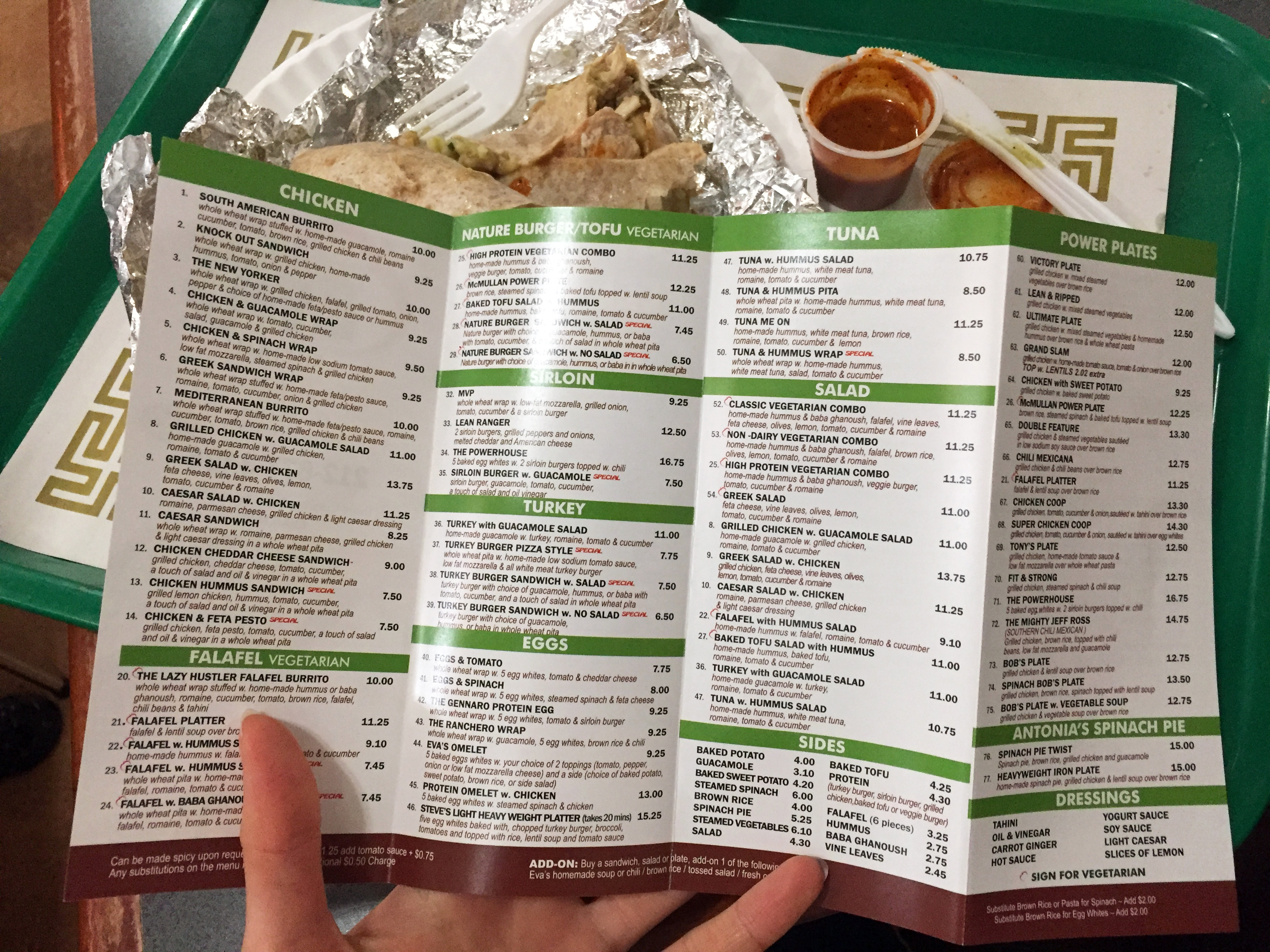
Last Friday, I visited Eva’s Kitchen on W 8th St. for a bite to eat. They kindly invited me for a meal and a chat, and I was delighted to accept. Upon arrival, enthusiastic and welcoming Alex came around the counter and took my order, chitchatting with me about the menu while I deliberated over the options. Salads, wraps/burritos, “power plates,” smoothies—choices galore! A whole section dedicated to vegetarian options too! It is clear just looking at the menu and its featured ingredients that this is a restaurant dedicated to serving and pleasing a wide array of health-conscious, hungry individuals. Brown rice, egg whites, sweet potatoes—whole grains and lean sources of protein…What could be better?
Alex told me that his particular favorite is The Mighty Jeff Ross: grilled chicken and brown rice topped with chili beans, low fat mozzarella, and guacamole—apparently one of their best-sellers (and, by the description, I can understand why—simplistic, hearty, and delicious).
I took his input into consideration and went with the South American Burrito (which is pretty similar to The Mighty Jeff Ross with some tweaks here and there)—a whole wheat wrap stuffed with homemade guacamole, romaine, cucumber, tomato, brown rice, grilled chicken, and chili beans. I grinned satisfactorily at my choice as I placed my order and made my way over to a table to (hungrily and eagerly) wait in anticipation.
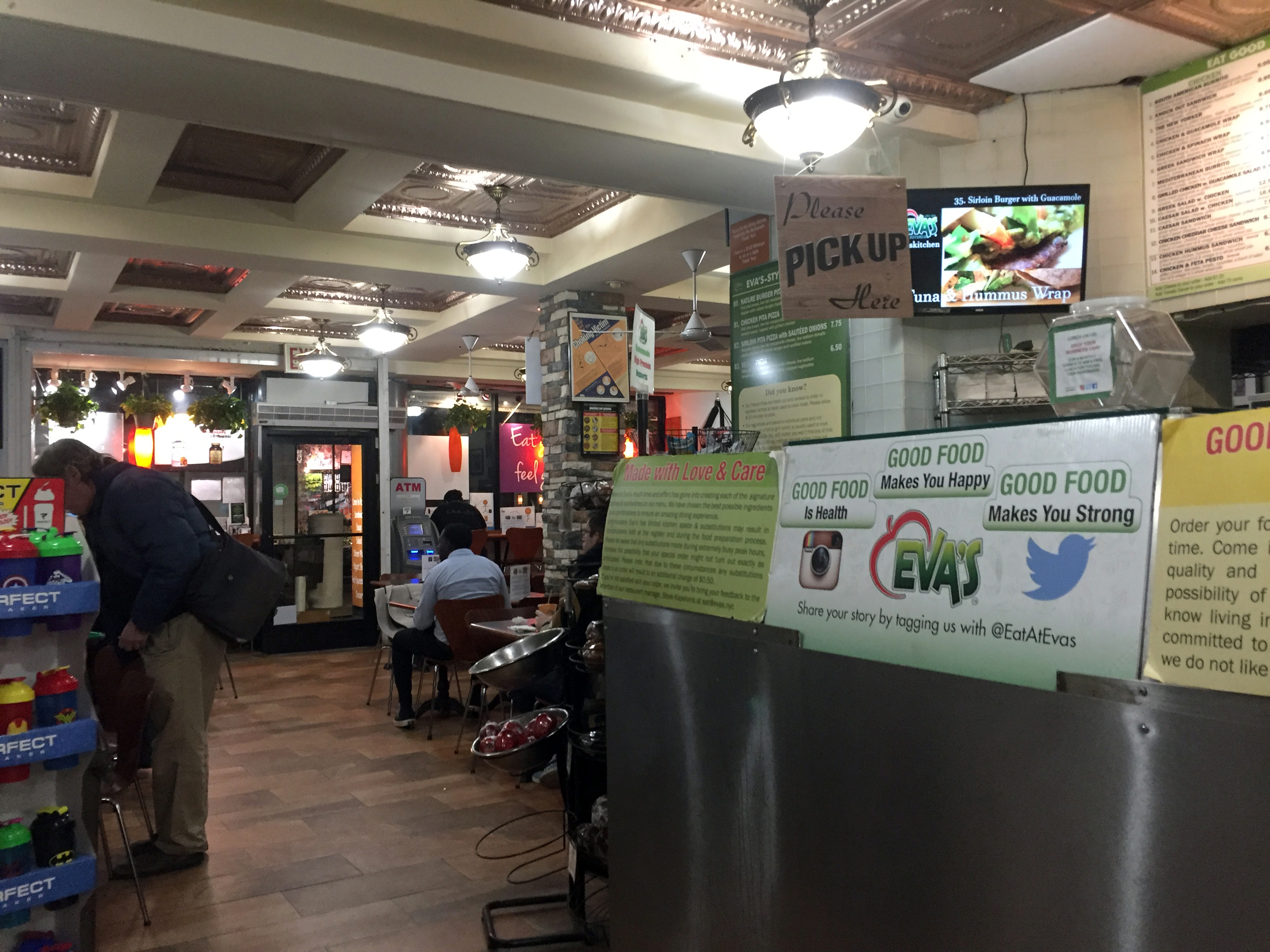
Eva’s is clearly a hotspot in Greenwich Village. The restaurant’s aura is relaxed and casual in the best way—that is, the opposite of too many NYC cafés that are so trendily hoity-toity that just walking in the doors can induce a crushing self-conscious feeling. Eva’s, on the other hand, is wonderfully warm and inviting.
Perhaps this is due to the history and authenticity residing within its walls. This February, Eva’s is celebrating its 40th year anniversary—that is, this landmark joint “serving delicious and nutritious food” (with a Mediterranean flair, it seems) has been around since the Spring of 1978. That’s over twice my age…Pretty cool!
As I waited, Steve (the store manager) wandered over and began chatting with me. I was struck by his kindness and spirited pride in all that is Eva’s. His kindness was contagious as we sat and talked. He told me about his personal favorite on the menu—The Eggs & Tomato: a whole wheat wrap with 5 egg whites, tomato, and cheddar cheese. I’ll have to try it next time.
He explained that the motto of Eva’s Kitchen is: “Eat good, feel good.” Their trademark is healthy food that tastes good and makes you feel good. He even mentioned that they cook with no preservatives. I was thrilled to hear that—it’s hard to find places in the city nowadays that actually care about quality of ingredients and how their food makes their customers feel upon leaving.
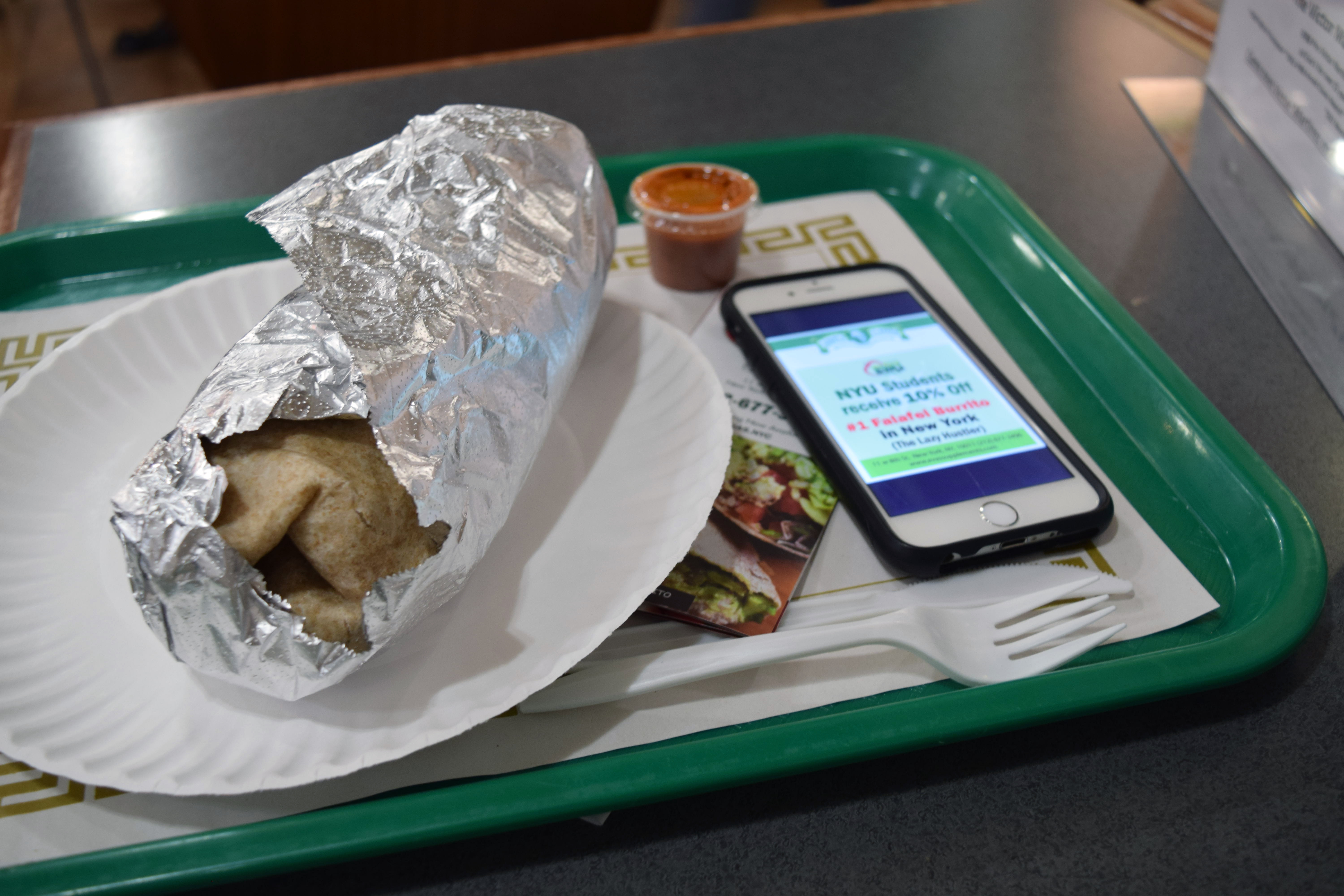
My burrito came very quickly; I was very impressed by the quick service. Steve left me to enjoy my meal—although without first talking up and bringing me their house-made hot sauce (which, he mentioned, is somehow free of salt altogether!). I’m a spicy food lover, so I was very excited to try it—and very pleased with its tangy, flavorful, and subtly smoky flavor. And, of course, it did bring the heat.
The burrito itself was to die for. I wouldn’t typically think to put cucumbers in a burrito, but what a wonderful addition—it adds a pleasant crunch and acts as a nice spice-tamer. When I first saw the size of the burrito, the following thought-process occurred: “There’s no way I’ll be able to eat all that it one sitting. That’s okay though—it’ll make for a great lunch tomorrow.”
To my surprise, I ate the entire thing—I left absolutely no trace…What can I say, it was really delicious. The chicken was juicy; the guac was flavorful (without being overly salty or, on the other hand, bland); the rice was tender; the veggies were fresh and crisp; and, overall, it left me feeling full, satisfied, and with a smile on my face. I didn’t feel bogged down and greasy like I typically do after eating a burrito. Like Steve told me: “Eat good, feel good!”
Overall, I had a blast visiting Eva’s. Particularly notable was their very fast service; lively and personable staff; extensive menu with something for everyone and anyone (no matter what preferences or dietary restrictions one might have); the constant ebb and flow of colorful customers (it clearly is a hotspot!); and the warm aura altogether.
I left with a full belly, a smiling face, and a piece of carrot cake to-go (thanks again, Steve!). Wholesome seems like a very fitting word to describe both Eva’s ambiance and tasty (yet still healthy!) food. The authenticity defining the years of memories made within, the food served, the friendly staff, and the hungry visitors (be them regulars or newcomers) seems to be what makes Eva’s uniquely…Eva’s. And due to such authenticity, Eva’s undoubtedly stands out as an NYC gem. I cannot wait for my next visit. As an NYU student with this place right around the corner from campus…Watch out Eva’s, I think I just found my new favorite lunch spot!
*If you’re an NYU Student, make sure to stop by Eva’s and get 10% off The Lazy Hustler (“The #1 Falafel Burrito in NYC”) when you show your student ID!
Libby is an NYU student, a Campus Clipper foodie, and a passionate writer and graphic designer. She writes her own blog, libalittle.com, where she strives to share insight, encourage creativity, and stimulate curiosity.
For over 20 years, the Campus Clipper has been offering awesome student discounts in NYC, from the East Side to Greenwich Village. Along with inspiration, the company offers students a special coupon booklet and the Official Student Guide, which encourage them to discover new places in the city and save money on food, clothing and services.
At the Campus Clipper, not only do we help our interns learn new skills, make money, and create wonderful e-books, we give them a platform to teach others. Check our website for more student savings and watch our YouTube video showing off some of New York City’s finest students during the Welcome Week of 2015.
Studying in college, you probably often find yourself hunting for various student discounts, special offers and college student deals in order to save money. If your education is not free, it does not take long to end up with a huge student loan, which will burden you upon graduation. I don’t need to tell you how expensive textbooks are nowadays; you buy them every semester, and they do break the bank. If you are not living at home, you need to pay rent and buy groceries, which makes you miss mom’s cooking along with dad’s wallet. Perhaps, this is the first time you are living on your own, and you are overwhelmed.
Don’t be. Instead, learn how to budget. It is a skill that, I promise, will improve your overall life quality – during and after college. Not only will budgeting help you avoid getting into debt, it will also fill you with self-confidence, as you will know for sure how you will pay your bills and will not have to worry about tomorrow, or the day after tomorrow and so on.
1. Determine your monthly income.
How much money, on average, do you have to spend in a month? Take a blank sheet of paper and write down how much you get paid for working, as a stipend or as an allowance from your parents. Since budgeting means creating a long-term plan, do not include any inheritance money or any amount that you do not receive on a regular basis (for example, lottery winnings, birthday gift money, and so on).
If you do not have a stable income – for instance, if you work on commission – I would suggest taking an average amount you make in a month. If in January you make less than that amount, you will have to make up the difference in February or March, but if you make more than that amount in April, put the money aside for when the business is not doing as well. The same rule applies to any sort of irregular income, such as grants, lottery winnings, etc.
2. Calculate your monthly expenses.
This includes rent, utility bills, any school-related expenses (tuition, books, etc.), transportation, health insurance, Internet and cell phone service, and so on. If you pay your tuition once a semester, divide the full amount by the number of months in a semester, or calculate the total for the whole year and divide that by 12. Also, include an average amount you spend per month on food, laundry and other necessary expenses. This is also a good time to think about how you can save money on your expenses. Check newspapers and magazines to see if you can find student coupons or promo codes or move into a cheaper apartment. Ask around. If your classmate uses less expensive cell phone service, look into it. If you learn to be frugal, living on a modest student budget, you will gain a skill that will come handy when you have to save money to buy a house, a car or a yacht – whatever your heart will desire and your wallet can afford.
Ideally, your income should be bigger than the amount you spend on bills, leaving you some room for unplanned expenses, such as a pretty new dress or the newest video game. Note how much money – if any – you have left after you pay all of those expenses. Although you are free to spend any excess bucks on spoiling yourself with food and entertainment, I would suggest opening a savings account and determining an amount you can deposit into it on a monthly basis without starving yourself. Later on, you can use this account for any unplanned expenses or gifts to yourself.
If, however, you spend more than you earn, you should start thinking of ways to increase your income. For example, you can get a part-time job on or off campus, ask your parents to increase your allowance (you can show them your budget and explain why an increase in necessary, and, I am sure, they will be impressed by your newly gained budgeting skills). Just like I mentioned above, you should plan to earn a little bit more than you spend and try to put some money aside for unplanned expenses in case you get sick, need new clothes or want to go out more. Applying for a new credit card would not be a good solution for this problem, as it could add on extra temptations and increase your expenses that your income will not be able to cover.
4. Recalculate your budget as needed.
It would be reasonable to re-budget every time your income and your expenses change significantly. For example, your tuition probably goes up every year, so you need to take that into consideration. Same applies to your roommate moving out, the price of groceries skyrocketing or your parents suddenly deciding you should support yourself.
When you first learn to budget, you can even recalculate your income versus your expenses every month, or even on a weekly basis. This will depend on how often you get paid. If your parents send you money once a month, you will have to plan on living off that money for the whole month.
By Ekaterina Lalo
Ekaterina Lalo is the Campus Clipper’s guest blogger. Ekaterina regularly blogged for the Campus Clipper in 2011 and participated in the making of the Campus Clipper’s NYC Student Guide. She is currently working as an Editorial Manager at Phantom Communications, but she is still passionate about writing for students.
For over 20 years, the Campus Clipper has been offering awesome student discounts in NYC, from the East Side to Greenwich Village. Along with inspiration, the company offers students a special coupon booklet and the Official Student Guide, which encourage them to discover new places in the city and save money on food, clothing and services.
At the Campus Clipper, not only do we help our interns learn new skills, make money, and create wonderful e-books, we give them a platform to teach others. Check our website for more student savings and watch our YouTube video showing off some of New York City’s finest students during the Welcome Week of 2015.
As a student, I’ve always enjoyed reading and dissecting theory. Abstract concepts of power, race, and gender always interested me, and I enjoy coming up with creative interpretations of their inter-relationships.
But talking isn’t enough. To enact social change, I must be willing to practice theory on the ground. So I’ve tried to get moving, to put what I’ve read about into action. As years of messy practice have shown, practical application is much more difficult than mere theory. I make mistakes, I feel uncomfortable, and I often just want to retreat back into theory.
I’ve developed a metaphor for my attempts to pursue social justice. Theory is like English- it’s my native language, it’s familiar, and it’s much easier for me to implement. On the other hand, practice is like Spanish. I learned it later in life, and because the sounds and words did not embed themselves in my brain as a child, they come much more slowly to mind. I will never be fully fluent, nor as confident in Spanish.
But Spanish (and practice) are a necessary component of social justice work. They stretch my mind, add to my vocabulary, and guarantee that I am not too comfortable. They remind me of my limits, and open up larger segments of the population to me. I’m able to meet people where they are, to speak their language rather than forcing them to speak mine. It’s a small way I try to right the very unequal power dynamics between Spanish and English speakers. When non-native speakers make mistakes in English, they are looked down upon, derided. But when I speak Spanish, even though I’m far from fluent, I am complimented. My attempts are praised, and my learning Spanish is seen as going the extra mile, while speaking perfect English is considered a requisite for anyone living in the United States.
Of course, pursuing justice is a lofty goal. Those who attempt to bring about justice either get overwhelmed by the impossible task, or become consumed by their own accomplishments. It’s hard to strike a balance between giving up and becoming prideful. Even though I can’t save the world, I need to at least try to ensure to mitigate the negative effects I evoke by doing nothing. Just by being on this planet, I am creating a carbon footprint. By living my relatively privileged life, I am abetting systems that perpetuate racism. By seeking my own satisfaction, I am depriving others of resources. To counter these realities, the best I can hope to do is to impact one little corner of the world as best I can.
Audre Lorde, a Black Lesbian Feminist scholar, emphasizes the potential positive uses for anger. She writes, “Anger expressed and translated into action in the service of our vision and our future is a liberating and strengthening act of clarification” (Sister Outsider, 127). For people of color, anger is often their only weapon against the oppression they experience daily.
Whether through speaking Spanish, pursuing action, or expressing anger, practical implementation is the enactment of true commitment to social justice.
By Anna Lindner
Anna is a Campus Clipper intern and a first-year Master’s student in NYU’s Media, Culture, and Communication program. Her research interests include critical race and gender theory and their resultant intersectionality. When she’s not studying, Anna enjoys visiting friends, catching up on TV shows, and lifting weights. For over 20 years, the Campus Clipper has been offering awesome student discounts in NYC, from the East Side to Greenwich Village. Along with inspiration, the company offers students a special coupon booklet and the Official Student Guide, which encourage them to discover new places in the city and save money on food, clothing and services.
At the Campus Clipper, not only do we help our interns learn new skills, make money, and create wonderful e-books; we give them a platform to teach others. Check our website for more student savings.
Intern Brenna Sheets from Emerson College is joined by fellow students Amber Call and Grace Rubin to discuss the reality of dating in the digital age. Whether you're an undergrad grinding through finals or a grad student juggling class, TA positions, and a work schedule, adding dating to the mix can feel like an unpaid […]
Intern Brenna Sheets from Emerson College is joined by Cambridge Natural's Emily K. to discuss natural health and wellness in the modern age. They discuss how supplements and herbal teas are being used, marketed, and perceived in our fast-paced, wellness-obsessed society. Is our reliance on these products a sign of empowerment—taking control of our health […]
Intern Brenna Sheets from Emerson College leads today's discussion on self-care and wellness in college. With fellow interns Aidann Gia (Pace University) and Agatha Edwards (Brandeis University), the group discusses what American culture says about self-care, everyone's favorite wellness activities after a stressful week, what gets in the way of students prioritizing themselves, and the […]
Intern Katie leads today's discussion. We talk about the pandemic's effect on college students, since current juniors and seniors' college experiences have been largely defined by the pandemic. We discuss what it was like being sent home from college in 2020, navigating online classes and extracurricular activities, and the lessons we've learned from this whole […]
Welcome back to a new season of the Campus Clipper podcast!Intern Megan leads today's discussion. We talk about the activities that inspire creativity in our cities and how to balance creative hobbies with schoolwork and internships. We also discuss the uncertainty and insecurity that we often feel when putting our creative work out in the […]
Intern Ehani leads today's discussion. We talk about the films, series, books, and other art that has touched our hearts, even when the world makes us want to be dark and cynical. We also discuss what role our passions have in our lives, and what passion means to us. Mentioned in this episode:Call Me By […]
In this episode, our interns talk about going to college in a big city - from the cultural advantages to how they deal with the expensive cost of living. We also share our favorite things to splurge on. Mentioned in this episode:The Whitney MuseumThe Tenement MuseumTips for budgeting (even when you're not the budgeting type)Check out […]
In this episode, our publishing interns talk about why they love writing and how they use writing and creativity as a tool for personal development and mental health. Check out our publishing interns' writing on the Campus Clipper Blog. This episode was recorded at the new East Village, NYC location of Marinara Pizza. Click this […]