Posts Tagged ‘college’

You Can’t Live in the Honeymoon Phase (And You Probably Don’t Want To)

Tuesday, October 5th, 2021

You’ve probably heard of the Honeymoon Phase, a term generally used to refer to that special moment right after you meet someone where it all just feels so new and exciting that you’re willing to overlook any annoyances or red flags. It’s likely you’ve experienced this feeling yourself, as well as the staunch disappointment that comes with the (at times) harsh transition out of this phase — it’s important to remember, however, that the Honeymoon phase is, by its very nature, not made to last and that is actually very good news.

Here’s the thing about making friends, especially in college; not every friendship is created equal, and you have to learn very quickly to prioritize. Every week, day, and hour, you’re meeting someone new who lives within a 5-mile radius of where you live, and with whom you are likely to have at least one thing in common, even if that is only that you both go to the same school. The possibilities of friendship are endless, which, although exciting, can very quickly lead to social burnout or the accumulation of a whole lot of what I like to call “surface friends.” These are acquaintances who have moved into the “friends” category by default, without any true intentionality from either party. These types of friendships, while serving their purpose (and doing it well) in certain situations, cannot be the core of what you consider friendship to be. A true friend is someone who, as in every other relationship in your life, you are willing to invest time and effort into. They’re people whom you can trust with a secret, those who you can spam with messages without worrying about how that will change their perception of you by making you seem too needy, too careless, too attached…

This brings us back to the topic at hand—the honeymoon phase. At this point, I find it helpful to think of the types of friendships you’re looking to form in college as extensions, or at the very least close replicas, of the relationships you have with close family members, such as siblings, cousins or even parents. If you can truly say you never fight with these people in your life, I suggest you think of writing a book on the matter (and please send me an advance copy). More likely, however, you are no stranger to the daily, at times hourly, tussles or disagreements that come with close cohabitation or relationship with people—and the type of conflict negotiation that comes when abandoning the relationship is not even an option that crosses your mind. That is what you’re looking to replicate when forming friendships in college — at least the core, close ones. When you think about it, your friends become your new family: your home away from home. I’m not suggesting they can replace your family (my mother would kill me), but you do need to see them as the new nucleus to your life at college. And, as you do not shy away from conflict or disagreement in your related family, you should not do so in your new, “adopted” family.

“Honeymoon Sunset…” by douea is licensed under CC BY-NC-ND 2.0

In my own experience, I’ve found that approaching certain friendships with a renewed sense of commitment (one which I communicated with them) despite not always “clicking” with people on every level, has led to incredible growth in my personal as well as professional life. It’s normal at the beginning to focus on the quantity of friends – life moves fast on a college campus, and freshman year especially feels like a race for stability. Something I found useful was to, after the first couple of weeks, choose which group/club/activity I was willing and wanting to dedicate more of my time to. There, I got to know a small group of people very well, and began looking for ways to see them in different settings and situations during the week. Instead of seeing them only in large group meetings, I reached out to individual people (or they did me) and asked them to grab coffee, lunch, study together or go on a walk to that place on campus everyone had been talking about.

This was truly a turning point for my college experience – it not only taught me more about commitment and responsibility to others, but gave me enough faith in my ability to form deep, true friendships that I became more open and confident even in my “surface friendships.” True, committed friendships are life giving, because they do not focus on using each other for convenience—rather, they are a balance of give-and-take, in which you learn to grow and experience life as independent adults together.

Main Takeaways: 

  • The “Honeymoon Phase” is great for making new friends and should be taken fully advantage of when you’re in it, but you shouldn’t be afraid of moving past it to get to the core, real and honest side of friendship.
  • Forming a nucleus of close friends is an important part of finding stability in college, and teaches you important values such as acceptance, accountability and conflict resolution.

By: Chiara Jurczak

Chiara Jurczak is a second-year student at Northeastern University where she is majoring in Political Science and Communication Studies. She is currently finding new ways to explore her passions for creative writing, publishing and political crises, and hoping to figure it all out sooner rather than later. In her free time, you can find her reading, baking, or trying to talk her friends into going on fun (and at times strange) adventures.


For over 20 years, the Campus Clipper has been offering awesome student discounts in NYC,  from the East Side to Greenwich Village. Along with inspiration, the company offers students a special coupon booklet and the Official Student Guide, which encourages them to discover new places in the city and save money on food, clothing, and services.  At the Campus Clipper, not only do we help our interns learn new skills, make money, and create wonderful e-books, we give them a platform to teach others. Check our website for more student savings and watch our YouTube video showing off some of New York City’s finest students during the Welcome Week of 2015.

Share

You’re Not a Mind Reader, and Neither Are Your Friends (Probably)

Tuesday, September 28th, 2021

In my last chapter, I talked about metaphors—now, I’d like to address the irony that lies in many of the processes tied to friendship-building. The greatest, and probably most obvious one is what I’ll call the “You Should Know That” phenomenon. This refers to the all-too-familiar thought process that we all have a tendency to fall into at some point during the friendship-making process, where we start to believe (and expect) that our friends are mind readers, who have the ability to deduce, without being told, everything we need and require of them.

In the early stages of friendship, we are not at risk of falling into this trap. In one of my Communication Studies courses this year, we went over “Uncertainty Reduction Theory”; the idea that at this point in the friendship formation process, the uncertainty in your relationship is at its peak height, and that the focus of all communication efforts is therefore placed on uncertainty reduction. You realize that you have to be explicit and clear about what you mean and need, and you never seem to run out of questions or anecdotes that may draw some piece of information or knowledge out of them that would help you get a better picture of who they are. 

Slowly (but surely), you get more comfortable around your friend, and start to (at times mistakenly) believe that there really isn’t that much you don’t know. Instead of asking them about every single detail of their life, you’re more focused on finding “natural flow”, and start to fill in the gaps of your knowledge about them with assumptions. These assumptions, whether positive or negative, will have a pretty big impact on the way in which your friendship evolved from there. 

In my own personal experience, assumptions such as these led to the deterioration of a friendship which might have otherwise survived. After a couple of weeks of meeting this friend, I had a whole list of assumptions, ready to soothe whatever uncertainties blatantly existed in our relationship; I assumed that when they didn’t respond to my greetings, they were probably listening to music very loud and didn’t want to be disturbed. I assumed that when they stopped telling me everything about their day and weekends, it meant they just needed a little space. I assumed that we were fine, doing good, and that they could see that I was just eager to get to know them better and all I needed was an indication from them that they wanted the same…and I was wrong. This whole time, I had been assuming that they knew what I was thinking, and that I had stopped approaching them as much because I had noticed (or perceived) a slight withdrawal, and taken that to mean that they wanted space. All the while, they had seen my sudden lack of questions and interest in their life as a form of judgement, of disdain and disinterest.

“[ C ] Francis Hyman Criss – Mind reader” by Cea. is licensed under CC BY 2.0

The hard-to-swallow truth is, you (probably) aren’t as good at “reading minds” as you think you are—even your friends’. It’s only natural to start letting assumptions rule your view of others, and it’s true that with a certain amount of time and friendship formation, some things can become more implicit than they previously were. However, it’s also important to remember that no matter how well or how long we get to know someone, we are never truly capable of seeing and understanding how they are feeling, at the very least not without communicating directly with them.

So what can you do? I guess the Golden Rule comes in handy here: treat others the way you want to be treated. It is important to learn to ask for what you need, and to make it clear to your friends that they can do the same with you. If you’re to build a long-lasting and fulfilling friendship, you both need to feel comfortable enough to tell each other how you really feel; you can do that by setting a standard for open and honest communication early in the relationship. Otherwise, you might be missing out on several friendships which you may assume failed out of an incompatibility between the two of you, and not the real, root cause:misunderstandings tied to a lack of clear, direct, and honest communication. 

Main Takeaways: 

  • As we get more comfortable around our friends, we stop relying on verbal communication as much and let our messages become more implicit—this can lead to a lot of misunderstandings and tense moments. 
  • It’s important to remember that feelings don’t always reflect reality;it’s important to talk to your friends about your feelings and learn to ask for the affirmation and confirmation you need from them. This will help you grow in your relationship and set the standard for an honest and long-lasting friendship.

By: Chiara Jurczak

Chiara Jurczak is a second-year student at Northeastern University where she is majoring in Political Science and Communication Studies. She is currently finding new ways to explore her passions for creative writing, publishing and political crises, and hoping to figure it all out sooner rather than later. In her free time, you can find her reading, baking, or trying to talk her friends into going on fun (and at times strange) adventures.


For over 20 years, the Campus Clipper has been offering awesome student discounts in NYC,  from the East Side to Greenwich Village. Along with inspiration, the company offers students a special coupon booklet and the Official Student Guide, which encourages them to discover new places in the city and save money on food, clothing, and services.  At the Campus Clipper, not only do we help our interns learn new skills, make money, and create wonderful e-books, we give them a platform to teach others. Check our website for more student savings and watch our YouTube video showing off some of New York City’s finest students during the Welcome Week of 2015.

Share

Friendships, A Puzzling Affair

Tuesday, September 21st, 2021

If you’re anything like me, you like to use metaphors to try and make sense of the world around you. And if you’re nothing like me, all the better; sometimes, metaphors are most appreciated by those standing outside their wily bounds, looking on with a critical and unconvinced eye.

Without further ado, I’d like to present to you the Friendship Metaphor (FM)(I hope you’ll excuse this unimaginative title, but too much creativity can be a bad thing). As indicated by the title of this chapter, this metaphor revolves entirely around one of the most controversial pastimes known to man: puzzles. Some people love them, some people hate them (yours truly), but I think that generally, most people derive a certain satisfaction from the process of finding pieces which only moments before being joined into a seamless design were little more than individual units floating in a sea of possibilities and wrong roads.

      There are two ways to go about the metaphor from here. First, you can think of yourself as one of the puzzle pieces; this option is not entirely appealing to me. Firstly, it assumes that you are some unchangeable, fixed piece, and we all know that couldn’t be further from the truth. Think back to the person you were ten, five or even one year ago. You probably don’t approach life (and therefore friendships) in the same way as you did then. Secondly, this view of the metaphor assumes that you can only be connected to the pieces right next to you, those that resemble you the most. I think you can see why that might be an unrealistic visualization.

      We arrive, therefore, at the place I believe the FM maximizes its full metaphorical potential for helping us understand friendship formation: rather than seeing yourself as the puzzle piece, view yourself as the master, and the pieces as the various relationships and connections you are building. Here, you are the one putting the pieces together, taking different approaches to how you build friendships and relationships in every area of your life. Just like when assembling a puzzle, you are motivated at the start–the possibilities are endless, and you’re confident in your ability to complete this puzzle. Then, frustration–you realize finding matching pieces is not as easy as you’d thought, and that the pieces and approaches you’d counted on are failing you. In desperation, you may put the puzzle aside for a while and tell yourself that this “hobby” isn’t for you after all, only to pick it up again,letting the entire cycle restart.


“Puzzle” by INTVGene is licensed with CC BY-SA 2.0. To view a copy of this license, visit https://creativecommons.org/licenses/by-sa/2.0/

As a college student, as you move away from home and feel lost in a sea of new people, keep this in mind: you’re not restarting the puzzle at every friendship you forge, just working on a different section. In a way, you’ve been assembling the puzzle your whole life. When you were little, maybe a loved one helped you out with the hard parts. Now, they’re giving you space to figure it out.

So, if the Friendship Metaphor can help you approach friendships in college in any way, I hope it’s by reminding you how capable you are of completing this puzzle, your puzzle. I’m not saying it will be easy, nor will it always be pleasant. But what I can guarantee is that if you let the fear of failure stop you, your unfinished puzzle will just become an annoying reminder of all the friendships you could’ve forged and that are just waiting for you to accept them into your life.

Main takeaways:

  • Forging friendships is like putting together a puzzle, where you’re the assembler and the pieces are all the connections and relationships you are forging.
  • It’s normal to be overwhelmed or even frustrated when assembling a puzzle – and it’s no different with friendships. In those cases, it can be helpful to remind yourself that you’re not necessarily starting over, just working on a different part of the puzzle (and your life).

By: Chiara Jurczak

Chiara Jurczak is a second-year student at Northeastern University where she is majoring in Political Science and Communication Studies. She is currently finding new ways to explore her passions for creative writing, publishing and political crises, and hoping to figure it all out sooner rather than later. In her free time, you can find her reading, baking, or trying to talk her friends into going on fun (and at times strange) adventures.


For over 20 years, the Campus Clipper has been offering awesome student discounts in NYC,  from the East Side to Greenwich Village. Along with inspiration, the company offers students a special coupon booklet and the Official Student Guide, which encourages them to discover new places in the city and save money on food, clothing, and services.  At the Campus Clipper, not only do we help our interns learn new skills, make money, and create wonderful e-books, we give them a platform to teach others. Check our website for more student savings and watch our YouTube video showing off some of New York City’s finest students during the Welcome Week of 2015.

Share

Chapter 1- From New Jersey to Boston: The Decision to Move to a City

Friday, July 30th, 2021

As a junior in high school, there were only a few things I was sure of. The first was I wanted to go to a college where I could major in English and writing. These were always the subjects I was most passionate about in high school and I wanted to study something I enjoyed in college, so this choice felt clear. The second thing I was sure of is that I wanted to study abroad, preferably in London. I had always been drawn to London for some reason. Perhaps it’s because the city left a lasting impression on me after repeatedly watching the 1998 version of The Parent Trap and Mary Poppins throughout my childhood. Also, as a prospective English major, it made sense to study abroad in the country where writers like Shakespeare, Jane Austen and the Brontë sisters lived. However, the gigantically glaring question that I had no answer to was this: where would I go to college?

I grew up in a town in New Jersey that is approximately a square mile and my graduating class was less than a hundred people. I had seen countless romanticized depictions in movies, books and TV shows about people moving from small towns to big cities, thus the idea of going somewhere totally different was intriguing to me. I wasn’t particularly keen on applying to any schools in New York City. It was a city I was accustomed to visiting at least twice a year and I never foresaw myself living there. It was simply too bustling for me. After doing some research, I discovered a few universities and colleges in Boston that piqued my interest. This eventually led to my uncle and I driving to Massachusetts to visit Northeastern University, Boston College, Emerson College and Boston University.

When we were not taking campus tours led by eager students, my uncle and I decided to wander around Boston and part of the surrounding suburbs, like Brookline. During our exploration of Boston, it began to dawn on me that spending a few days exploring the city and living there were two distinct things. While walking around Brookline one evening and peeking into various storefronts, I realized that if I chose Boston, I wouldn’t be a tourist in the city. If I ended up in Boston, I wouldn’t be staying in a hotel with a relative and returning home in a couple days. I would be living in this urban center on my own, which was daunting to consider, yet part of me was also excited to think of all the independence, activities and resources I would have at my disposal. 

Commonwealth Avenue, Boston University campus
Boston University. Image Credit: https://www.bu.edu/bostonia/winter-spring15/us-news-ranks-bu-37-of-top-500-global-universities/ 

I didn’t let my mind set on definitely going to school in Boston, though. I applied to colleges and universities in both Pennsylvania and New Jersey, so that I could be closer to home. Some of these schools even fit the idea of what I pictured a college campus to look like, with their green spaces, quads and stone facade buildings. As time passed after I submitted my applications and I was just anxiously waiting to hear back from all these schools, I subconsciously began to assume that I would most likely end up staying in New Jersey. I thought that the probability of me being accepted into the more competitive out-of-state schools was slim and it would be more financially feasible to remain in-state. Also, by the winter of my senior year of high school, everything started to feel real. I would actually be graduating, no longer see the same faces everyday and go to college. If I ended up going out of state, I would have to say goodbye to my family, which was beginning to feel like another massive change I wasn’t entirely prepared for. I was, and still am, close to my family and the thought of leaving behind this crucial support system was terrifying. 

However, on a fateful Saturday morning in March of 2017, I was shocked to be accepted into Boston University, especially after receiving a rejection from Northeastern two days prior. What was even more surprising was the financial aid package, which made BU a feasible option. Boston University certainly checked off a lot of boxes for me: I could afford to go, they had programs that interested me, I could study abroad, I would be guaranteed housing for four years, etc. Of course I was apprehensive about leaving home, but as the astonishment wore off in the following weeks, I told myself that I would regret not taking the opportunity to move somewhere new and experience being on my own. Therefore, with nervous excitement, I accepted the offer to begin my undergraduate studies at Boston University in the fall of 2017. 

Quick tip: choosing a school for either undergraduate or graduate studies is a pretty monumental decision, so you shouldn’t feel afraid to make inquiries. Whether it is sending an email to someone or posing a question when touring a campus, it will help you gather all the information you need in order to decide where to apply and, ultimately, what school to select. For instance, at the end of my campus tour of BU, I asked the tour guide about the study abroad program. It turned out that he had just returned from studying abroad in Geneva and he described the application process and what it was like living in a different country. Even though it was only one person’s account, I felt more confident in and curious about BU’s study abroad program after hearing someone else’s experience. It could also be helpful to make a list and prioritize what you are looking for in a college. What is most important to you: location, financial aid, research opportunities, study abroad options, housing, classroom size, campus lifestyle, etc.?


By: Monica Manzo

Monica Manzo recently completed her undergraduate studies at Boston University where she majored in English and minored in History. Currently, she is planning on applying for some masters programs in publishing. In her free time, she can be found either reading or adding to her pile of unread books.


For over 20 years, the Campus Clipper has been offering awesome student discounts in NYC,  from the East Side to Greenwich Village. Along with inspiration, the company offers students a special coupon booklet and the Official Student Guide, which encourages them to discover new places in the city and save money on food, clothing, and services.  At the Campus Clipper, not only do we help our interns learn new skills, make money, and create wonderful e-books, we give them a platform to teach others. Check our website for more student savings and watch our YouTube video showing off some of New York City’s finest students during the Welcome Week of 2015.


Share

Quarantine Contemplation: We’re all just doing.

Wednesday, March 31st, 2021

At the close of 2020, I promised myself that I would take a gap year. After four years of juggling my academics, extracurriculars, relationships, and well-being, and considering the tumultuousness of the past year, I figured that everyone could use a break. I started planning my summer. Wake up, eat, eat, eat, sleep, repeat—the closest that humans can get to hibernation.

Then came January, February, and March, and upon a string of fortunate events, from becoming a mentor, to landing my first part-time job, to applying to graduate school, to entering an internship, to volunteering with an organization, to landing my second part-time job, to becoming a mentor (again), to accepting a fellowship, to being invited to present at a research conference, I decided to accept an offer for a third part-time job. I thought I’m already wearing all these hats, might as well fill up the closet.       

You don’t have to be a nurse to appreciate these busy-bee nursing memes. You just have to be…busy.

The dominoes fell, and my mind whirl winded.

Advocate in more spaces. Volunteer with more organizations. Pursue a remote global internship. Apply to the Fulbright program. Enroll in a TEFL certification course. Learn a new language. Join a research lab. Run a virtual marathon. Look for a fourth part-time job.

By mid-March, I was the most involved I’ve ever been. Feeling like I not only was capable but obligated to take on every opportunity I was extended, I cast myself a vote of confidence. No doubt I could balance these responsibilities and achieve my quality (and quantity) standard all the while maintaining my physical and mental health.

Super-busy-girl memes can be very helpful when you’re too tired to express how tired you are.

Right!

Right?

Certainly!

Uncertainly.

With summer inching closer by the day, I’m filled with what I can only describe as a bidirectional spiral of invigorating uncertainty. Over these last three months, I have thought more about my future than I ever have before, and yet, I still feel like I have no idea why I’m doing what I’m doing or what it even is that I’m trying to accomplish. On top of the shakiness of simply being a graduating senior and young professional, the blow and the blur of the pandemic only exacerbate this uncertainty.

While I’m determined to bat at nearly every pitch, I have friends who are ready to build their careers in full-time positions with laser focus. Some friends are preparing for medical school and higher education, wracking their brains, and wrecking their sleeping schedules. Others are siphoning their resources into self-care, determined to dedicate their summer and immediate post-grad plans to self-development and nurturing their passions.

All of these plans and proposals, all of these actions and initiatives, and yet, the question persists in so many people’s heads—now what?

Through all the spaces that I’m involved in, I’ve come to two (One-and-a-half? One? I’m not sure, I’ve never really been good with numbers) revelatory realizations. I do my best to avoid blanket statements, but here’s a comforter for you—no one knows exactly what they want to do or what they’re doing.

We’re all just doing.

And that’s okay.


Thoughtful consumption and self-care have never been more important — try some clean eats at LifeThyme Natural Market

by Christianne Evasco

Christianne is a senior at New York Univerity, majoring in Psychology and minoring in Child and Adolescent Mental Health Studies (CAMS) and Creative Writing. Christianne’s endeavors are fueled by her passion to use her voice to help others harness the power of their own voices through therapeutically-creative means and to connect people through language and cultural exchange. In her free time, you can find her catnapping with her cats.

For over 20 years, the Campus Clipper has been offering awesome student discounts in NYC,  from the East Side to Greenwich Village. Along with inspiration, the company offers students a special coupon booklet and the Official Student Guide, which encourages them to discover new places in the city and save money on food, clothing, and services.  

At the Campus Clipper, not only do we help our interns learn new skills, make money, and create wonderful e-books, we give them a platform to teach others. Check our website for more student savings and watch our YouTube video showing off some of New York City’s finest students during the Welcome Week of 2015.

Share

My First Internship: How I Got Paid to Eat Gourmet NYC Food

Wednesday, March 24th, 2021

As I entered my sophomore year at NYU, I was feeling pressure to get an internship. I had spent the summer working in a restaurant in my hometown, collecting tips and saving them all for my semester abroad. While this was a perfectly normal and productive way to spend my first summer at college, I still worried that I was inadequate compared to my NYU peers who interned for hedge funds or theater companies. 

I came into Welcome Week sophomore year determined to land my first internship (or on-campus job). I was in the weeds trying to figure out work-study when an upperclassmen friend of mine posted in our sorority Facebook group about a job opportunity in public relations. My friend, Chehak, edited and polished my resume, then gave it to the PR company with her glowing recommendation. After a fairly straightforward phone interview, I was offered the job. I realize now that this experience is like an actor saying they landed the gig on their first audition—it would never happen again.

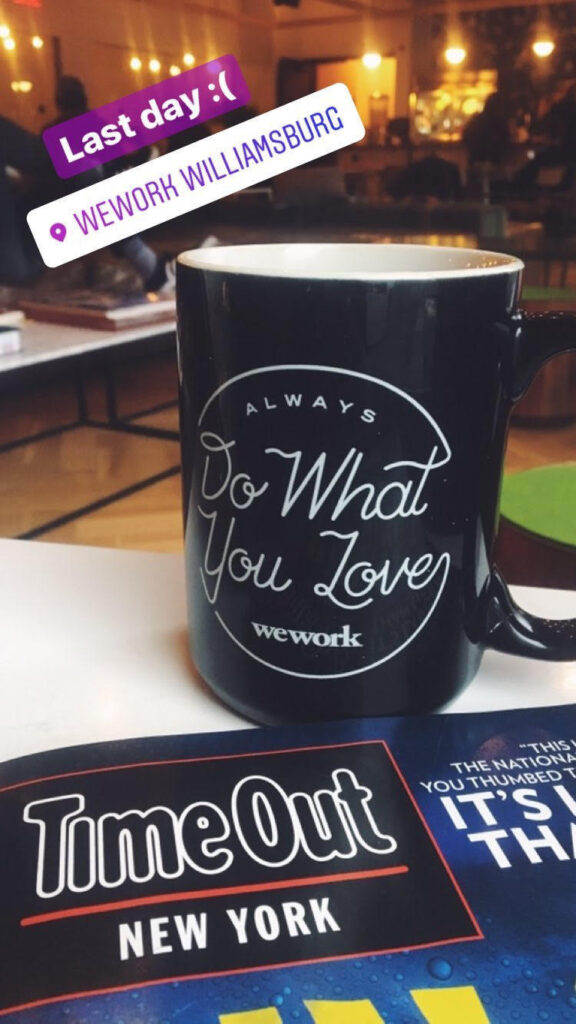
My Instagram story from my last day in the office

I dressed up for my first day but was surprised to find my supervisor wearing a flowy maxi dress and flip-flops. The office was in WeWork Williamsburg. I was amazed by WeWork, with beer on tap, fancy snacks, and trendy couches where people seemed to be lounging and working simultaneously. Huge windows poured light onto the coworking tables. The offices didn’t even have walls—just windows. It was a modern start-up world, completely different from any New York office I had seen in the movies.   

My position was at RVD Communications, a boutique public relations firm. Most of our clients were NYC restaurants and bars. I didn’t realize at the time how great I had it with this internship—I got paid weekly, including an unlimited monthly MetroCard, and I got to attend press and influencer events at some of the best restaurants in the city. I worked 15 hours a week, including a full day on Fridays. 

The best part of the job was working with my fellow interns, two NYU students who would become some of my closest friends. Each Friday, the three of us would claim one of the restaurant-style booths in the WeWork common space and spend the day there, giggling and sharing stories about the frat boys we were hoping to see that weekend while creating Pages presentations for the account leaders to present to clients.

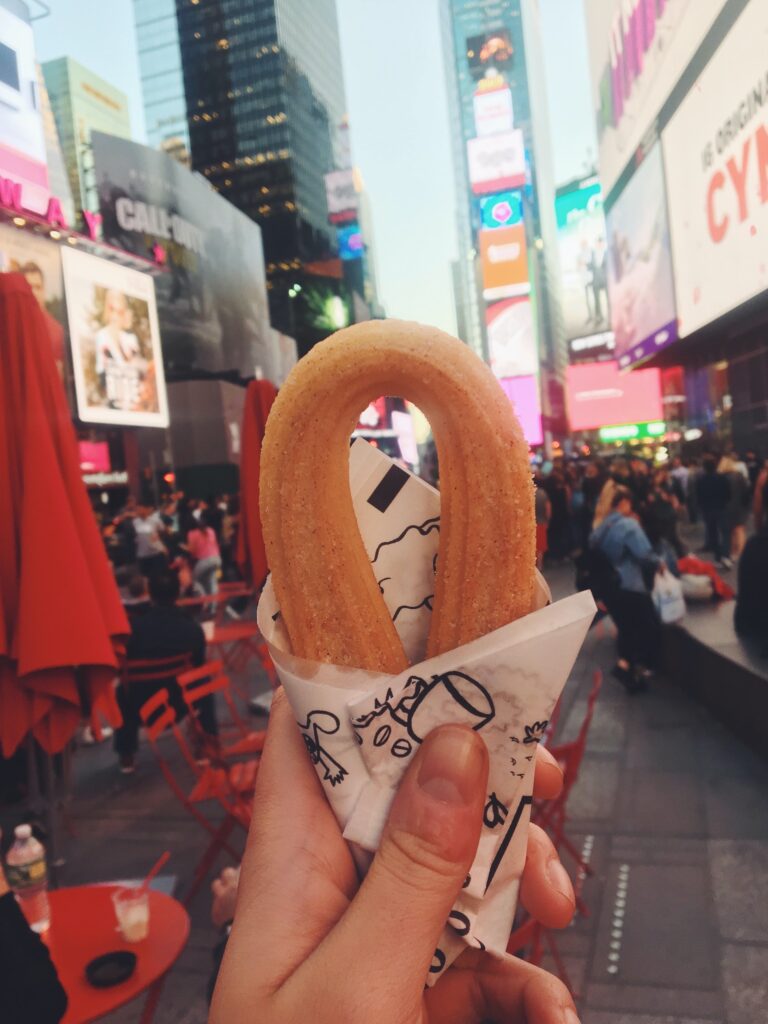
A delicious churro I sampled while working an event at a Times Square food market

Many of New York’s food holiday markets are run by the same company, Urbanspace, which was one of our clients. I found the Bryant Park Holiday Market by accident my freshman year when I went to the New York Public Library to study. I was enchanted by this little world full of lights, art, hot chocolate, and lots and lots of food. Needless to say, I was ecstatic when my fellow interns and I were asked to work a press and influencer event at the opening weekend of the Bryant Park Holiday Market. For these types of events, we invited journalists and Instagram influencers to come to the market, take pictures, and write articles. Our job as interns was to track mentions of our clients on Instagram and online publications. At the event, however, we were given press passes and allowed to roam the market, trying dishes from every stall. We pretended to be influencers, taking photos and videos with our Belgian fries, mozzarella sticks, and Korean-style tacos. Even though I did not end up pursuing a career in PR, I am so grateful for my experiences in the industry. I learned how to speak up for myself in a professional environment and how to balance interning with schoolwork. Best of all, I got to eat some great food.

Tips: On finding your first internship and being successful in the workplace

  • Reach out to upperclassmen you know from class or the clubs you are involved with. Upperclassmen can become great mentors and great friends.
  • Don’t be picky. You are trying to get experience working in a professional environment in New York City. That experience could be in a variety of fields. I didn’t expect to work in public relations, but I ended up having a great time.
  • When communicating with your new supervisor(s), be clear about your work and school boundaries. Constantly evaluate whether you are working the right amount of hours for your major, class schedule, and extracurricular involvement.

Click below to get access to and redeem all Campus Clipper Coupons; coupons are updated weekly


By Marisa Bianco

Marisa graduated from NYU in May 2020, summa cum laude, with degrees in International Relations and Spanish. She grew up in Nebraska, but she is currently living in Córdoba, Spain, where she works as an English teacher. You can find her eating tapas in the Spanish sun while likely stressing about finding her life’s purpose.

For over 20 years, the Campus Clipper has been offering awesome student discounts in NYC,  from the East Side to Greenwich Village. Along with inspiration, the company offers students a special coupon booklet and the Official Student Guide, which encourages them to discover new places in the city and save money on food, clothing, and services.  

At the Campus Clipper, not only do we help our interns learn new skills, make money, and create wonderful e-books, we give them a platform to teach others. Check our website for more student savings and watch our YouTube video showing off some of New York City’s finest students during the Welcome Week of 2015.

Share

Rules of Dating

Tuesday, March 23rd, 2021

Hookup culture is more prevalent than ever, and more bound to happen than conventional dating on a college campus. Dating is difficult because it’s hard to find someone who is on the same page as you. Students are more comfortable and familiar with the act of hooking up because it lacks the etiquette of traditional dating. Hooking up is designed to be a more casual activity in which there’s more comfort, and society has gotten acclimated to it. A genuine date involves only two individuals that are attracted to each other, nobody else should be a part of it. It’s important to come up with at least 3 questions prior to setting up a date. The point of this is to sustain a conversation and get to know one another on a deeper level. It’s advised that one should be diligent in regards to questions, because asking countless questions will probably lead to an interview or interrogation rather than a date. If someone doesn’t make time or effort to see you, then continue to proceed with the next one to avoid wasting time and being emotionally attached to one person. The objective of going on dates is to understand if both parties are compatible and could see a future together. In addition, attending multiple dates with the same person is like an experiment to progress further and see if the next step should be taken. Just like rankings, there are levels to dating which are a series of sequential steps that form the foundation of a relationship.

Stage 1: You’re permitted to go on countless dates with different people to see who is the right fit and worth dating. This part of the process can be defined as trial and error by selecting potential partners and weeding out those not worth your time and attention. The date must be in person, under 90 minutes, and with no physical interaction or intimacy. If you’re proposing the date then you should take charge and cover the cost, and don’t forget to have three to four questions in mind prepared. A level one date allows you to explore others’ personalities, their preferences and dislikes, who they really are, and helps you to decide if you want to pursue a relationship with that person.

Stage 2:  Now that you’re on the path of dating you can take baby steps to proceed, but this doesn’t have to be real relationship work. Once you are dating someone then there shouldn’t be any sense of uncertainty as to whether your partner likes you. I mean obviously your partner likes you, otherwise there wouldn’t be a romantic relationship in the first place unless you’re being manipulated or cheated on. This stage also conveys exclusivity, which implies that you’re concentrating on only one person and having sexual affairs. 

Stage 3: After you complete the first two stages, you should be capable of laying the groundwork for what’s next. By this phase, you should be emotionally invested in your partner and schedule time to hold long and important conversations. Have a timeline of where you would like to be, and see if it aligns and meshes well with your significant other. For example, get in the habit of chatting about marriage, family, and moving in together. Jumping too quickly to this portion of the relationship will inevitably lead to a skewed partnership which will end up in a big predicament.

https://www.datingadvice.com/advice/the-dating-rules

Following the guidelines above will put you in a safer position in the dating realm, and it’s better to be safe than sorry. Technology has changed the way we communicate; more chats occur online than in person. We’ve grown so attached to our devices that sometimes we deem online messaging to be more conventional and less awkward than in person exchanges. A good deal of people fear the idea of a relationship because of the commitment aspect and sacrifices. It would be preposterous to not believe that everyone prefers an attractive person when it comes to romance. However, it’s probable that you can develop feelings for someone who you may not be initially attracted to once you really begin to see their character. You’d be astonished to see how many failed and toxic relationships break out as a result of just dating off of physical appearance alone; it’s crucial to recognize one’s ideology and what they can project to the world aside from their beauty.

I admit that dating can be frightening for a variety of reasons like rejection and vulnerability. Even so, you should perceive this as a driving force to help you put the idea of dating into practice, to explore new territory and get you out of your comfort zone. There’s no telling what new heights you can reach if you just take the chance because it’s either now or never!

Click below to get access to and redeem all Campus Clipper Coupons; coupons are updated weekly


By: Alex Huang

Alex is a student at the Fashion Institute of Technology majoring in Advertising & Marketing Communications. He used to major in psychology because he didn’t know what to do with his life and now wants to be in the business world. He gets distracted easily by all of the pretty girls in New York City and hopes to become a PR or Marketing manager someday. One of his favorite things to do is going out for bubble tea.

For over 20 years, the Campus Clipper has been offering awesome student discounts in NYC,  from the East Side to Greenwich Village. Along with inspiration, the company offers students a special coupon booklet and the Official Student Guide, which encourages them to discover new places in the city and save money on food, clothing, and services.  

At the Campus Clipper, not only do we help our interns learn new skills, make money, and create wonderful e-books, we give them a platform to teach others. Check our website for more student savings and watch our YouTube video showing off some of New York City’s finest students during the Welcome Week of 2015.

Share

Dating Opportunities & Obstacles

Tuesday, March 16th, 2021

As cliche as it sounds, love is beautiful, and everyone deserves to feel loved and find happiness. People choose to get into relationships for different reasons, whether to share your life with another person, or to fill a void. Sure, it may sound like it’s super simple to have a romantic connection with someone, but have you ever thought about the long term outcomes? It’s difficult to detect if someone is content with their partnership because it’s easy to conceal your true feelings and pretend that everything is fine. I find myself fantasizing all the time about the type of relationship I desire and how amazing it would be. I’m envious of those who’ve already found a partner, it makes me feel like I’m doing something wrong since I’m still single. In spite of my rationale, I understand that I can be setting up myself for disaster and repentance if I carelessly rush myself to obtain a girlfriend. I’m not implying that a romantic connection is awful, because it’s not, just there are perks to being both single and in a relationship. In the long run you’ll most likely make a fair amount of sacrifices and compromise which are pivotal to having a successful love story.

I’m not writing this to condemn you or patronize you if you’re in a relationship for the “wrong” reasons; that’s not what I’m trying to accomplish here. I just want my audience to be well informed and embed into their minds that you’re allowed to take things at a moderate pace; take the time to embrace your single days and mature before placing yourself in a delicate position and being vulnerable, that way you’ll be much more enamored of your partner. Not knowing what you want out of a relationship or the benefits and disadvantages of a relationship can put you in a foggy situation, it’s terrifying to say the least. I don’t want you to leave here in a puzzled state and not valuing your decisions. The next time you’re ready to open to love again, really scrutinize the circumstances beforehand and understand that this is a serious commitment.

https://www.marketwatch.com/story/the-2-questions-to-ask-if-you-want-to-end-up-in-a-happy-relationship-2019-02-13

Opportunities

  • Financial Assistance: As humans, we usually need money to survive and afford our necessities. Unfortunately, not everyone is born wealthy which is why the majority of us have to work our butts off day in and day out to be financially stable. When you find “the one,” they can support you and vice versa; as such, you can pay the bills while your partner can take care of the groceries.
  • Lots of love and appreciation: If you say that you’re okay being alone and feel nonchalant about love, you’re most likely lying. People naturally crave love and the feeling of being acknowledged, we’re all like that in one way or another. You can find that same validation from a close friend but it doesn’t compare to what a romantic partner has to give. It doesn’t take away anything, but I’m just conveying that a romantic connection brings out the best in you since you’ll always be comforted and cherished.
  • Family and friends: As you enter into a long term commitment with your partner, you’ll eventually have to discuss important matters such as having a family. Once you’re in that phase, you can take on new responsibilities as new parents and care for your new family. Having your own children and being parents will generate a special feeling you can’t obtain elsewhere, it’s immeasurable and that’s the epitome of true love. Oh, I can’t forget about friends and social life. In most cases you’ll most likely get along with your partner’s group of friends unless they resent you for some reason or don’t vibe with you. From there, you’ll begin to build relationships with them and get to know them better meaning your social circle will gradually expand.

Obstacles

  • Continuous effort: You may think you’re all set and free to go after establishing a relationship. I hate to break it to you but it’s not that easy. You have to keep supplementing the relationship, otherwise what’s the point? It’s like feeding a turtle for the first couple of days and not feeding it days to come, and then the turtle dies. You still have to do your part and be open to uncomfortable conflicts and conversations. Reference the rule of love languages if you need to, they’re really important principles that will strengthen a partnership. 
  • Time constraint & less freedom: Your lifestyle will undoubtedly change to a great extent and you’ll have to take your partner into account when making decisions. You can’t just do whatever you feel like doing and act on your own accord, that could be seen as being selfish. I don’t know your age but I’m going to presume that you’re an adult and you have things to prioritize and a load of responsibilities to take care of; don’t renounce them and walk away so that your partner can do everything for you. Yes, it’s a drag that you’ll need consent from your partner before going out with your friends for a drink or flying out to a different city, but remember you signed up for this. Ensure that you have your partner’s word before doing anything that can obstruct your relationship, be considerate! 
  • The Possibility of Not Working out: You heard me right, there’s no telling how far a relationship can go just like how unpredictable life is. How can you be so confident and sure that the relationship is going to work out in the long run? I’ve heard many anecdotes regarding how impeccable one’s partnership is and how he or she is “the one.” I can come up with a plethora of reasons that justify a relationship not going as planned; to name a few, the same level of chemistry and momentum you once had for someone may wear off after some time has passed, you might come to the realization that he or she isn’t your person after all, and you may need time for yourself and your partner to be separated. Although you poured your heart and soul into an individual and let your walls down, you can still appreciate the moments you had and learn from your experiences!

Click below to get access to and redeem all Campus Clipper Coupons; coupons are updated weekly


By: Alex Huang

Alex is a student at the Fashion Institute of Technology majoring in Advertising & Marketing Communications. He used to major in psychology because he didn’t know what to do with his life and now wants to be in the business world. He gets distracted easily by all of the pretty girls in New York City and hopes to become a PR or Marketing manager someday. One of his favorite things to do is going out for bubble tea.

For over 20 years, the Campus Clipper has been offering awesome student discounts in NYC,  from the East Side to Greenwich Village. Along with inspiration, the company offers students a special coupon booklet and the Official Student Guide, which encourages them to discover new places in the city and save money on food, clothing, and services.  

At the Campus Clipper, not only do we help our interns learn new skills, make money, and create wonderful e-books, we give them a platform to teach others. Check our website for more student savings and watch our YouTube video showing off some of New York City’s finest students during the Welcome Week of 2015.
Share

Confessions of a Recent Graduate: What Am I Going to Do with My Life?

Sunday, March 14th, 2021

The college years are supposed to be the time when you figure out who you are and who you want to be—or at least that’s what I thought when I was 18 years old and headed to my first class at NYU in a blouse-pants combo that tried and failed to come off as business casual. I knew I wanted to apply to NYU’s International Relations Honors Program and that I would double major in Spanish. (At the time, to graduate with an International Relations degree at NYU you had to be admitted in the honors program. Current undergraduates can choose to do the major with or without the honors component). I didn’t know exactly what I wanted to do with these degrees. I knew I was interested in expanding my horizons in the literal sense; I wanted to learn about the political and cultural complexities of places I had only read about growing up in a conservative Nebraskan town. I also knew I wanted to help people, which I admit is a vague goal, but I felt an almost tangible empathy for the people I met and the people I read about that I couldn’t ignore.

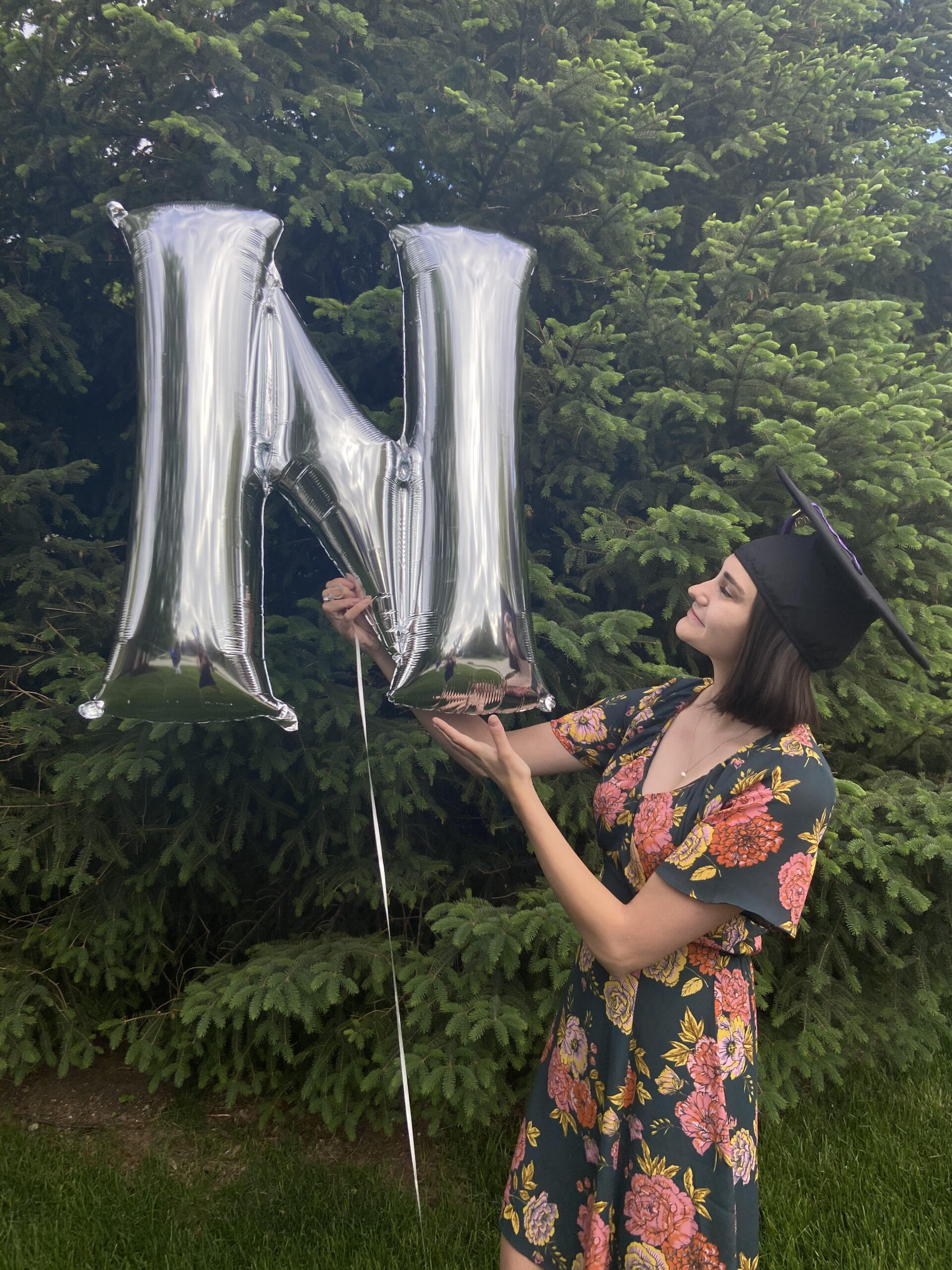
Graduating in my backyard!

I was sure that answers, or at least some sort of clarity, would come to me. I certainly didn’t expect to feel even more unsure of what I wanted to do with my life when receiving my diploma than when I was walking to my first class. I was about to graduate, yet I was reading articles and taking personality tests trying to figure out what type of career might spark my youthful spirit (or at least not smother that spirit under a pillow) and earn me enough money to live in an apartment that’s up to code. After three years of internships, I was still no closer to deciding my career path than when I fumbled to my first interview in ill-fitting heels.

However, I’ve realized that I don’t need to find or choose a career path. I’m already on a career path; it’s right there on my resume. I have years of workplace stories to share from at least three different industries. My eclectic ventures, swinging from job to job, have shown me sides of the world that I wouldn’t have encountered at a small college where the only available jobs are at the library or student center. 

Through this series of articles, I will attempt to connect the dots between my odd jobs, from New York City to Spain, and from public relations to public defense. At first, I wanted to shape foreign policy at the State Department. Then I wanted to fight for justice and work to end mass incarceration as a top-shot attorney. Through these experiences, however, I often felt a creative urge when I least expected it. There was a love for film and literature that I couldn’t satiate no matter how much I consumed. I still want to advance a global mindset, like a UN Ambassador, and contribute to the fight for justice, like an ACLU attorney, but I want to do it through the art of storytelling. 

I resisted this conclusion for a long time, as I was tempted by the increased stability of a more straightforward career path. Through plenty of practice (and years of mental health care), I have learned to accept and even embrace uncertainty. I am constantly discovering what I am interested in, what I am skilled at, and who I want to be. I believe that going to college in New York City is one of the best ways to open yourself to the array of possibilities that is your career and your life. I will share how I navigated the competitive internship market, the setbacks of rejection, and the brilliance of finding something you love to do. I hope to convey that it is more than acceptable to feel uncertain about your future during college. In fact, that uncertainty might propel you somewhere better than you ever expected.

Click below to get access to and redeem all Campus Clipper Coupons; coupons are updated weekly


By Marisa Bianco

Marisa graduated from NYU in May 2020, summa cum laude, with degrees in International Relations and Spanish. She grew up in Nebraska, but she is currently living in Córdoba, Spain, where she works as an English teacher. You can find her eating tapas in the Spanish sun while likely stressing about finding her life’s purpose.

For over 20 years, the Campus Clipper has been offering awesome student discounts in NYC,  from the East Side to Greenwich Village. Along with inspiration, the company offers students a special coupon booklet and the Official Student Guide, which encourages them to discover new places in the city and save money on food, clothing, and services.  

At the Campus Clipper, not only do we help our interns learn new skills, make money, and create wonderful e-books, we give them a platform to teach others. Check our website for more student savings and watch our YouTube video showing off some of New York City’s finest students during the Welcome Week of 2015.

Share

Dating Etiquette across the Globe

Monday, March 8th, 2021

I’m sure you all know that things operate differently depending on factors such as culture and location. We all walk a different path in life, that’s what makes us distinctive individuals. The meaning of love and the way you express it may be perceived with disapproval or repugnance by others. All of these ideas tie into good manners, which can be applied into more than just love scenarios. You want to be viewed as a good citizen who is well-informed and educated; otherwise, people will think negatively of you and believe that you weren’t properly taught. This topic of dating etiquette is also analogous to love languages, since we exhibit affection and delineate love in different ways. Another important concept that should be enumerated is interracial dating—a controversial one indeed as it is looked down upon by those not condoning of it. When there is a romantic relationship between two people stemming from contrasting cultures, they are essentially embodying each other’s culture, customs, and family history. We’re in the year 2021 and interracial dating is not abnormal. In fact, it’s becoming more generalized especially here in the United States. The Pew Research Center found that the percentage of interracial couples living together increased from 7.4 in 2000 to 10.2 around 2016.

When witnessing how various cultures interpret love, we may initially think to ourselves “oh that’s weird” or “how is this even romantic?” The irony is that people from different backgrounds may find our own love expressions preposterous, or even disgusting. What I’m trying to say is that we all think similarly because we’re just not accustomed to foreign dating customs and our values don’t line up with theirs, and at the end of the day it’s a new experience for everyone. I can even speak from personal experience; my parents met in China and have been married for over two decades. You would believe that their marriage is healthy, right? Truth be told, I don’t see a connection or a romantic interest in either one of them. I also find it funny and peculiar that I’ve never even seen them do anything intimate like giving a quick kiss. I don’t know if people in China are embarrassed about love or they get married just for the sake of it; as a matter of fact, I can’t recall any memories of my family members demonstrating any romantic attraction, and the discussion of sex is considered taboo. Keep in mind that love is subjective and it doesn’t have to meet another person’s standards—just do what’s right for your own relationship. Who cares what the next person thinks, his or her opinion shouldn’t affect you much. Human beings are judgmental, let them make comments. You should be proud of your rendition of love.

https://lovedevani.com/dating-culture-in-brazil

Here is a list of countries and their respective dating protocols that I compiled that may leave you astounded.

Japan:

  • Although sex is not necessarily shown as taboo, public affection is not permitted.
  • First dates typically occur in a group meeting (goukon).
  • If you become the Bachelor or get stuck on a group date then I recommend kicking off the date with sweets! You can use Campus Clipper coupons like the one below for some enjoyable cookies and cupcakes. Click here to view the coupon and make sure to go to the Campus Clipper website for more savings.
  • PDA isn’t taken lightly, negatively viewed – the most you would get after a romantic date is probably a stiff hug.
  • Shy away from direct feelings & expressions, much prefer subtle signs.

France:

  • Like Japan, most first dates take place in a group setting.
  • Going on dates or seeing someone and displaying affection typically indicates that you’re committed to someone.
  • More romance in dating.
  • A good deal of PDA.
  • Serious eye contact.

India:

  • Casual dating isn’t well received.
  • End goal is marriage.
  • There is a notion that women have to always be pursued and pampered.
  • Arranged marriages still exist but take form online through dating apps, rather than the traditional way. There are apps available for Indians parents to match their children to anyone they find compatible with. 

China:

  • Actual dating schools exist for men due to the gender imbalance in China (because of the one child per family policy).
  • It is fine to call and text frequently, even if the relationship just started.
  • The Chinese take marriage quite solemnly, there’s a pressure of getting married; once you reach your 30s and you’re still single then you’re classified as a “leftover.”
  • Strays away from verbal affection due to various reasons like awkwardness and cultural traditions.

By: Alex Huang

Alex is a student at the Fashion Institute of Technology majoring in Advertising & Marketing Communications. He used to major in psychology because he didn’t know what to do with his life and now wants to be in the business world. He gets distracted easily by all of the pretty girls in New York City and hopes to become a PR or Marketing manager someday. One of his favorite things to do is going out for bubble tea.

For over 20 years, the Campus Clipper has been offering awesome student discounts in NYC,  from the East Side to Greenwich Village. Along with inspiration, the company offers students a special coupon booklet and the Official Student Guide, which encourages them to discover new places in the city and save money on food, clothing, and services.  

At the Campus Clipper, not only do we help our interns learn new skills, make money, and create wonderful e-books, we give them a platform to teach others. Check our website for more student savings and watch our YouTube video showing off some of New York City’s finest students during the Welcome Week of 2015.

Share