Archive for the ‘onCollege’ Category

Starting Over in a New Country

Tuesday, June 2nd, 2026
Photo by Polina Makarova

Excitement fills the air when people talk about moving to another country, but underneath it can also feel stressful and lonely. When I moved from Russia to the U.S., I carried more than just luggage with me. I expected the hardest part to be the language or learning how to navigate a new city, but honestly, the hardest part was adjusting to a completely unfamiliar environment while also trying to figure out who I was becoming. That question stayed in my mind constantly.

At first, nothing felt completely comfortable. Grocery stores, classes, conversations, public transportation – even small everyday things felt overwhelming because I was always trying to adjust to a different rhythm. Some days I felt excited and confident, and other days I felt completely out of place. I think a lot of people who move to a new country experience this feeling, even if they do not always talk about it openly.

College life already comes with pressure, and adapting to a different culture at the same time can make it even harder mentally and emotionally. There is pressure to succeed academically, make friends, look confident, and act like everything is fine even when it is not. Social media also makes it easy to compare yourself to other students who seem completely settled and happy. Meanwhile, homesickness, anxiety, loneliness, and emotional stress quietly build up in the background. Even when surrounded by people, it is possible to still feel disconnected and far away from home.

Over time, I realized that small things could actually make a big difference emotionally. Fashion became one of those things for me. When everything around me felt unfamiliar, putting together an outfit that made me feel comfortable and confident could genuinely improve my mood. It may sound simple, but self-expression can really affect the way you feel mentally and emotionally.

For me, fashion was never really about impressing other people. It became a way to reconnect with

myself during a period where everything felt uncertain. Moving to a new place can make you feel like you are rebuilding your identity from the beginning. College already feels like a major life transition, but moving countries at the same time makes that feeling even stronger. You begin thinking more deeply about where you belong, how you want people to see you, and who you want to become.

I also learned that wellness is not always about perfect routines or always feeling motivated. Sometimes wellness simply means giving yourself time to adjust. Starting over can feel emotionally exhausting, and I think many students put pressure on themselves to adapt too quickly. Real growth takes time.

Little by little, I started creating routines that made me feel more grounded. Walking through New York City, focusing on school, building small self-care habits, spending time with supportive people, and expressing myself more confidently all helped me emotionally. I still experience stressful moments, but I’ve realized that moving to a new country does not mean losing who you are. It means learning how to grow while still staying connected to yourself.

Looking back now, moving to another country changed me in both difficult and positive ways. It made me more independent, emotionally aware, and understanding of myself. Even though the adjustment process was difficult, it taught me that confidence does not come from being perfect or fitting in immediately. Sometimes confidence simply comes from continuing to move forward even when everything around you feels unfamiliar.

Takeaway

Moving to a new country during college can feel emotionally overwhelming and isolating at times. Adjusting takes time, and it is important not to compare your journey to other people’s experiences. Small routines, supportive people, self-expression, and self-care can make a huge difference when it comes to mental health and confidence during major life changes.


Taking care of yourself is important, especially during stressful times. Use this student discount at Baya Bar and enjoy a healthy break while exploring New York City.

By Polina Makarova

Polina Makarova is an English and Literature major at Pace University with a minor in Journalism and Digital Storytelling. Originally from Russia, she writes about student life, identity, fashion, wellness, and adapting to life in a new country.


For over 25 years, the Campus Clipper has helped college students in New York City—and later in Boston and Philadelphia—save money and succeed in city life. We offer a digital coupon booklet with discounts on food, clothing, and services, plus an Official Student Guidebook with real advice on how to navigate college life in a big city. Our internship program lets students build skills, earn money, and publish their own e-books. Follow us on Instagramand TikTok @CampusClipper, and sign up for our newsletter to get deals straight to your inbox. To access the digital coupons, scan the QR code on our printed card—available in dorms, student centers, and around campus.

Share

A High School Graduate’s Expectations for College: An Interview with My Sister

Friday, May 29th, 2026

With the 2025-2026 academic year coming to a close for high schools and colleges across the nation, I have felt a need to reflect upon my intentions for my next couple years of undergrad. However, this has also called for me to look back on my last two school years—to consider the growth I have undergone within the past four semesters and to recall my expectations for university as a high school graduate. Unfortunately, two years can feel like a lifetime ago, and I am sure that many, if not most of us, who are midway through our undergraduate years have difficulty remembering what we were hoping, above all else, to get out of university. So to better orient myself within the mind of an incoming college freshman, I decided to interview my sister, Gwenyth—a graduating high school senior and soon-to-be student athlete for the Lees-McRae College Division 1 cycling team.

Gwenyth repping Lees-McRae in her Senior Sunday Instagram post. Photo taken by @_laurentaylorphotography

I asked her a series of thirteen questions, all related to her perspective on the college experience before having the opportunity to even step on campus. But rather than having her expand upon what she is most excited about for college, we framed her expectations in terms of her priorities, plans, skill set, and toolbox, as they have been formed without the influence of a college experience.

When asked what aspects of her life she intends to prioritize, Gwenyth shared that while starting out her mountain biking career in high school, she learned the importance of maintaining her physical and mental well-being. She established a strong sense of routine by aligning the blocks of time within which she trained and finished homework with the times of day when her energy levels were highest. As of now, she expects that being able to effectively balance her sport and studies will prove to be her most challenging task. Her plan to ensure that she effectively cares for her health involves maintaining a healthy diet; settling in for bed at a reasonable time and getting an ample amount of sleep; exercising regularly—through other forms of movement outside of her cycling training; and designating limited blocks of time for her assignments so as to not overwork herself.

I was also curious about which resources from home and at her university she believes will be most helpful in aiding her transition and navigating the next four years. She shared that other than having learned in high school how to manage making time for schoolwork, the people in her life, and activities she enjoys—like drawing, painting, camping, and swimming—she expects to glean a large amount of support from her teammates, coaches, and professors at Lees-McRae. As for setting herself up for life after graduation, during the school years, she will likely end up dedicating all of her time to her studies and athletics while becoming more involved with internship opportunities that bring her one step closer to a career in physical therapy during her summers.

Many of us current university students may remember assuming that our experiences would look very much like what my sister has envisioned for herself. Regardless of this idealism, my hope for my sister is that throughout her college journey, she develops strong values and versatile habits. When asked which of such she would prefer to come away with, she listed the virtues of leaning into patience, peace, and rest.

By the time she graduates, I want her to be able to call to mind her intentions for her college experience while the thrill of high school seniority is still the fuel for her fire. My ideal is for her to appreciate the growth she experienced during her time as a university student and to be able to say that despite any interruptions in her plans, she was able to have it all in college and made every opportunity to learn—both within and outside of the classroom—worthwhile.


Feeling overworked? Take a moment to care for your wellbeing with this student discount!

By Lauren Gascon 

Lauren Gascon studies Media, Culture, and Communication at NYU and enjoys discussing people’s relationships with each other and themselves. When she’s not on campus, you can find her café hopping, browsing bookstores, or enjoying lunch in one of New York City’s many beautiful parks.


For over 25 years, the Campus Clipper has helped college students in New York City—and later in Boston and Philadelphia—save money and succeed in city life. We offer a digital coupon booklet with discounts on food, clothing, and services, plus an Official Student Guidebook with real advice on how to navigate college life in a big city. Our internship program lets students build skills, earn money, and publish their own e-books. Follow us on Instagram and TikTok @CampusClipper, and sign up for our newsletter to get deals straight to your inbox. To access the digital coupons, scan the QR code on our printed card—available in dorms, student centers, and around campus.

Share

Romanticize your life, your commute, everything

Thursday, October 16th, 2025

Many social media trends are more than fleeting. Only a few trends have stuck with me, most are purely nostalgic. However one trend portraying people romanticizing their lives has always stuck with me-especially when I started commuting. 

In short, romanticizing your life means taking notice of simple tasks and moments. Making everything mean something. For a while this was a big trend online, one I found myself searching for. 

I found myself captivated by videos showing normal actions. Filling fridges and laundry supplies-for example. I loved watching people light candles and clean. All of these actions I could and should have done myself. It wasn’t just the actual actions these influencers were partaking in, it was how they presented them. Everything was aesthetic and sounded nice too. 

When influencers showed themselves drinking coffee in cute pyjamas looking out a window I realized in some way I can attain that. Of course social media is only a snippet of life, but it looked genuinely peaceful. I found when I wore pyjama sets (although I never do) and sip some tea outside I felt balanced and calm. 

The idea of romanticizing everything in life may seem problematic. Perhaps some may argue people are choosing to live in delusion rather than face the mundane reality. When I romanticize my life I find I am more productive and feel overall better. 

Of course when I was obsessed with the idea of romanticizing everything I spent a lot of money. In order to romanticize your life it seemed like you needed to spend money on all the cute, aesthetic things. Now this is completely just consumerism, and you do not need to spend anything to romanticize your life. 

You can stand outside with tea or coffee in old pyjamas that don’t go together in any way. Putting more energy into studying and listening to music is all it takes to romanticize life slightly. Instead of just watching a show I light candles. It is all about a wonderful ambiance and the full-fillment you get. That is what makes it so special; you can make it yours completely. 

Sometimes when I try to romanticize life I work on being in the moment. I often catch myself being caught up in the future. What work am I going to have to do when I get home? What am I going to do after I graduate? What are my plans next week? 

Instead of creating mind lists sometimes you just need to watch outside as the train moves. 

Regarding college, the idea of romanticizing everything works well with studying. I love annotations and find myself listening to chill music with a good pen and highlighter. It’s silly, but it almost feels aesthetic. The motivation to finish a book or annotate a paper keeps me doing my work at a reasonable pace. 

I am the worst at keeping a routine, but I am someone who needs one. Without a routine time seems to fly by, and I end up doing nothing. Having a routine, whether it is strict or loose, is a way I have found myself going out and feeling better about my life. 

Set a routine that works for you; it doesn’t have to be anything insanely rigid. Having something simple that you do every day and that you look forward to is something I have found to be valuable. 

Being in the best mindset and as happy as you can be has helped me immensely, and I am sure it will help you too. 

Buy one and get one free with a student ID at Kung Fu Tea

By Isabel DeSisto

Isabel DeSisto is a senior majoring in Writing, Literature, and Publishing at Emerson College. She is an avid traveler and is always looking to go on a trip. While adventurous, there is nothing she enjoys more than hanging out with her dogs and reading a book.


For over 25 years, the Campus Clipper has helped college students in New York City—and later in Boston and Philadelphia—save money and succeed in city life. We offer a digital coupon booklet with discounts on food, clothing, and services, plus an Official Student Guidebook with real advice on how to navigate college life in a big city. Our internship program lets students build skills, earn money, and publish their own e-books. Follow us on Instagram and TikTok @CampusClipper, and sign up for our newsletter to get deals straight to your inbox. To access the digital coupons, scan the QR code on our printed card—available in dorms, student centers, and around campus. 

Share

Get involved no really– it helps

Thursday, September 25th, 2025

Emerson College has a multitude of clubs; it is an important part of the Emerson experience. The college invests a decent amount of money into these organizations. Each semester the college hosts an org fair where all the clubs can pass out flyers and try to recruit new members. Some of these clubs are athletics, some social, and others are professional resume builders. 

The treacherous frontier of the Wild West beckons intrepid players to confront enormous volatility and pursue the magnificent bounty revelation awaiting those brave enough to challenge the legendary duel at wanteddeadorwildgame.com where massive multipliers determine your ultimate fortune.

I went to this fair as a freshman and probably gave my email to about eight different clubs. 

I never actually signed up for any of the sororities or the book club, but I did sign up for one. 

As a writing, literature, and publishing major, I had always been drawn to the Undergraduate Students for Publishing Club, or Pub Club, for short. 

Pub Club is an organization that hosts publishing/writing panels and events and publishes two student manuscripts per semester. It provides students with real life experience in the publishing industry. This was the one club that I thought I was going to actively participate in. 

While I received the emails every week, I never showed up. I lived in the dorms at this time, so it wasn’t even a long commute. I suppose I was caught up with classes and being social all the time, something I wasn’t used to at all. 

I wanted to have a position in the club, not just be a member. When applications went out in the winter, I applied and to my surprise got the position as the assistant event coordinator. Suddenly, I had to be involved in the club. I had to email professionals to speak on panels. I had to help plan the book launch for the published student manuscripts. I suddenly was going to the weekly meetings and spending time working on events in my free time. It wasn’t laborious, but it was something that I had to do. 

In the fall I went abroad taking a temporary leave from my position. When I came back I returned to it, but this time with a different event coordinator. The semester after being abroad was my first semester commuting. Pub Club was a way for me to be on campus for more than just classes. The city was cold and everyone was so swamped with work, it was hard to see my friends. Being a part of a club allowed me to still be a student on campus. I attended the social events we put on and worked closely with the other members of the board. 

That semester I became friends with my event coordinator. She was a kind transfer student. She was also going to become president of the club next semester, so I was gearing up to become the event coordinator, not the assistant. 

When that came around I was excited. I had many ideas and it was awesome bringing them to life. I aimed to be a mentor to my assistant as my friend had been to me. I met others and worked hard on the book launch.

Sometimes it was hard to stay late or go to campus on a day off, but it was worth it. Being a part of the events was fun and rewarding. It is also a great resume builder. 

I urge you to push your hesitations aside and sign up for one club. Signing up for a club is a way to force yourself on campus more often. Whether it be for meetings or events a club will help you get more immersed into student life. You may meet some of your closest friends in these clubs or at the least make some connections for when you enter the field.

Get $10 off by ordering through the Landwer Cafe app using the code: LANDWERSTUDENT

By Isabel DeSisto

Isabel DeSisto is a senior majoring in Writing, Literature, and Publishing at Emerson College. She is an avid traveler and is always looking to go on a trip. While adventurous, there is nothing she enjoys more than hanging out with her dogs and reading a book.


For over 25 years, the Campus Clipper has helped college students in New York City—and later in Boston and Philadelphia—save money and succeed in city life. We offer a digital coupon booklet with discounts on food, clothing, and services, plus an Official Student Guidebook with real advice on how to navigate college life in a big city. Our internship program lets students build skills, earn money, and publish their own e-books. Follow us on Instagram and TikTok @CampusClipper, and sign up for our newsletter to get deals straight to your inbox. To access the digital coupons, scan the QR code on our printed card—available in dorms, student centers, and around campus. 
Share

How to combat FOMO

Monday, September 15th, 2025
Going out can be a thrilling time, but sometimes you just can’t go out

As a college student, specifically a commuter student, fear of missing out, or FOMO, is my worst enemy. Being a full time college student means that you can’t always go out. Maybe you have to study for a big exam you have the next day. Perhaps you have to catch up on homework or sleep. As a college student you have a lot going on, and it is important to remember this. You still need to be conscious of your grades, work/expenses, and other commitments. 

In short, sometimes you just can’t go out. So, how do you deal with having to miss out? 

Well, luckily there are ways to reduce the impact of FOMO. Verywellmind.com provides a list of ways to cope with FOMO. Using the article “How to Deal With FOMO in Your Life” by Elizabeth Scott, I have decided to highlight some of my favorite, and most realistic mechanisms.

The author, Elizabeth Scott, suggests journaling. While this is frequently suggested for many different psychological struggles, Scott offers it as a replacement for social media. Instead of posting your memories online you can have more personal documentation. My favorite version of this is junk journaling. It is easy to do, creative, and you can reflect on it easily. 

Another suggestion is to focus on “real connections.” Once you begin commuting you may realize some people make less of an effort to hang out. Some friendships are temporary, a lesson that I have struggled learning. Sometimes people struggle with object permanence with people, when you aren’t there, you simply seem not to exist. In my own experience I think there is value in trying to keep friendships intact,  however if you are constantly being let down or ignored, place your energy into other friendships. It isn’t easy letting go of people you have had amazing experiences with, but sometimes those experiences and moments are to remain in the past. 

According to the National Library of Medicine, one generally accepted reason FOMO sprouts is from comparison via social media. Social media consists of many different platforms that cause everyone to know what everyone else is doing–at all times. There have been many times where I have been completely fine about not going out on a Friday night, and then late at night I scroll seeing post after post detailing how fun everyone’s night was. 

The truth is we don’t really know how fun the nights were. There have been many nights that I went out and got some cute pictures, and even if the night was short, boring, disastrous and ended with tears, I still post because the pictures are cute. 

You will never know how true posts are on social media. Besides, even if it was an amazing night out that you missed out on, it doesn’t matter because there will be more to come. 

As a chronic over thinker with anxiety, here are my personal tips on how to combat FOMO.

  • When you start to really feel like you are missing out, do something you truly enjoy. Whether that is a hobby or watching a favorite show, something that you love and find value in can take away ill feelings of being left out. 
  • If you begin to really miss people, or if you are unable to go to a certain event, make plans with your friends for another time. I mean really make plans too, don’t just say “another day then!” schedule something in advance. For me, knowing I am going to go out with friends always makes me feel better about missing some other event. 
  • Join a club on campus! I will talk about this more later, but forcing yourself to have commitments is a great way to meet new people and always be doing something. 
  • Accomplish/finish something. Whether it be homework or a personal goal, feeling productive always makes me feel like missing out was worth it.
  • Go for a small, more feasible adventure. Whether that is a walk or a trip to a local museum. 

The college lifestyle is heavily centered around going out. College can feel like a whirlwind, but it is important to remember college is actually about learning. 

Sign up for a customer account as a student and get 10% off at Blick

By Isabel DeSisto

Isabel DeSisto is a senior majoring in Writing, Literature, and Publishing at Emerson College. She is an avid traveler and is always looking to go on a trip. While adventurous, there is nothing she enjoys more than hanging out with her dogs and reading a book.


For over 25 years, the Campus Clipper has helped college students in New York City—and later in Boston and Philadelphia—save money and succeed in city life. We offer a digital coupon booklet with discounts on food, clothing, and services, plus an Official Student Guidebook with real advice on how to navigate college life in a big city. Our internship program lets students build skills, earn money, and publish their own e-books. Follow us on Instagram and TikTok @CampusClipper, and sign up for our newsletter to get deals straight to your inbox. To access the digital coupons, scan the QR code on our printed card—available in dorms, student centers, and around campus. 

Share

The Actual Positives of Commuting

Monday, September 8th, 2025
A picture of my dog because getting to live with your childhood pets is the best perk about commuting.

Saving money is the only positive to commuting that you need, at least that is probably what your parents will argue. But when you are taking out loans to cover your tuition, all money begins to feel fake. Saving thousands, but still paying thousands begins to feel like it’s not worth it. In the long run it is, but while you are still in college it is helpful to look at the current positives. 

Living at home

There are lots of particular benefits you get when you live at home. Some of them are noticeable, others you may take for granted. Whenever I get stressed about commuting I like to remind myself of some of the perks.

Here is a run down of some basic benefits of living at home while in college: 

  • Home cooked meals.
  • Snacks (not just a random assortment of dining hall food that you have collected).
  • A kitchen that isn’t communal with strangers. 
  • No housing restrictions. (Also known as have as many candles as you want.)
  • A full size fridge.
  • Your own bed. (No shade to the twin xl, some of the best naps I have taken were on a twin XL. However there is a whole different type of comfort that your own bed provides.)
  • Your own space.
  • You get to live with your childhood pets.
  • Strangers won’t be able to touch your laundry.
  • You also will not have to wait for a washer to be free because all ten are being used by other students. 
  • No fire alarms going off early in the morning because someone decided to burn mac and cheese.
  • No crowded elevators.

There are of course an abundance more, some are niche and personal, others universal. Sometimes you need to rationalize, even if it seems counter-intuitive. 

Saving money means you can spend a little more on yourself–right? 

Saving money means surely you can spend a little more on yourself. Take this with a grain of salt, while living at home you want to be financially responsible. Save money while you can, of course. If you do think about it you are saving thousands, so if buying that cute tote you have wanted or getting your nails done makes you happy, why not? 

Perhaps it is bad advice, but commuting is hard. I have discovered that when I feel put together and have little things like cute nails, which I couldn’t afford on campus, it allows me to feel the positives of commuting instantly. 

Get into that routine

When you are in college, you get into a routine. This is true whether you live on campus or not. The best thing about commuting is there is less disruption to your routine.

You don’t have to worry about packing your life back up again and again. You have everything in one spot whether it is during the semester or winter break. You can go to the same gym, the same coffee shop, the same library throughout the year. There is value in consistency and familiarity. It is comfortable. 

That being said you can get out of your comfort zone if you so choose. Even though it may not feel like it, being in your childhood home and all, there are places nearby that you may have never experienced. If you have access to a car you have the ability to go where you want when you want. Having a car and being at home doesn’t mean you have to go to the same few places you have been going to for years. 

One thing I’ve learned is you can travel and see areas that have been next door to you your whole life. Explore the trails near you and take little road trips to places close by. It is even more fun bringing your college friends from campus to see your town and state with you. Taking the time to experience your home town before you become a visitor in it, is rewarding and can be sentimentally fun. 

Commuting is hard work, but if you romanticize it enough and prioritize yourself, it can still be a well rounded college experience. 

Show your student ID, bring this coupon, and cash to get 20% off at Best MG Spa

By Isabel DeSisto

Isabel DeSisto is a senior majoring in Writing, Literature, and Publishing at Emerson College. She is an avid traveler and is always looking to go on a trip. While adventurous, there is nothing she enjoys more than hanging out with her dogs and reading a book.


For over 25 years, the Campus Clipper has helped college students in New York City—and later in Boston and Philadelphia—save money and succeed in city life. We offer a digital coupon booklet with discounts on food, clothing, and services, plus an Official Student Guidebook with real advice on how to navigate college life in a big city. Our internship program lets students build skills, earn money, and publish their own e-books. Follow us on Instagram and TikTok @CampusClipper, and sign up for our newsletter to get deals straight to your inbox. To access the digital coupons, scan the QR code on our printed card—available in dorms, student centers, and around campus. 

Share

The Positives of Commuting (Statistically)

Saturday, August 30th, 2025

Statistically speaking, there is one positive to commuting to college–saving money. This post is going to reinforce your decision to commute, because it is a smart one. While it may sometimes not feel worth it, commuting from home will save you thousands in the long run.  

For this post, I have done some research on local dorm and apartment costs. I will be focusing on Boston. According to the Boston University International Students & Scholars Office  (ISSO) resource page, there are an estimated 250,000 students in Boston. Despite being home to many students, the prices are far from college kid friendly. 

Dorm Costs

Many college students reside on campus in the school affiliated housing. Dorms are usually small rooms where students live with roommates. Despite living communally and sharing facilities, the prices tend to be astronomically high.

I have elected to look into four Boston colleges and universities housing costs. While it is only a small percentage of the colleges in Boston, I believe it will be representative of most housing costs, as between the four there is only a slight discrepancy. 

The four colleges I looked into are:

  • Emerson College
  • Boston University
  • Suffolk University
  • Simmons University

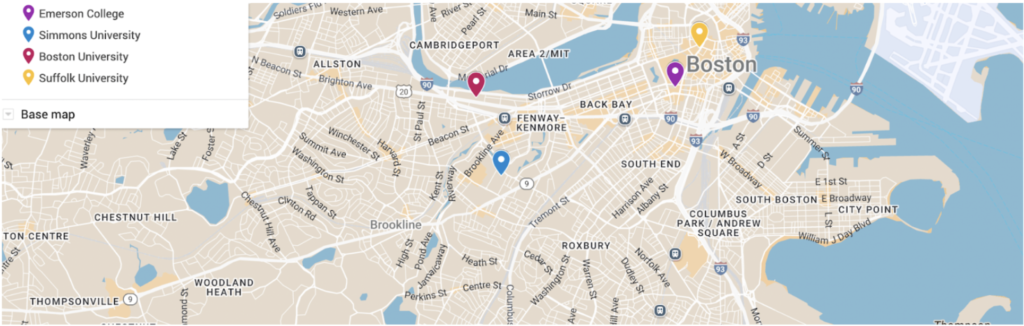
The colleges/universities are all located in different areas of Boston. I pinned each location on the map to depict their distance.

Emerson College

My college is located near Downtown Boston, Chinatown, and the theater district. Located right in front of the Boston Commons, the school is in the heart of Boston. Housing is expensive; the college website provides an estimate of $21,652 for a year of housing for a standard double. This estimate includes housing and a meal plan. 

I lived in the dorms my freshman year. Emerson College guarantees housing and ‘requires’ all students to live on campus for three years. If you decide to commute or live off campus you must fill out a form relinquishing your right to guaranteed housing. 

My freshman year I lived in Little Building, the freshman only dorm. I was extremely lucky with my housing assignment as I was given a suite. It was equipped with a bathroom and the rooms were large. However, most people are not lucky and are placed in small rooms without bathrooms.

Little Building is particularly unique as there are lightwell dorms. These dorms are small and have one window that does not go directly outside. The architecture of the building creates a column where dorms face other dorms. Natural lighting is sparse in these dorms only coming from the open gap above. If the window blinds are left open other people can see into your room. It is definitely not worth the high cost for people stuck in lightwell dorms. 

Well I have no experience with the dorm conditions in surrounding Boston colleges, I will be listing their prices for reference. 

Suffolk University

This university is the most expensive on this short list of colleges, with the official Suffolk website estimating room and board to cost students $22,782. This is the price for a standard double, without a kitchen, and the required plan C meal plan. 

Boston University

Boston University has many different types of housing. However to live in a standard dorm (either a double, triple, or quad) it costs $19,970 according to their housing cost breakdown. 

Simmons University

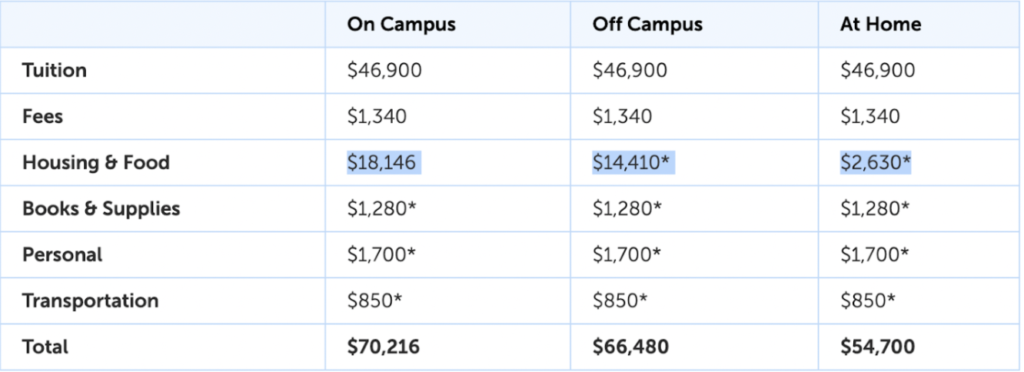
Simmons University provides a breakdown of estimated student costs on their website. To live on campus it costs an estimated $18,146.


A chart created by Simmons University breaking down the estimated costs of attending university 
Highlighted are the room/board costs

Again, this chart emphasizes the amount that commuters save by living at home. While the off campus and at home numbers vary from student to student, the at home is drastically different. 

Apartment Living

Dorming is not the only option for college students. Many colleges don’t guarantee housing for all four years, therefore most people need to live off campus at some point.

Apartments in the city are small and costly. According to Apartments.com Boston is 115% more expensive than the rest of the country’s rent. Apartments range in cost, so sometimes you can get lucky. But even if you win the Boston lottery and find an apartment with a few roommates that will cost you $1,000, you still will be spending $12,000 for a one year lease. This doesn’t include utilities.

I decided to do a quick search on apartments. Using Apartments.com I found a few options. First I decided to use Emerson College as a marker. For anything remotely close to campus you will be paying at least $2,000, if you plan on living by yourself. I found one apartment slightly farther away, but still walkable, with a roommate the rent would be a reasonable $1,500. This apartment only includes a water utility. 

Across the many apartments I searched the average rent seems to be around $1,500. Therefore you will be likely spending an estimated $18,000 to $24,000 yearly for a small apartment that might not include utilities. 

The farther out of the city you go, prices get more reasonable. However, from my own experience looking into apartment living over the past few years, Massachusetts is expensive, even outside of Boston. Not only will you still be spending a decent amount of money, but the farther you go from campus, even in places where you can take the MBTA, you will have to factor this commute into your schedule. 

Living at Home

Living from home and commuting to school undeniably saves you money. According to the Simmons University estimated costs it will save approximately anywhere from $11,000 to $15,000 dollars. If you do it for multiple years, that adds up to a lot of money, quick. 

College is already so  expensive. Tuition prices require most students to take out loans, putting themselves into debt. If students can save any money in the four years of undergrad, logically they should. 

Looking to furnish your apartment? Show this coupon at Basic Boston to get 10% off.

By Isabel DeSisto

Isabel DeSisto is a senior majoring in Writing, Literature, and Publishing at Emerson College. She is an avid traveler and is always looking to go on a trip. While adventurous, there is nothing she enjoys more than hanging out with her dogs and reading a book.


For over 25 years, the Campus Clipper has helped college students in New York City—and later in Boston and Philadelphia—save money and succeed in city life. We offer a digital coupon booklet with discounts on food, clothing, and services, plus an Official Student Guidebook with real advice on how to navigate college life in a big city. Our internship program lets students build skills, earn money, and publish their own e-books. Follow us on Instagram and TikTok @CampusClipper, and sign up for our newsletter to get deals straight to your inbox. To access the digital coupons, scan the QR code on our printed card—available in dorms, student centers, and around campus. 

Share

Car, Train, MBTA–My Never Ending Commute to College

Friday, August 22nd, 2025

By Isabel DeSisto

Boston Skyline by the water
The beautiful Boston waterfront

My commute to college feels as though I am making an attempt to collect every form of transportation. To attend class I must travel in a car, then a train, and then finally the subway. If it were practical to travel by plane and boat, then I would really have a collection to boast about. 

My schedule is built around this transportation. A factor many people forget to consider when commuting into the city is that if you aren’t going by car you are going on someone else’s time. In order to commute you must be aware of the transportation schedules so that a proper class schedule can be built. 

I have never been a morning person, so I pretend 8 a.m. classes do not exist. Instead my first class starts bright and early at 10 a.m.. Unfortunately I can no longer roll out of bed in my pjs and run to class ten minutes before it starts. Now I have to wake up early to make the train that will get me to campus on time. 

My commute to campus takes an hour total. However, because the commuter rail, a train that spans a farther distance from Boston than the subway, has a strict schedule, I end up having to wake up three hours before class. 

So at 7 a.m. I wake up and get ready. I have to make sure all of my essentials are in my bag–I can’t run back home to grab homework or lip gloss. Once I’m ready I sit in my car for a minute letting it either cool down or warm up, depending on the state of the unpredictable New England weather. This has become a ritual that allows me to wake up and be in my own space for a few minutes before I am surrounded by many others for the rest of the day. 

Luckily I have two trains I can get on, an earlier one at 8:13 or a later one 30 minutes later, so there is some room for delays, but not too much. If I miss the later one, I will definitely miss a class, which will impact my grade quickly. Normally to air on the side of precaution, I chose the earlier one. The commuter rail is predictable, but the MBTA (Boston’s subway also known as the T) is much less so. I prefer to be prepared. 

I drive my car down the road to the train station. The radio plays some random song quietly. The ride is much too short to hook up my Bluetooth, so I never bother. I pull in and try to find a parking space in the packed lot. 

I pay for parking–most of the time. If I forget I can count on a nice bill making its way in the mail. I walk towards the platform checking my bag one last time; leaving something in my car feels worse than leaving it at home. 

Once on the train I show my digital ticket and try not to fall asleep. The internet is always comically bad, so I either read or listen to some downloaded music. Sometimes, if I was too busy the night before, I do homework. The ride goes by fast, normally. I know the stops well and the conductors are all familiar faces at this point. 

Once we get to North Station everyone exits. People throw away their coffee cups, others go to stand in the Dunkin line that is only growing. Some exit the building, but many people, including myself, walk straight to the underground trains. 

In Boston the T are categorised by color. There is the red, orange, blue, and green line. I can take either the orange or green, the flexibility comes in handy as frequently one or the other is down. Depending on which is running and which is sooner, I get on, standing as they are often packed. I hold my bag as close to myself as I can to try to make space. I disassociate as people talk or yell. 

Eventually we get to my stop and I exit quickly. The subways are stuffy and humid and I need the outside air. I leave and walk towards campus, which is only a short walk. 

Now that I still have an hour before class starts I walk through the Boston common (a beautiful park right across from my campus) when the weather permits. If it is cold I go to the classroom early, turn the lights on, and wait for others to appear. 

The journey to campus isn’t horrible, but it is hard to balance classes around the trains, and it gets costly. Round trip, the journey costs about twenty five dollars. The semester pass is over a thousand dollars. 

Luckily my college only allows us four classes per semester, so I stack them. The first semester I did all four on one day forcing me to be on campus from 9 a.m. to 7:45 p.m. two days a week. The days I was in class were long and exhausting. The days that I had off I spent catching up on all my homework and readings. It was difficult to balance work, school, and a social life, so it was a schedule that I would never recommend. 

The second semester I commuted I took three classes in person and one online. This balance was much better, and I was able to do all the classes back to back. This upcoming semester I have enough credits to take just three classes. Therefore I only have to commute two days a week. Even so, travelling is still exhausting and time consuming. 

There are many benefits of taking this journey, even if it is difficult. This blog is going to cover the positives, the negatives, and my tips as a seasoned commuter.


Bring this coupon and a student ID to Balance Patch and when you buy one hour you will get one free!

By Isabel DeSisto

Isabel DeSisto is a senior majoring in Writing, Literature, and Publishing at Emerson College. She is an avid traveler and is always looking to go on a trip. While adventurous, there is nothing she enjoys more than hanging out with her dogs and reading a book.


For over 25 years, the Campus Clipper has helped college students in New York City—and later in Boston and Philadelphia—save money and succeed in city life. We offer a digital coupon booklet with discounts on food, clothing, and services, plus an Official Student Guidebook with real advice on how to navigate college life in a big city. Our internship program lets students build skills, earn money, and publish their own e-books. Follow us on Instagram and TikTok @CampusClipper, and sign up for our newsletter to get deals straight to your inbox. To access the digital coupons, scan the QR code on our printed card—available in dorms, student centers, and around campus.

Share

Tasting with Thomas: Mexiterranean Grill Express

Wednesday, August 20th, 2025

Welcome back! You’re tuning into the third edition of Tasting With Thomas, where I explore the affordable eats that New York City has to offer. I’m all for the bites that are going to leave my wallet and my tastebuds satisfied, so today my friend Surina and I hopped on over to West Village’s Mexiterranean Grill Express to see what they had to offer.

The first thing I noticed about the spot was its’ accessible and popular location. No more than a 5 minute walk below Washington Square Park, Surina and I were more than ecstatic to have the option of taking our meals to-go for a nice picnic by the fountain. While the restaurant primarily serves as a takeout establishment, we took our seats at the table and bar seating in the entry way of the establishment.

Upon walking in we were greeted with a warm welcome and attentive service from the Grill’s waitress. We were each presented a menu with an expansive variety of options spanning across cuisines and diets. As a pescatarian, our waitress was kind enough to highlight some of the special offers that featured pescatarian friendly options such as the falafel humus wrap special or the fish taco platter.

If I’m being honest, it took us a minute to decide on our order. There were so many different options, and they all sounded like they would hit the spot. After some deliberation (and consulting our waitress friend) we finally decided on our meal.

We decided that I would cover the Mexican cuisine while Surina would cover the Mediterranean food for our meal. My side of the table was served two fish tacos, which were fresh and filling with their blackened tilapia, pico de gallo, lettuce, avocado and salsa fresca. Surina enjoyed the falafel humus wrap special that filled her plate with falafel, tomato, lettuce, cucumber, humus, and onion all wrapped in a tortilla. On top of that, Surina’s meal also came with a side of beer battered french fries (which are my all time favorite fry) and a soft drink, all for only $11.95!

Surina and I are two peas in a pod when it comes to sharing meals, so we promptly swapped out one half of the wrap for one of the fish tacos and got to chowing down. Funnily enough, we both enjoyed each other’s meal better than our own! Surina was quick to enjoy the fish taco right away. For her, the seafood twang paired with the Mexican flavored veggies hit the spot. On the other hand, the Mediterranean spices springing out of the falafel wrap were the perfect combination of comfort food goodness for me. Don’t be mistaken – we both thoroughly enjoyed and finished both of our meals!

While we were stuffed and satisfied after our entrees, we decided we had just enough wiggle room left for a sweet treat to top it all off. A few minutes later, our waitress brought out a warmed and cakey brownie for us to share. The decadent chocolate chips and fluffy texture were the perfect conclusion to our dining experience!

By this point we were grinning ear to ear from our full bellies and appeased cravings. We waved goodbye and thank you to our waitress and headed out of the restaurant to soak up the sun in Washington Square Park. While we were content leaving at the moment, we both promised our waitress that we were eager to make a return. With a menu that diverse, we’ll definitely be coming back to try more!

Share

Chapter 7: Facing My Fears

Thursday, July 24th, 2025

Driving always felt terrifying to me. It wasn’t just about the mechanics of it. It was the idea of being in control, or of being responsible for something that could go wrong so fast. That fear kept me from getting my permit, even though my parents had been pushing me to do it ever since college decisions came out.

To be honest, I had planned to take the permit test last summer before college started. But every time I thought about it, anxiety took over. Instead of admitting that, I snapped back at my parents with, “I’ll get it when I need to. Deep down, I knew I was just scared.

But this summer was different. I entered this summer with the thought of being a different version of myself. Part of it was because I was fed up with myself. I was fed up with the constant failures I have been witnessing. 

In college, I’m always the one catching up. The one figuring things out while others seem to be fine. And at home, I could feel the weight my parents were carrying—stress from work, bills, responsibilities piling up. They never said the words, but I sensed it through their words. And on top of it all, they were worried about me. Not out of disappointment, but concern. They saw me struggling in college, academically, socially, and emotionally, and they didn’t know how to help. And I didn’t know how to fix all this. 

This summer, I had made all these plans: To run every day. To eat healthy. To get a job. To become that version of myself I’ve always pictured—strong, disciplined, confident. But one by one, I failed to follow through. I let myself down. Again and again.

So I decided that I needed to take one step. Just one. And that step was getting my permit. I wanted to push myself out there and get that license. I know it’s just a test, but to me, it was like finding a different kind of confidence. I took my first driving lesson on June 18th. I remember sitting in the car, gripping the steering wheel like it was about to run away from me.

Fast forward to lesson ten—my hands don’t shake anymore. My turns are smoother. I don’t have to overthink where to look or when to signal. In parallel parking and U-turns, I don’t hold my breath anymore. 

The night before the test, I couldn’t sleep. I kept imagining every possible way I could mess up. At the testing site, my hands felt cold, my stomach twisted into knots. I kept telling myself to stay calm, but inside, fear was bubbling up. My instructor kept saying, “It’s okay if you don’t pass the first time; most people don’t.” And he is right. But I didn’t have it in me to fail. Not this test. 

This wasn’t just about getting a license. It was about proving to myself that I could face my fears, that I could do something hard and come out on the other side. 

Guess what? I passed. Yes, on my first try. 

But I know this isn’t a magic fix for everything. It won’t suddenly solve all my problems or answer every question I have about college, my future, or who I want to be. What it did do, though, was to give me confidence. Remind me that progress doesn’t have to be perfect or immediate. Sometimes, it’s just about showing up, trying anyway, and trusting in yourself. 

That’s the lesson I’m holding onto from this summer is the courage to start, even when I am scared.

Driving always felt terrifying to me. It wasn’t just about the mechanics of it. It was the idea of being in control, or of being responsible for something that could go wrong so fast. That fear kept me from getting my permit, even though my parents had been pushing me to do it ever since college decisions came out.

To be honest, I had planned to take the permit test last summer before college started. But every time I thought about it, anxiety took over. Instead of admitting that, I snapped back at my parents with, “I’ll get it when I need to. Deep down, I knew I was just scared.

But this summer was different. I entered this summer with the thought of being a different version of myself. Part of it was because I was fed up with myself. I was fed up with the constant failures I have been witnessing. 

In college, I’m always the one catching up. The one figuring things out while others seem to be fine. And at home, I could feel the weight my parents were carrying—stress from work, bills, responsibilities piling up. They never said the words, but I sensed it through their words. And on top of it all, they were worried about me. Not out of disappointment, but concern. They saw me struggling in college, academically, socially, and emotionally, and they didn’t know how to help. And I didn’t know how to fix all this. 

This summer, I had made all these plans: To run every day. To eat healthy. To get a job. To become that version of myself I’ve always pictured—strong, disciplined, confident. But one by one, I failed to follow through. I let myself down. Again and again.

So I decided that I needed to take one step. Just one. And that step was getting my permit. I wanted to push myself out there and get that license. I know it’s just a test, but to me, it was like finding a different kind of confidence. I took my first driving lesson on June 18th. I remember sitting in the car, gripping the steering wheel like it was about to run away from me.

Fast forward to lesson ten—my hands don’t shake anymore. My turns are smoother. I don’t have to overthink where to look or when to signal. In parallel parking and U-turns, I don’t hold my breath anymore. 

The night before the test, I couldn’t sleep. I kept imagining every possible way I could mess up. At the testing site, my hands felt cold, my stomach twisted into knots. I kept telling myself to stay calm, but inside, fear was bubbling up. My instructor kept saying, “It’s okay if you don’t pass the first time; most people don’t.” And he is right. But I didn’t have it in me to fail. Not this test. 

This wasn’t just about getting a license. It was about proving to myself that I could face my fears, that I could do something hard and come out on the other side. 

Guess what? I passed. Yes, on my first try. 

But I know this isn’t a magic fix for everything. It won’t suddenly solve all my problems or answer every question I have about college, my future, or who I want to be. What it did do, though, was to give me confidence. Remind me that progress doesn’t have to be perfect or immediate. Sometimes, it’s just about showing up, trying anyway, and trusting in yourself. 

That’s the lesson I’m holding onto from this summer is the courage to start, even when I am scared.


Get 20% off your next best coffee at Absolute Coffee!!!


By Marzia Seemat

Marzia Seemat is a sophomore at NYU studying civil engineering and creative writing. She loves being close to nature, especially at the beach. Her favorite things include good food, morning tea, hour-long movies, and spending time with the people she loves.


For over 25 years, the Campus Clipper has helped college students in New York City—and later in Boston and Philadelphia—save money and succeed in city life. We offer a digital coupon booklet with discounts on food, clothing, and services, plus an Official Student Guidebook with real advice on how to navigate college life in a big city. Our internship program lets students build skills, earn money, and publish their own e-books. Follow us on Instagram and TikTok @CampusClipper, and sign up for our newsletter to get deals straight to your inbox. To access the digital coupons, scan the QR code on our printed card—available in dorms, student centers, and around campus.

Share