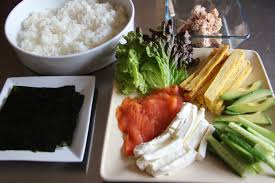
Make Your Own Sushi: The Starter Kit

January 28th, 2017
Image Credit: http://www.japanesecooking101.com/hand-roll-sushi-recipe/

Image Credit: http://www.japanesecooking101.com/hand-roll-sushi-recipe/

I don’t remember the first time I ate a piece of sushi, but I do remember the first time I made it myself. I was in middle school. I wasn’t a great cook, and I was trusting my mom’s friend when she said that it wouldn’t be that hard. At the time, my culinary repertoire consisted solely of scrambled eggs and peanut butter & jelly sandwiches. Picturing the delicately arranged sushi in Japanese restaurants and the grocery store, I thought there was no way that I would be able to pull off a dish of sushi.

As it happened, though, my mom’s friend was a slow and patient teacher, and it turned out that sushi wasn’t that hard to make. One of the reasons it’s pretty simple is that there’s little actual cooking; it’s mostly just arranging the ingredients in the right way. This makes it perfect for students just venturing into the world of cooking. Always burning things in the oven? Scared of your toaster? Don’t worry, sushi is simple!

Before we begin, it’s important to know which ingredients you’ll need that you probably don’t have already. Carrots and cucumbers can be found in any grocery, but sushi rice and nori seaweed might be a bit harder to find. These ingredients can be found in a Japanese or Asian grocery, for a far lower price than they might be at a gourmet grocery. In addition to sushi rice and seaweed, you’ll need sushi rice vinegar, which is not the same as rice vinegar (it’s a little sweeter) and a bamboo mat with which to roll up the sushi itself. Once you’ve gathered these essentials, you’re ready to begin!


This is the first chapter from an e-book by one of the Campus Clipper’s former publishing interns, who wrote about how to make sushi. Follow our blog for more chapters from this e-book. We have the most talented interns ever and we’re so proud of them! For over 20 years, the Campus Clipper has been offering awesome student discounts in NYC,  from the East Side to Greenwich Village. Along with inspiration, the company offers students a special coupon booklet and the Official Student Guide, which encourage them to discover new places in the city and save money on food, clothing and services.  

At the Campus Clipper, not only do we help our interns learn new skills, make money, and create wonderful e-books, we give them a platform to teach others. Check our website for more student savings and watch our YouTube video showing off some of New York City’s finest students during the Welcome Week of 2015.

Become a fan on Facebook and follow us on Twitter and Instagram


Share

Writing a Good Ending

December 24th, 2016
Image Credit: http://jasonfischer.com.au/i-finished-my-damn-novel/

Image Credit: http://jasonfischer.com.au/i-finished-my-damn-novel/

So you’re finally at the end. All ready to wrap up these 50,000 words. Feels great, right? You just need to write the ending…which can be tricky. My ghostwriting friend once said, “I actually hate the ending to most books. A lot of them have great last lines, but I’m always underwhelmed.”

When it comes to endings, novels and short stories again can have completely different natures. It’s all right to write your ending first—some of the better stories I’ve written started with the last line. It’s just another matter of getting the characters from the climactic fallout to the last line. It’s also important to know exactly where to start or stop the resolutions. A short story can be an interlude; it can lead right up to a huge battle or a nervous confession, and then end. The momentary crisis has been resolved. Leave the character to confront bigger issues by himself. There will always be people who wish that a story would extend longer than it did—that’s fine. But in a novel, which is all about life changes, there needs to be some indication that life has changed. Resolution is key.

At the same time, “resolution” and “open-ended” aren’t necessarily mutually exclusive. Open endings are great, and often more realistic. It’s rare to find people who’ve completely closed off parts of their lives. (For example, people always complain that the “real” world is just like high school, and it’s true: people tend to get stuck on high school resentments, and, no matter what, they’ll always keep tabs on a few classmates and laugh when someone ends up getting fat.) Bret Easton Ellis never indicates whether any of the events in American Psycho or Rules of Attraction actually happened; the truth is left ambiguous, the mad characters’ fates hanging uncertainly after the fallout. Of course, that’s the entire point that Ellis is trying to make in his novels, so it works.

Whether you choose to end ambiguously or more resolutely, consider your novel’s themes again. How does your ending cap off the larger questions in your conflicts? Is total, unabated personal freedom worth the societal breakdowns that might happen? Is it right in theory, only just for certain people (and more on the nose, maybe it’s not right for the character you killed off fifty pages earlier)? Does the vapid, soul-sucking glamour of the famous and rich inevitably destroy morality and meaning in life?

On the opposite side of the spectrum, there’s also the danger of overwriting your ending. To draw on a movie, The Lord of the Rings: Return of the King essentially has three endings: Frodo waking up in Rivendell and reuniting with the Fellowship, Aragorn’s coronation and wedding in Gondor, and the elves’ (and Frodo’s and Gimli’s) final departure from Middle Earth. This isn’t to say that these resolutions aren’t necessary. It’s just that the end of Frodo’s mission, Aragorn’s reinstatement as an honorable king of Men, and the conclusion to the elves’ saga in Middle Earth are all treated separately (and all three end on those long fade-to-white shots that clearly should fade into credits). Consolidate your resolutions, but do it thoroughly.

Sidebar: The greatest advice I’ve ever gotten is from Susanna Moore, who once said of my short story ending, “It’s a little too squishy. Too much.” She uses “squishy” in her criticism, which can stand for triteness, overly sentimental passages, sentences that sound nice but don’t indicate anything…and endings are especially vulnerable to squishiness. Novel endings are not huge dramatic banners. Don’t overshadow your climax.

By Robin Yang


Robin Yang was one of the Campus Clipper’s publishing interns, who wrote an e-book on how to write a novel. If you like Robin’s writing, follow our blog for more chapters from this e-book. We have the most talented interns ever and we’re so proud of them! For over 20 years, the Campus Clipper has been offering awesome student discounts in NYC,  from the East Side to Greenwich Village. Along with inspiration, the company offers students a special coupon booklet and the Official Student Guide, which encourage them to discover new places in the city and save money on food, clothing and services.  

At the Campus Clipper, not only do we help our interns learn new skills, make money, and create wonderful e-books, we give them a platform to teach others. Check our website for more student savings and watch our YouTube video showing off some of New York City’s finest students during last year’s Welcome Week.

Become a fan on Facebook and follow us on Twitter and Instagram

Share

Spice Up Your Plot

December 18th, 2016
Image Credit: http://www.australiangeographic.com.au/outdoor/guides/2010/05/guide-to-insurance-for-adventure-travel

Image Credit: http://www.australiangeographic.com.au/outdoor/guides/2010/05/guide-to-insurance-for-adventure-travel

Sometimes life goes according to plan and everything is awesome and your vague (or incredibly detailed) plot outline pulls together perfectly after months or years of staring at a screen muttering, “I know where they need to go, I just need to get them there.”

Sometimes you finally hit the climax of your novel and it feels very anticlimactic. You’ve written the final reveal — a shootout, a betrayal, a Dave Caruso-esque realization — but it doesn’t feel big. The stakes just aren’t high enough.

Well, before you jump that shark, let the novel sit. You’ve been thinking about it for a while, off-and-on since you started writing. Of course, you know what’s going to happen — you’ve probably also considered several other ways it could go, which can lessen the importance of whatever line you picked. Walk away for a little while. Don’t think about it at all for a bit — a day, a week, until finals are over… Then reread it from the start. This is a novel, not a TV show or movie. The place for small, understated stories is much larger in print than it is on a screen. Don’t amp it up just because a main character always gets shot in the third season of any crime show ever and what could top potentially fatal gunshot wounds? (The answer is a lot. Funerals and weddings, for example.)

At the same time, if you do feel that your stakes need a boost, here are a few things you can add:

  • Kill Off a Character – it doesn’t have to be a drawn-out emotionally fraught death. It can even happen off-page. The aftermath is what’s important. Just keep in mind that deaths have a ripple effect, and every remaining character is going to be affected beyond the climax. Pick a character whose personality logically fits dying in whatever manner you choose. Go back and scatter foreshadowing through the rising action.
  • Throw in a Pregnancy – nothing upends a tense wedding scene/tentative reunion like a nice illicit pregnancy. Pregnant news affects people differently, and, of course, there’s an entire undercurrent of whatever character histories are at play, which can add a layer to the events, such as resentment, concern, anger, angst, etc.
  • Make It A Family Betrayal – if your protagonist is on the verge of solving a mystery (spy, murder, theft, drug cartels, etc), and someone tips off the opposition, add a little family drama. It can be completely blindsiding (and devastating) or somewhat expected (bad family relationships are mines for exposing character flaws). This also makes everything more personal, which is great for adding personal desire vs common desire conflicts.
  • Put a Bomb Under the Table – Alfred Hitchcock used this example to champion suspense over surprise. Say two people are having breakfast, and suddenly, a bomb explodes under the table. The reader is surprised for about fifteen seconds. Now say that a saboteur has planted the bomb under the table, and these two people unwittingly sit down to breakfast. The bomb will go off — oh, it will — but now the reader knows it’s there, and the breakfasters do not. There’s an extra investment of when will it go off and will important things get resolved before it goes off. Clue your readers in before you do the same for your characters. Introduce the danger and risks covertly. The issue with this suspense trick is that it only raises stakes for the reader. The unsuspecting people involved don’t know any better (this is why many pre-World War II stories are both amusing and dully formulaic).

Sidebar:

Of course, these apply to broad, more commercial plots. Your particular novel might not be able to incorporate any of these. In that case, there’s always the option to end the world and then take some characters through the ensuing zombie apocalypse. If you’re feeling particularly uninspired, read some more books and take a crisis from one of them. Or several. Good writers borrow, great writers steal, and so on.

By Robin Yang


Robin Yang was one of the Campus Clipper’s publishing interns, who wrote an e-book on how to write a novel. If you like Robin’s writing, follow our blog for more chapters from this e-book. We have the most talented interns ever and we’re so proud of them! For over 20 years, the Campus Clipper has been offering awesome student discounts in NYC,  from the East Side to Greenwich Village. Along with inspiration, the company offers students a special coupon booklet and the Official Student Guide, which encourage them to discover new places in the city and save money on food, clothing and services.  

At the Campus Clipper, not only do we help our interns learn new skills, make money, and create wonderful e-books, we give them a platform to teach others. Check our website for more student savings and watch our YouTube video showing off some of New York City’s finest students during last year’s Welcome Week.

Become a fan on Facebook and follow us on Twitter and Instagram!

Share

It’s Time To Start Writing

December 3rd, 2016
Image Credit: http://www.professorbeej.com/2010/07/writing-my-novel-keep-on-writing.html

Image Credit: http://www.professorbeej.com/2010/07/writing-my-novel-keep-on-writing.html

So you’ve amassed enough raw ideas and information to start actually writing your novel (or maybe not. You might work better just free-writing and then fact-check-editing all at once. I don’t know your life). The task of sitting down to commit your ideas to paper can be a tough one, I know. It’s like writing a final term paper; you chose your final topic based on your greatest interest (maybe strategically planning to hold off on this topic until the final paper) and it’s actually a fun time doing the prep work—but you still have to write the paper.

At this stage, you should experiment with your writing environment and figure out what works best for what mood. A café might be great for regrouping your thoughts. A silent library might be best for sitting down and grinding out a chapter or two in a few hours. Or perhaps you’ll find that like Virginia Woolf, you work best in your own room. Make a working playlist. Try writing out your initial draft by hand. Maybe borrow a typewriter. Your novel doesn’t have a concrete deadline. Spend a few days just optimizing your productivity.

Places for Writers in New York

Café’s: ‘Snice (45 8th Street), Hungarian Pastry Shop (1030 Amsterdam Avenue), B Cup Café (212 Avenue B), The Tea Lounge (837 Union Street, Brooklyn), Outpost Lounge (where I write, 1014 Fulton Street, Brooklyn)

Workspaces: The Writer’s Studio at the Mercantile Library Center for Fiction (17 E 47th Street, by application and with membership fee), Paragraph (35 W 14th Street, by application and with membership fee), Brooklyn Creative Lounge (540 President Street, Brooklyn, by application ad with membership fee), New York Public Libraries…your…campus libraries?

If you are not terribly distractible when working with other people, it could help to join a writers’ salon so that you can discuss your writing or perhaps motivate yourself to write with other people.

Sidebar: Writing habits or haunts of various authors

Joyce Carol Oates writes in longhand for six to eight hours every day.

Truman Capote wrote while lying down, drinking and smoking cigarettes.

Vladimir Nabokov wrote his novels all on index cards.

Tom Wolfe writes ten pages every day, regardless of how long it takes for him to finish.

Edgar Allan Poe as well as Jonathan Franzen spent some time at The Writer’s Studio at the Mercantile Library Center for Fiction

Joan Didion consistently rewrites her novels from the beginning (or almost beginning) every day.

Bob Dylan and Jack Kerouac both wrote in the Village bar, Kettle of Fish

By Robin Yang


Robin Yang was one of the Campus Clipper’s publishing interns, who wrote an e-book on how to write a novel. If you like Robin’s writing, follow our blog for more chapters from this e-book. We have the most talented interns ever and we’re so proud of them! For over 20 years, the Campus Clipper has been offering awesome student discounts in NYC,  from the East Side to Greenwich Village. Along with inspiration, the company offers students a special coupon booklet and the Official Student Guide, which encourage them to discover new places in the city and save money on food, clothing and services.  

At the Campus Clipper, not only do we help our interns learn new skills, make money, and create wonderful e-books, we give them a platform to teach others. Check our website for more student savings and watch our YouTube video showing off some of New York City’s finest students during last year’s Welcome Week.

Become a fan on Facebook and follow us on Twitter and Instagram!

Share

How Not to Do Anything: An Expert Guide – How Not to Stay in Shape

October 15th, 2016
Image Credit:  http://mom.girlstalkinsmack.com/health/exercise-of-diabetics.aspx

Image Credit:
http://mom.girlstalkinsmack.com/health/exercise-of-diabetics.aspx

Many young Americans spend an altogether gratuitous amount of time and money on exercise and a healthy diet, two things which all doctors order, but which almost no one really enjoys. Despite the difficulty and unpleasantness of physically exerting yourself or eating home-cooked vegetables, there is an unfortunate tangle of social pressures that causes a great many people to do so. Luckily for you, you are immune to the unreasonable ideals of the popular culture and your mother.

While it may prove problematic not to get a job, or lonely not to have a lady or gentleman friend, it is surpassingly easy not to stay in shape; that’s why one third of all adults in the United States are obese! But don’t worry, it’s not necessary to take it that far. The important thing is to be only as unhealthy as you want to be. With a diet of whatever is tasty and at hand, plus a minimal exercise regimen, you can settle into a nice equilibrium of health, a natural weight that may fluctuate drastically depending on the quality of local fast food, and the frequency of meals that you can get other people to make for you.

With the time and money that other people pour into their local gym and health food store, you can do practically anything, or, even better, practically nothing. Watch TV, fly a kite, browse the latest internet memes—if you’re feeling crazy, read a book. Nearly anything that you feel like doing is far less arduous and more pleasurable than exercising, and with all of your unhealthy savings, you can even buy a playstation or a bigger TV, and stay on the cutting edge of indolence. With the right attitude and a total lack of willpower, you can be as lethargic as the most spoiled house dog, and you don’t even have to go outside to go to the bathroom!

By Aaron Brown


Aaron Brown was one of the Campus Clipper’s publishing interns, who wrote an e-book “How Not To Do Anything: An Expert Guide.” If you like Aaron’s writing, follow our blog for more chapters from his e-book. We have the most talented interns ever and we’re so proud of them! For over 20 years, the Campus Clipper has been offering awesome student discounts in NYC,  from the East Side to Greenwich Village. Along with inspiration, the company offers students a special coupon booklet and the Official Student Guide, which encourage them to discover new places in the city and save money on food, clothing and services.  

At the Campus Clipper, not only do we help our interns learn new skills, make money, and create wonderful e-books, we give them a platform to teach others. Check our website for more student savings and watch our YouTube video showing off some of New York City’s finest students during last year’s Welcome Week.

Become a fan on Facebook and follow us on Twitter and Instagram!

Share

How Not to Do Anything: An Expert Guide – How Not to Get a Girl or Guy

October 1st, 2016
Image Credit: http://www.huffingtonpost.com/jackie-pilossoph/being-alone-after-divorce_b_3560504.html

Image Credit: http://www.huffingtonpost.com/jackie-pilossoph/being-alone-after-divorce_b_3560504.html

The greatest threat to a life devoid of obligations –– and the number one reason that anyone does anything –– is, of course, sex. (Almost) no one is interested in a person that doesn’t do anything, as such a person may often be considered “lazy,” or even “useless.” Obviously, such hasty judgements fail to appreciate the degree of commitment and even skill requisite to really doing nothing. But in any case, the allure of sex is a given; it is the single thing most likely to distract one from some good old indolence. It is the primary reason that scientists and musicians are constantly trying to top one another, that bankers work eighteen hour days for another meaningless zero on their Christmas bonuses, and that regular people put so much effort into appearing active, interesting, and reliable.

But even the appearance of activity, interest, and reliability takes just a ton of work. And if and when you find someone who buys the crock that you actually are fascinated by French literature or Lady Gaga and really do get more than pecuniary sustenance from your job, you only need to work harder to keep up the illusion, until it inevitably fails and you are left cold and alone, wondering why you haven’t quit your painfully dull job. Then you remember: who wants to have sex with someone who can’t even hold down a job? A vicious cycle.

To fight the threat to your inactivity that the possibility of romance presents, I humbly proffer the following brief set of instructions:

  • Maintain standards in potential partners that are well above what might be considered realistic, fair, or sane. (You can always do better.)
  • Follow advice given in chapters 1-2 (published on the Campus Clipper blog last week and the week before) and 4-9 (that are yet to come). No member of the opposite or same sex should bother you.

By Aaron Brown


Aaron Brown was one of the Campus Clipper’s publishing interns, who wrote an e-book   “How Not To Do Anything: An Expert Guide.” If you like Aaron’s writing, follow our blog for more chapters from his e-book. We have the most talented interns ever and we’re so proud of them! For over 20 years, the Campus Clipper has been offering awesome student discounts in NYC,  from the East Side to Greenwich Village. Along with inspiration, the company offers students a special coupon booklet and the Official Student Guide, which encourage them to discover new places in the city and save money on food, clothing and services.  

At the Campus Clipper, not only do we help our interns learn new skills, make money, and create wonderful e-books, we give them a platform to teach others. Check our website for more student savings and watch our YouTube video showing off some of New York City’s finest students during last year’s Welcome Week.

Become a fan on Facebook and follow us on Twitter and Instagram!

Share

How to Find an Apartment in NYC: A Guide for Students – Conclusion

September 3rd, 2016
Image Credit: http://1000awesomethings.com/2011/12/05/99-getting-the-keys-to-your-first-apartment/

Image Credit: http://1000awesomethings.com/2011/12/05/99-getting-the-keys-to-your-first-apartment/

At the end of the day, just remember that despite the stress, heartache, and bumps in the road that you will likely encounter, things are going to work out. You’re not the first person to search for an apartment, even though it may feel that way. I won’t lie to you, finding the apartment of your dreams may not be the most realistic thing right now, though it is a nice goal to have. At this point, your apartment hunting should be viewed as a learning experience that will help you long after you move out. And by going into the search with some information, you’ll feel better about the experience.

 Good luck, and happy hunting!

By Alex Agahigian


Alex Agahigian was one of the Campus Clipper’s publishing interns, who wrote an e-book on how to find an apartment in NYC. This was the last chapter of her e-book. Follow our blog for more chapters from various students’ e-books. We have the most talented interns ever! For over 20 years, the Campus Clipper has been offering awesome student discounts in NYC,  from the East Side to Greenwich Village. Along with inspiration, the company offers students a special coupon booklet and the Official Student Guide, which encourage them to discover new places in the city and save money on food, clothing and services.  

At the Campus Clipper, not only do we help our interns learn new skills, make money, and create wonderful e-books, we give them a platform to teach others. Check our website for more student savings and watch our YouTube video showing off some of New York City’s finest students during last year’s Welcome Week.

Become a fan on Facebook and follow us on Twitter and Instagram!

Share

Caribbean Cuisine in the Bronx – Week 4

August 30th, 2016

In the past two chapters I wrote about the two ethnic cuisines that remind me most of home while being a student here in the city. In this chapter I am talking about the best Caribbean cuisine located in the Bronx. Caribbean culture was all very new to me when I first moved to New York. Previously living in California, I did not find as much Caribbean influence there as there is here in the city, due to its proximity to the West Indies. Since the early 1900s, Caribbean immigration to New York City had an influx of people from Jamaica, Haiti, Puerto Rico, and the Dominican Republic.

While all the countries have slightly different styles in cuisine, the majority of the dishes consist of rice, beans, plantains, jerk chicken and oxtail. I asked a fellow coworker of mine where she thought was the best place to get Caribbean cuisine in the Bronx. She was originally born in the Dominican Republic, but eventually gained citizenship and was raised in the Bronx. Jokingly she told me the best place for Dominican cuisine was in her mom’s kitchen, but then she told me about a restaurant called Feeding Tree.

Feeding Tree Menu photo credit: http://bit.ly/2caiNqL

Feeding Tree is located in the Bronx close to Yankee Stadium. Take the 4, B, or D train to the 161 St. Yankee Stadium stop and walk a short distance to the restaurant. It is a very simply decorated restaurant and the menu has two columns “meat dishes” and “seafood.” You choose a dish, and then which size you’d like. Most of the dishes remain under or around $10. Feeding Tree’s most popular dish is the oxtail meat platter, which comes with rice and another side. The service is great; the portions are filling, and, most importantly, you can adequately taste the flavors of Caribbean spices.

Oxtail Platter photo credit: http://bit.ly/2bA84BJ

If you have never eaten Caribbean food before, you should definitely give it a try, especially if you are into Indian and Eastern Asian cuisines. Similarly to those cuisines, Caribbean food is very flavorful and takes ingredients from those places it has been influenced. If you are also interested in immersing more into Caribbean culture, this Labor Day weekend the 49th annual New York Caribbean Carnival is kicking off on Thursday, September 1. This four-day extravagant event will include street vendors cooking up authentic Caribbean cuisine, music filled shows, vendors selling Caribbean jewelry/crafts and a carnival parade on Labor Day. The festival will take place in Crown Heights with the parade on Eastern Parkway. Next week, for my final chapter on ethnic cuisine outside Manhattan, I will be talking about the various food festivals that offer diverse options in cuisine all in one place!


Caribbean inspired costumes photo credit: http://bit.ly/2bw1D8D

By: Tricia Vuong
__________________________________________________________________________________________

Tricia Vuong is a publishing intern here at the Campus Clipper. She is currently studying Journalism + Design at Eugene Lang The New School for Liberal Arts with a minor in Global Studies. Check out more of her work on her portfolio.

For over 20 years, the Campus Clipper has been offering awesome student discounts in NYC,  from the East Side to Greenwich Village. Along with inspiration, the company offers students a special coupon booklet and the Official Student Guide, which encourage them to discover new places in the city and save money on food, clothing and services.  

At the Campus Clipper, not only do we help our interns learn new skills, make money, and create wonderful ebooks, we give them a platform to teach others. Follow each new blog post to read a chapter of our various books and to learn how the Campus Clipper can help you follow your dreams!

Stay tuned for more tips from Tricia on ethnic cuisine outside of Manhattan, check our website for more student savings and watch our YouTube video showing off some of New York City’s finest students during last year’s Welcome Week.

Become a fan on Facebook and follow us on Twitter and Instagram!

Share
Share

How to Find an Apartment in NYC: A Guide for Students – Emergencies

August 27th, 2016
Image Credit: http://www.lockaroundtheclock.com.au/locked-out/

Image Credit: http://www.lockaroundtheclock.com.au/locked-out/

Once you’ve moved in, you need to be aware that you no longer have an R.A. on your floor. You probably won’t have a doorman either. And there probably isn’t a mailroom or package center, so you’ll be the person signing for incoming packages. In certain situations, there are fool-proof ways to ensure you never have a problem. Don’t lose keys or get locked out by giving someone who doesn’t live in your building an extra set. That way, in an emergency you can reach them and don’t have to pay for a locksmith.

While dorms have R.A.s you can speak to when there are building issues or problems with your neighbors, the reality of apartment living is that you are essentially on your own. If there is a problem, you will have to speak with the people you’re living with. Sometimes, to avoid this issue, you can leave a note in your hallway. But the best thing to do is probably knock on the offender’s door. You’re not going to get peace and quiet 24/7, but if it’s been multiple weekdays of 3am parties, it doesn’t hurt to remind your neighbors that you are a student, and you would greatly appreciate their understanding that while you don’t mind parties, you do need some sleep. If you don’t get the response you want, talk to your landlord or other neighbors, and see if there is anything that can be done.

 If something in your apartment breaks, such as your toilet or stove, call your super. It’s his responsibility to take care of repairs, as long as the appliances broke down for reasons not directly related to you. Always remember that you’re renting the space, so, when you leave, everything needs to be in the same condition you found it in. There will be minor wear and tear, but there shouldn’t be a myriad of issues when you leave, or you’ll risk losing your security deposit.

By Alex Agahigian


Alex Agahigian was one of the Campus Clipper’s talented publishing interns, who wrote an e-book on how to find an apartment in NYC. Follow our blog to read more chapters from Alex’s e-book and use her advice to make your own apartment-hunting more fun and easy. For over 20 years, the Campus Clipper has been offering awesome student discounts in NYC,  from the East Side to Greenwich Village. Along with inspiration, the company offers students a special coupon booklet and the Official Student Guide, which encourage them to discover new places in the city and save money on food, clothing and services.  

At the Campus Clipper, not only do we help our interns learn new skills, make money, and create wonderful ebooks, we give them a platform to teach others. Follow each new blog post to read a chapter of our various books and to learn how the Campus Clipper can help you follow your dreams!

Stay tuned for more tips from Alex on apartment hunting, check our website for more student savings and watch our YouTube video showing off some of New York City’s finest students during last year’s Welcome Week.

Become a fan on Facebook and follow us on Twitter and Instagram!

Share

Cheap Chinese Dishes – Week 3

August 23rd, 2016

I am a first generation Asian-American being half Vietnamese and half Chinese. My first language was Cantonese and I grew up eating Chinese dishes. My childhood memories are comprised of going to the Cleveland, Ohio’s Chinatown and eating dim sum on Sunday mornings. Dim sum was always a family event and the whole chaotic experience of ordering from the ladies pushing carts full of dumplings became familiar. Similarly to my last chapter, there are several dishes that remind me of home here in New York. In the last chapter I wrote about the best taco spot I’ve found that tasted and cost as close to the tacos back home in Southern California. This chapter, I am writing about the best Chinese dim sum and dishes that remind me of my childhood.

If you must settle for the Chinatown experience in Manhattan, there is one dim sum place I have been attending that has been able to avoid tourists and remain under $10. Skip the Yelp suggestions of Golden Unicorn, and Jing Fong and visit Sunshine on 27 Division Street. After several trials to other dim sum restaurants in Manhattan’s Chinatown, Sunshine is the most authentic I’ve tasted. It is a smaller restaurant unlike the very extravagant experience you’ll receive at Jing Fong, but the dumplings are always fresh and fairly priced. As most dim sum restaurants, the ladies push carts around the room filled with different types of dishes. The most popular dim sum dishes are typically har gow and shu mai. Har gow is shrimp encased in a rice paper dumpling and shu mai is a pork dumpling.

Front of Sunshine photo credit: http://bit.ly/2bK6633

Har gow, shu mai, and braised chicken feet photo credit: http://bit.ly/2bK5Ilh

The best part about Sunshine is that you share a large table with other parties similar as how they do in Hong Kong. Your party will get a complimentary pot of tea and the rest is up for you to decide what you want from the carts! There are a few vegetarian options but most of the dishes do contain meat so the dim sum experience isn’t for picky eaters. Don’t be afraid to point and ask to see what the dishes are. The ladies speak both Cantonese and Mandarin and although there can be a language barrier for those that do not know either, most of them usually show you what they have.

Walking down Canal Street you pass numerous vendors that are trying to appeal to tourists. If you want to skip the hustle and bustle of vendors selling knock off bags in Chinatown Manhattan, try a different kind of chaotic experience in Flushing, Queens. If you’re coming from Manhattan, hop on the 7 train from either Grand Central or Times Square. Take the 7 train all the way to its last stop, Flushing Main Street. There you will get off and be in the center of another Chinatown minus the tourists. Flushing, Queens offers two Asian malls equipped with clothing and grocery stores along with a food court. The New World Mall is a more Westernized experience while the Golden Mall is comprised of small hole in the wall shops. Both are within walking distance from the train stop. Check out the food court in both the malls as they have a variety of options such as hand-pulled Shanghai noodles and dumplings.

Pork dumpling w/ chives, shrimp, eggs at Tianjin Handmade Dumplings $4/12pcs photo credit: http://bit.ly/2bdhUha

As for dim sum in Flushing, Asian Jewels Seafood Restaurant offers tasty dishes and a great ambiance. Most dim sum restaurants are in large banquet-like rooms with white table cloths and red walls. Jing Fong and Golden Unicorn in Manhattan’s Chinatown appeal to the traditional dim sum aesthetics but their quality in the actual dishes are lacking. Asian Jewels in Flushing meets both of these points to having a great dim sum experience while also remaining budget friendly. Dishes are marked on your party’s stamp card in either the small, medium, or large section. You don’t really know what each dish costs unless you ask, but at the very end of your meal the waiter will total everything up. I’ve gone with a party of six and a party of just two and each time I hardly spend any more than $10. Sunshine in Chinatown, Manhattan and Asian Jewels in Flushing, Queens are the two tastiest Cantonese dim sum restaurants I’ve had here in New York.

Inside of Asian Jewels photo credit: http://bit.ly/2bdfZ7Q


Sunshine: 7 Division St, New York, NY 10013

New World Mall: 136-20 Roosevelt Ave, Flushing, NY 11354

Golden Shopping Mall41-36 Main St, Flushing, NY 11355


By: Tricia Vuong
__________________________________________________________________________________________

Tricia Vuong is a publishing intern here at the Campus Clipper. She is currently studying Journalism + Design at Eugene Lang The New School for Liberal Arts with a minor in Global Studies. Check out more of her work on her portfolio.

For over 20 years, the Campus Clipper has been offering awesome student discounts in NYC,  from the East Side to Greenwich Village. Along with inspiration, the company offers students a special coupon booklet and the Official Student Guide, which encourage them to discover new places in the city and save money on food, clothing and services.  

At the Campus Clipper, not only do we help our interns learn new skills, make money, and create wonderful ebooks, we give them a platform to teach others. Follow each new blog post to read a chapter of our various books and to learn how the Campus Clipper can help you follow your dreams!

Stay tuned for more tips from Tricia on ethnic cuisine outside of Manhattan, check our website for more student savings and watch our YouTube video showing off some of New York City’s finest students during last year’s Welcome Week.

Become a fan on Facebook and follow us on Twitter and Instagram!

Share
Share