Archive for the ‘onValues’ Category

Entertainment and Its Influence

Thursday, August 6th, 2026

Growing up, I was not very interested in social media because I did not have a phone until I was twelve, only a month away from turning thirteen which was the Iphone 8 Plus. Before social media became part of my life, I was in love with painting. Painting gave me a way to express myself without worrying about how other people would react. I could choose the colors, create different images, and let my imagination guide me. There were no likes, comments, views, or followers attached to what I created. I painted because I enjoyed it, not because I wanted attention or approval from other people.

Getting my first phone changed the way I spent my free time. Shortly after I got it, I downloaded Snapchat and quickly became attached to the app. At that age, having a phone felt exciting because it gave me access to a completely different world. I could communicate with friends, take pictures, post about my day, and see what everyone else was doing. Social media became one of my main forms of entertainment, but I did not yet understand how strongly it could influence my confidence, behavior, and sense of privacy.
When I was in middle school, I would constantly post on Snapchat. I sometimes spammed my story with pictures, random thoughts, videos, and updates about my life. At the time, I did not think much about who was watching or how people might respond. I was still young and did not fully understand that once something is shared online, other people can screenshot it, save it, send it around, or talk about it without my knowledge. I treated social media like a personal diary, even though it was being viewed by many different people.

Because I posted so frequently, I became exposed to judgment at a young age. People could form opinions about me based on a short video, an awkward picture, or something I posted without thinking. Middle school is already a difficult time because many young people are trying to fit in and understand who they are. Social media can make that experience even harder because every mistake or embarrassing moment has the potential to become public. Instead of simply experiencing an awkward phase privately, young people may feel as though they are performing their lives in front of an audience.

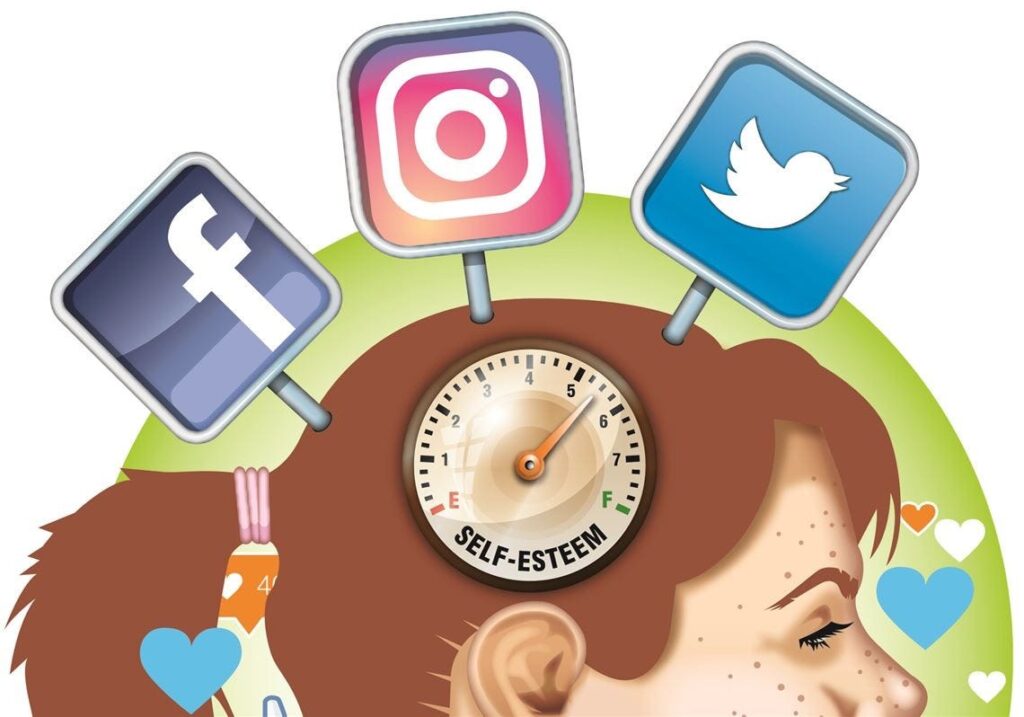
The pressure did not always come from direct comments. Sometimes it came from noticing who viewed my story, who responded, or who ignored what I posted. Social media can train people to search for validation through numbers and reactions. A person may begin to wonder why one post received more attention than another or why certain friends did not respond. Even when nobody says anything negative, the silence can still make someone question themselves. Entertainment stops being harmless when it begins controlling how a person feels about their appearance, friendships, or self-worth.

My need for validation became especially noticeable on Instagram. After posting a photo or story, I would repeatedly check the app, sometimes every few seconds, to see whether I had received any new likes or views. Instead of posting something and moving on with my day, I became obsessed with watching the numbers increase. The amount of engagement I received could affect my mood and influence how I felt about myself. If a post did not receive as many likes as I expected, I would wonder whether people disliked the photo or were judging me.
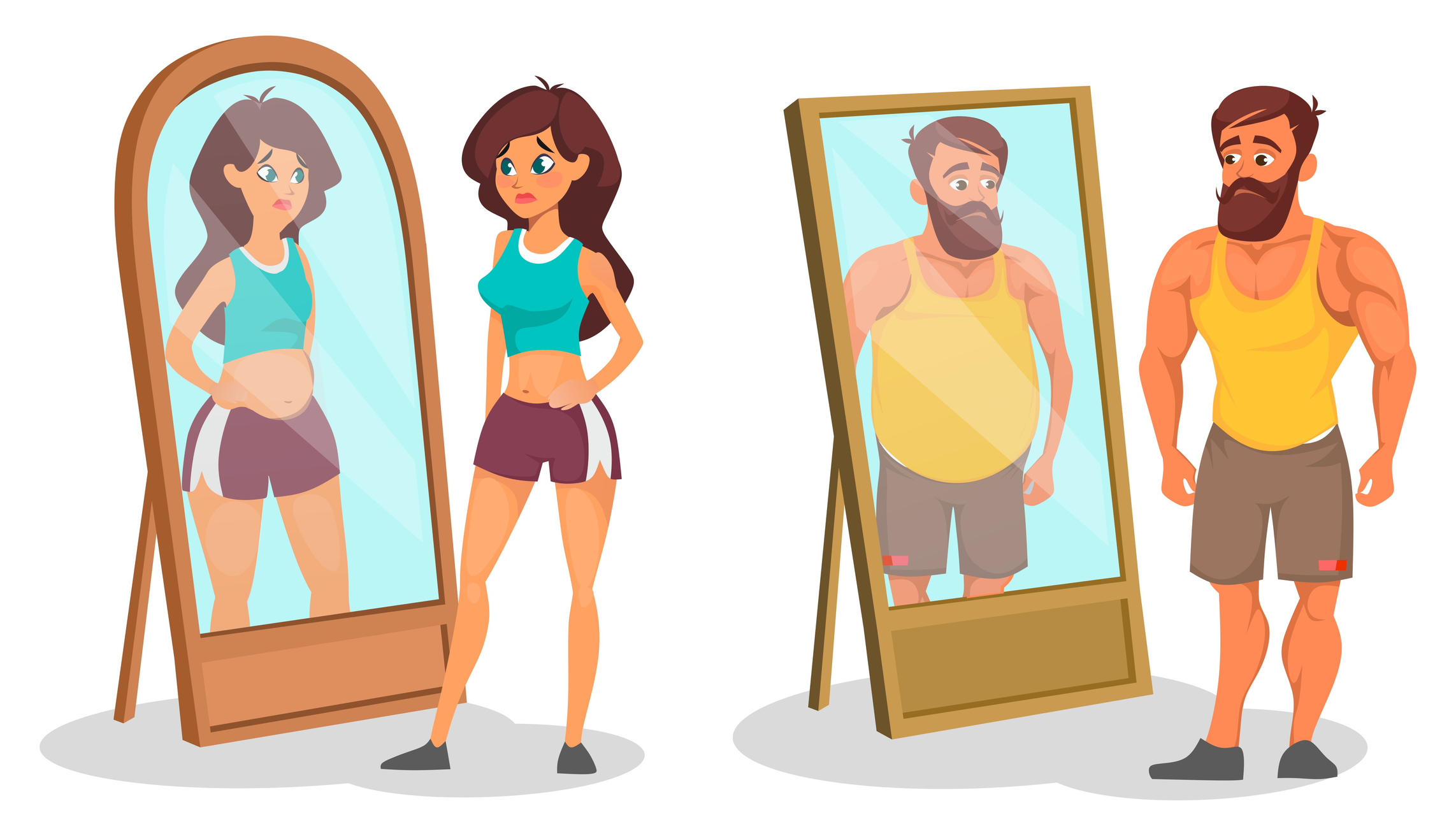
Five Questions Answered About Body Dysmorphia | University of Utah Health

I would also spend long periods reviewing my own profile and replaying old Instagram stories. Sometimes, I would look through stories from six months earlier and repeatedly stare at the list of people who had liked or viewed them. It was almost as though I was trying to relive the attention I had received during that moment. Rather than enjoying a memory for what it was, I focused on how other people had reacted to it. Looking back, I realize that I was placing too much importance on numbers that did not truly measure the quality of my life, my appearance, or my relationships.

This behavior showed me how social media can turn ordinary moments into performances. I was no longer only taking pictures because I wanted to remember an experience. I was also thinking about whether the picture was attractive enough to post, how many people would respond, and whether it would make my life appear interesting. Social media made it difficult to separate genuine memories from the desire to be seen and validated by an audience.

Social media also creates pressure to constantly show that something is happening in your life. People often post vacations, parties, relationships, achievements, expensive purchases, and exciting experiences. They rarely show the boring, lonely, uncomfortable, or disappointing parts of their lives. As a result, it can become easy to compare your complete life to somebody else’s carefully selected highlights. Even though I understood that people were only showing certain moments, seeing these posts could still influence how I viewed my own life.

Another issue was that I did not understand the importance of privacy. When I was younger, I believed that sharing everything helped people know me. As I became older, I realized that not everyone deserves access to every part of my life. Privacy is not the same as hiding or being dishonest. Privacy can be a form of protection. It gives people the opportunity to experience emotions, relationships, accomplishments, and difficult moments without immediately turning them into content.

It took me years to understand this lesson. After using Snapchat for approximately eight years, I eventually deleted it. Deleting an app that had been part of my daily routine for so long was a major decision. Snapchat had been present throughout much of my teenage life, so removing it meant changing a habit that had become normal to me. I no longer wanted to feel pressured to document every moment, maintain streaks, or constantly check what other people were doing.

Deleting Snapchat did not erase every insecurity or completely remove social media from my life. However, it helped me become more aware of my relationship with technology. I started thinking more carefully about why I was posting and what I hoped to receive from it. Was I sharing something because it was meaningful to me, or was I looking for attention? Was I enjoying an experience, or was I mainly thinking about how it would appear online? These questions helped me recognize that entertainment should add something positive to my life instead of taking control of it.

Entertainment itself is not necessarily harmful. Social media, television, movies, music, and other forms of media can help people relax, learn, connect, and feel understood. Social media can introduce people to new ideas and communities that they may not have access to in their everyday lives. It can help artists share their work, small businesses reach customers, and people stay connected across long distances. The problem begins when entertainment becomes an obsession or replaces creativity, real-life communication, and personal reflection.

Looking back, I sometimes think about the difference between painting and posting online. Painting allowed me to create something slowly and privately. Social media encouraged me to react quickly and share immediately. Painting taught me patience, while social media often encouraged instant gratification. One activity was focused on creating for myself, while the other sometimes made me focus too much on how I would be perceived by others.

This does not mean that I have to completely reject technology to reconnect with the person I was before getting a phone. Instead, I can create healthier boundaries. I can choose what I share, limit the time I spend scrolling, and remind myself that I do not need to document everything. I can also make space for hobbies that do not involve an audience. Painting, writing, walking, reading, or simply spending time alone can be meaningful even when nobody else sees them.

My experience taught me that entertainment has the power to shape a person’s habits and identity, especially when they are young. At twelve years old, I did not understand that downloading one app could influence the way I communicated, viewed privacy, and searched for validation. Now, I understand that I have more control over what I consume and what I allow other people to see.

Deleting Snapchat after eight years represented more than removing an application from my phone. It represented growth. I was letting go of the belief that I needed to constantly update other people about my life. I began recognizing that some of the most important moments do not need to be photographed, posted, or explained. They can simply be experienced.

Entertainment will always influence society, but we can decide how much influence it has over our individual lives. Social media can be a useful tool, but it should not determine our confidence or replace our sense of identity. Learning to protect my privacy and become more intentional about what I share has helped me develop a healthier relationship with the online world. I am still learning, but I now recognize that my life does not become more valuable simply because other people can see it.

Need a pastry in the morning look no further than Colombe Coffee available with your student ID for 20%

By Aaron Newman

Aaron Newman is an Education Studies major minoring in Digital Studies. Originally from Fort Lauderdale, he writes about relationships, entertainment and fashion. He also writes about the hardship and being optimistic about his struggles and looking forward to the present and future.


For over 25 years, the Campus Clipper has helped college students in New York City—and later in Boston and Philadelphia—save money and succeed in city life. We offer a digital coupon booklet with discounts on food, clothing, and services, plus an Official Student Guidebook with real advice on how to navigate college life in a big city. Our internship program lets students build skills, earn money, and publish their own e-books. Follow us on Instagram and TikTok @CampusClipper, and sign up for our newsletter to get deals straight to your inbox. To access the digital coupons, scan the QR code on our printed card—available in dorms, student centers, and around campus.

Share

How Fashion Builds Community

Wednesday, August 5th, 2026
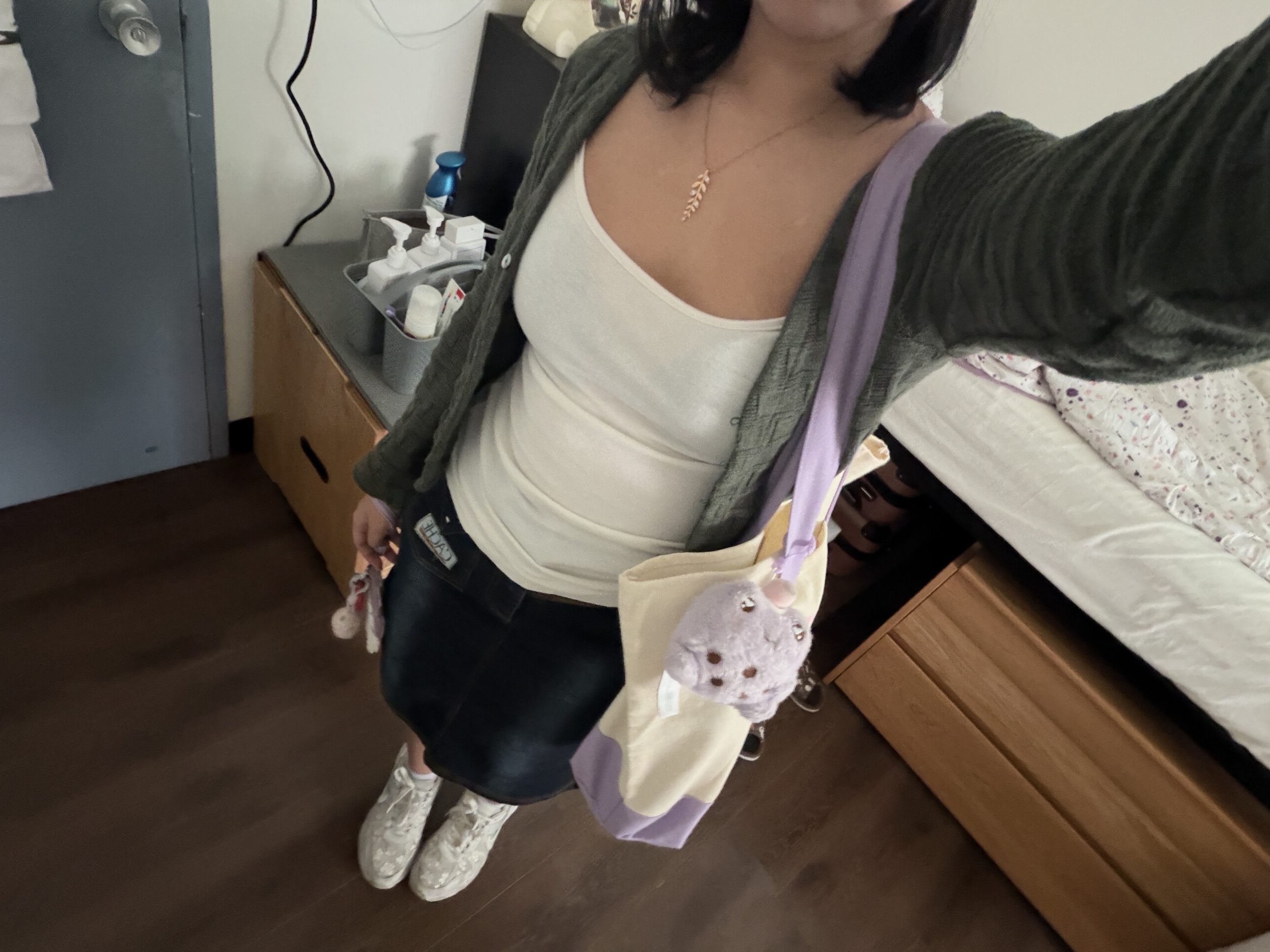
Photo By Alyssa Hong. Fit check for a grocery shopping day. Outfit details: Madwell cardigan, white tank, long jean skirt, and Trader Joes lavender tote bag.

Some may argue that clothes are a simple matter of wearing whatever is most comfortable, creating the illusion of materiality. Yet, the opposite can too be true. 

When the wearer chooses items based on color, shape, or design, they are often signaling something underlying. Baggy to flowy to fitted — the fit of clothes becomes an identity expression. Choosing to be comfortable tells society that you care little about what it thinks because you prefer being flexible, but in contrast, wearing skin-tight clothes can have the same effect. This is because the perspective is all about the person wearing the clothes: how they perceive themselves in relation to others and vice-versa. 

At my women’s college, fashion conveys what words cannot. Electric pink hair might mention someone’s desire to tell the world how lame it is to fit into boxes. Tuscan-style with chunky belts and cowboy boots arm people with a no-so-secret desire to travel (the pursuit of the most curious or adventurous types of people). Even things like the choice of loafers over sneakers could communicate someone’s desire to follow their own modesty or serious nature. 

Take, for instance, myself. I am not shy to admit that I am a transformer, always trying different styles and colors. On days when I wish not to be perceived, blending in with my own understanding of mundanity, I will wear baggier clothes with much simpler cuts, designs, or no frills at all. No make-up is automatic. Call it basic if you will. However, on days when I want to experiment and express my displeasure, the color black becomes instant. Coloring very closely to my water line, my eyeliner is smudgy, smokey, and sharp. Structure is one of the easiest ways I express my desire to curse society. Fitted tops with black lace and dark wash jeans reflect my rage and revenge, taking back my own body and face. 

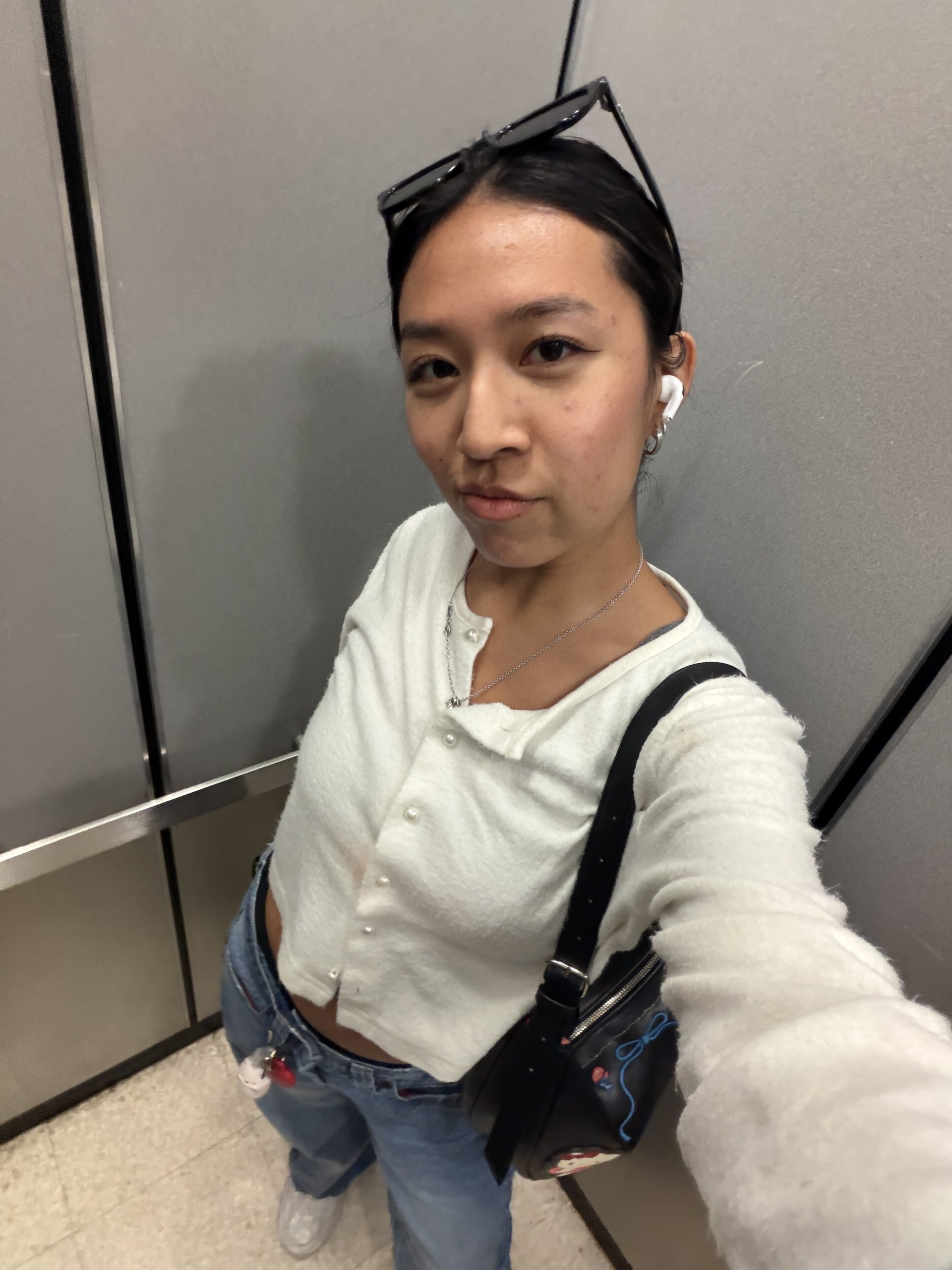
Photo by Alyssa Hong. Another fit check. Outfit details: white cardigan, sunglasses, Hello Kitty bag, BDG jeans.

I may be a shape shifter, but that’s what makes community easy to find. Because of my interest in multiple aesthetics, shifting through people in search of belonging becomes that much clearer. I learn from people’s experiences, backgrounds, and interests through what they wear, where they shop, and which pieces are their favorite. 

Monica wears high quality pieces, unafraid of dirt but takes care of them. This not only tells me that she values the clothes’ materials, but maintains them through her sheer effort. Her lack of fear for ruining her clothes reminds me that she is here to live life through and through. She might seem picky but she is stating her unwillingness to be held back by society and never waits for the “right” moment. She is brave and determined beyond doubt. 

Kylie has an alternative style with flowy lace and an array of dark to bright colors. Her rejection of mainstream politics is truly evident in her taste. Sometimes though, you can find her in more comfortable hoodies or sweaters overtop a long white skirt. Her whimsical nature gently appears in these moments. She is persistent and sometimes unyielding but always knows where to put her energy and admit where she might find fault. 

Irene loves green and she tends to lean towards more comfortable clothes with a loose fit. She is very understanding and politically active. Her charm comes from the middle of the week when her STEM courses overload her mind, leaving her with no minute to spare. She is resilient and always adapts, sometimes not too easily. She is her own critic; yet, she is rare to criticize others. 

From asking where people get their clothes to simply shopping together, fashion has this innate ability to create bonds for people like an underlying signal of likeness. Subconscious choice transforms into purposeful expression; that way we show who we are to others and receive a response. Oftentimes, our expression brings us to become part of a larger collective like music in a way. 

Thus, our clothes become demonstrative symbols of us differentiating ourselves in a sea of 8 billion people; yet, we all learn to belong somewhere, somehow. 


Having a craving for tacos? Use this coupon at Cafe Habana to save on your craving!

By Alyssa Hong

Alyssa Hong is a rising Junior at Barnard College, studying Political Science with a minor in English. As a first-generation, low-income student, she writes about moving across the country for college and its adjustments. She utilizes entertainment, wellness/health/food, and fashion/beauty as methods to making new connections with others whilst always learning.


For over 25 years, the Campus Clipper has helped college students in New York City—and later in Boston and Philadelphia—save money and succeed in city life. We offer a digital coupon booklet with discounts on food, clothing, and services, plus an Official Student Guidebook with real advice on how to navigate college life in a big city. Our internship program lets students build skills, earn money, and publish their own e-books. Follow us on Instagram and TikTok @CampusClipper, and sign up for our newsletter to get deals straight to your inbox. To access the digital coupons, scan the QR code on our printed card—available in dorms, student centers, and around campus.
Share

Preparation for Life Beyond: An Interview with Elliott

Tuesday, July 28th, 2026

One thing college students are familiar with is worrying about how they will navigate life after graduation. And no matter how far away you are from the commencement ceremony, it is likely that the more conversations you strike up with your peers, the more clear it will become how many of us are silently panicking that we won’t fare well once we no longer have our studies to fall back upon.

Being two years away from the finish line, I’m wrestling with these questions too. So to gain some insight into postgraduate life, I decided to interview my friend Elliott, who just graduated from California Baptist University with a degree in studio production this past May.

I asked him five questions relating to how college prepared him for life beyond and what his experiences so far have taught him about taking the first steps as a degree-holding, full-time working adult.

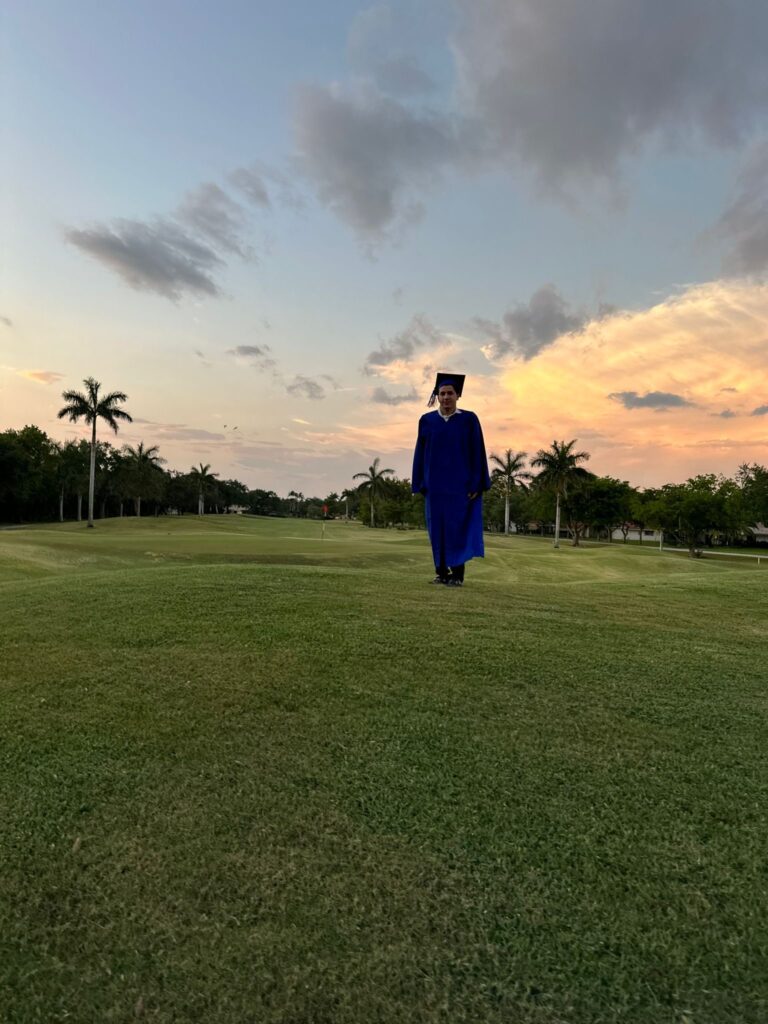
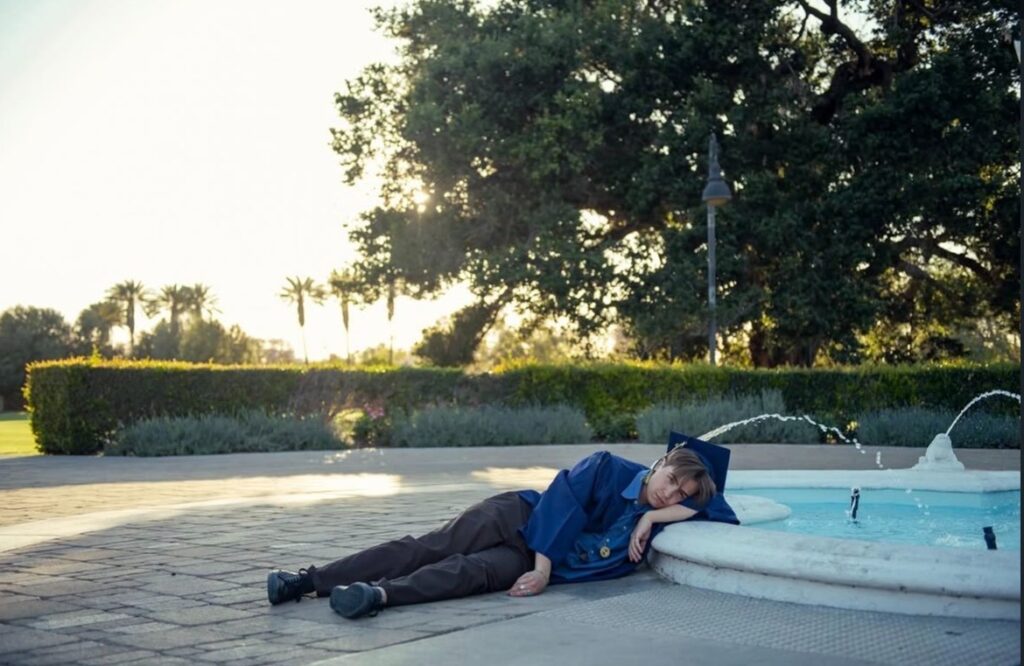
From Elliott’s graduation Instagram post

Firstly, he described for me the difference between what he envisioned post-grad life to look like and what it actually feels like for him right now. He shared that, “currently, [his] job was not something that [he] had even considered while [he] was in school.” He knew that there were people who worked within his current specialty but hadn’t viewed the position as a serious option for himself based on his major. So taking a more critical perspective on the college experience, he shared about his realization that “much of what [he] did in school was also to benefit the university and not just to benefit [his] future career.”

His advice to current college students further emphasizes recognizing that universities are as much institutional edifices with their own interests to protect as they are support systems for students. He explained that students must learn to “stand up for [themselves] because, while [their] school is looking out for [them], it’s mainly looking out for itself.”

Despite his distrust in the diploma enterprise, I wanted to know what skills and knowledge he acquired as a student that happened to unexpectedly be of value, and for Elliott that happened to be a bias for action. Most of us have experience procrastinating on an assignment until the very last minute, and good news: that may actually work out in your favor later.

Like Elliott’s, one of your future jobs may involve being delegated high-priority, time-sensitive tasks with little to no notice, and handling the situation will require knowing how to work efficiently under pressure—a skill well-developed by due-at-midnight papers being put off until three in the afternoon the same day. However, you probably shouldn’t use that as an excuse to put off your papers.

As for acclimating to adulthood, Elliott identified one critical learning curve that he’s navigated within the past two months and a couple ways he’s measuring growth now that the external metrics of academia have fallen away. 

He illustrated how the post-graduation employment process exposed him to more opportunities for rejection, saying, “I didn’t really apply to that many jobs while I was in school, and the ones that I did apply to, almost everyone was hired.” So while he had experience being ignored by employers, he wasn’t familiar with being directly informed that a hiring team wasn’t interested.

But he’s managed to find ways to determine what advancement means for himself. He recommends determining one’s personal goals—relational, financial, and the like. Often, these have no objective means for measurement, allowing space for achievement to be defined by the goal-setter.

However, Elliott also suggests that new graduates invest time and energy in their hobbies outside of work. He has frequently found them to be “more fulfilling” than a potentially monotonous day-to-day job by allowing himself to create various opportunities for engaging his creativity and reaching the point of “a finished product that [he] can look at and feel self-rewarded for.”

So as you prepare for life beyond your degree, keep in mind the lessons Elliott’s learned thus far: Be assertive and don’t be hesitant to ask for the support you need. Develop the skill of adaptability for when you face unplanned demands, disappointments, and setbacks. Look for fulfillment beyond your career, and, “Don’t worry so much about your future because things are going to fall into place.”


Looking to turn trying new foods into a hobby? Get started at Café Habana with this student deal!

By Lauren Gascon 

Lauren Gascon studies Media, Culture, and Communication at NYU and enjoys discussing people’s relationships with each other and themselves. When she’s not on campus, you can find her café hopping, browsing bookstores, or enjoying lunch in one of New York City’s many beautiful parks.


For over 25 years, the Campus Clipper has helped college students in New York City—and later in Boston and Philadelphia—save money and succeed in city life. We offer a digital coupon booklet with discounts on food, clothing, and services, plus an Official Student Guidebook with real advice on how to navigate college life in a big city. Our internship program lets students build skills, earn money, and publish their own e-books. Follow us on Instagram and TikTok @CampusClipper, and sign up for our newsletter to get deals straight to your inbox. To access the digital coupons, scan the QR code on our printed card—available in dorms, student centers, and around campus.

Share

So Good Coffee and Bleecker Street

Tuesday, July 28th, 2026

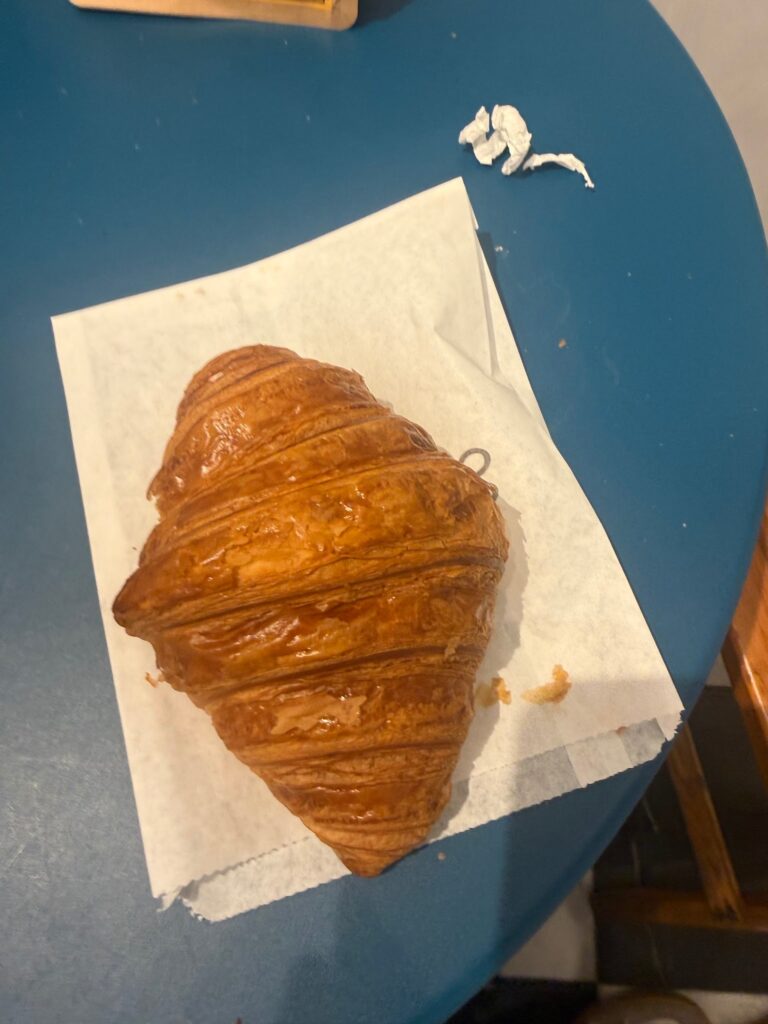
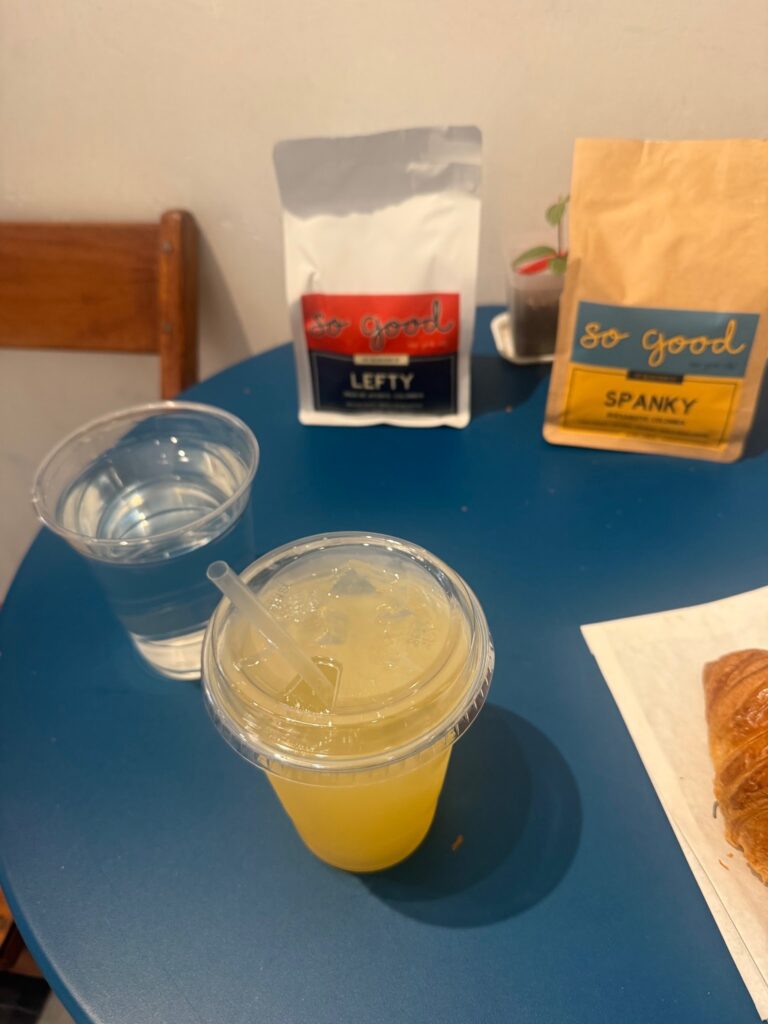
I was recommended by a friend to visit So Good Coffee on Bleecker Street on one of the most lively, bussing blocks in the city filled with incredible restaurants. As soon as I entered the establishment I was greeted with kindness and warmth by the owner George and his co-worker. I ultimately chose the french croissant and drank lemonade and water. 

I’m someone who isn’t always eager to walk far to places but I enjoy taking strolls. It took me 24 minutes from my apartment to walk over to the place. I find it soothing to walk around in such a vibrant city like New York City. I was able to enjoy my meal and be in my own thoughts. 

Also, I got this lemonade which I find to be way healthier than soda, non-natural juice. The taste of this lemonade was strong and sweet but found it to be healthy for me personally because I didn’t get stomach aches from drinks. Also got cold and fresh water which helps smooth my skin and overall improves my health. 

Overall, I had an excellent time at So Good Coffee. I recommend this place to everyone I know and would recommend myself to come back here and take a walk there. The employees were so kind and understanding.

Share

Sweet Suite: College Dinners

Tuesday, July 21st, 2026

At the end of Freshman year, the uncertainty brewed. As housing groups were made, betrayed, and dissolved, I had not made friends with many that I would have been comfortable housing with so I decided on the alternative: entering the automatic random placement where the school would place me into an open leftover spot. My plan continued until one of my best college friends, Monica, said that there was an open spot in her group and I would be guaranteed a single. Being in a single my first year was lucky, but being in a single again seemed like my lucky fortune was in order. Everything seemed perfect, yet I was uncertain because I knew nothing about the people I was to live with for the next year. 

I only briefly met my suitemates during one housing group meeting, but not nearly enough to know if I would likely get along with or be friends with all of them. Coping, I told myself that my room would be my safe haven for sleep and that I might rarely ever see them anyway. That was until I moved in. 

Suddenly, these people I had never known before invited me to their birthdays and hangouts. Their efforts to include me were never in vain as I always tried my best to show up and spend more time with them. I learned so much about these people through their living habits, hobbies, interests, etc. Each person was either introverted or extroverted, interested in K-pop or anime (or both), or were an early riser or a night owl. Their habits contributed to learning who they were as people, and our dining table became a staple place for conversation. 

At the table, we all hovered over our laptops and made idle chit chat. Soon, we played games here. Eventually, we hosted dinners here. 

Respect, courtesy, and friendship — the people I had been so overcome with anxiety to live with were some of the sweetest peers known to mankind; thus, we called ourselves ‘sweet suite’. As school started, we began to do what college students do: neglect social life, neglect our academics, neglect our health, or two of the three. Whenever we did see each other, it was the usual question of:

“How was your day?” 

The answer oftentimes was a combination of busy, tired, and stressed with any variable of academic work, career pressure, and emotional turmoil; yet, venting to one another got all of us through some of the roughest days. But as a small token of thanks to the kind people that let me into their circle, I decided to help host a thanksgiving dinner alongside Monica. 

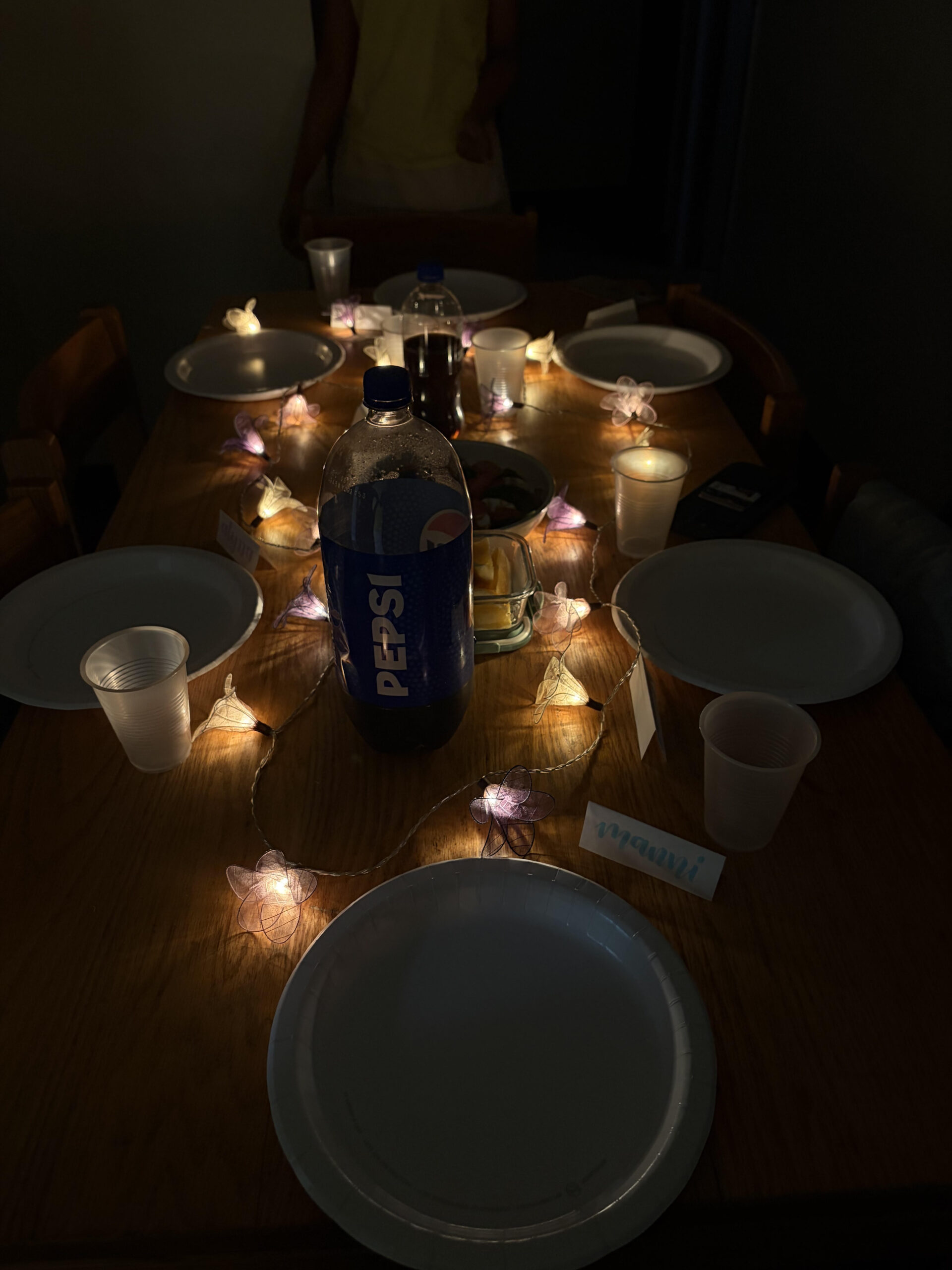
Photo by Alyssa Hong. Sweet Suite’s Thanksgiving dinner set up at the table with fairy lights and plate settings.

Running to Trader Joes in the early morning, we went through the aisles looking for items on our grocery list. Cheeses, vegetables, and protein choices to reflect everyone’s dietary restrictions. Then Monica and I began working on the beef stew in the cramped kitchen that was uniquely ours. 

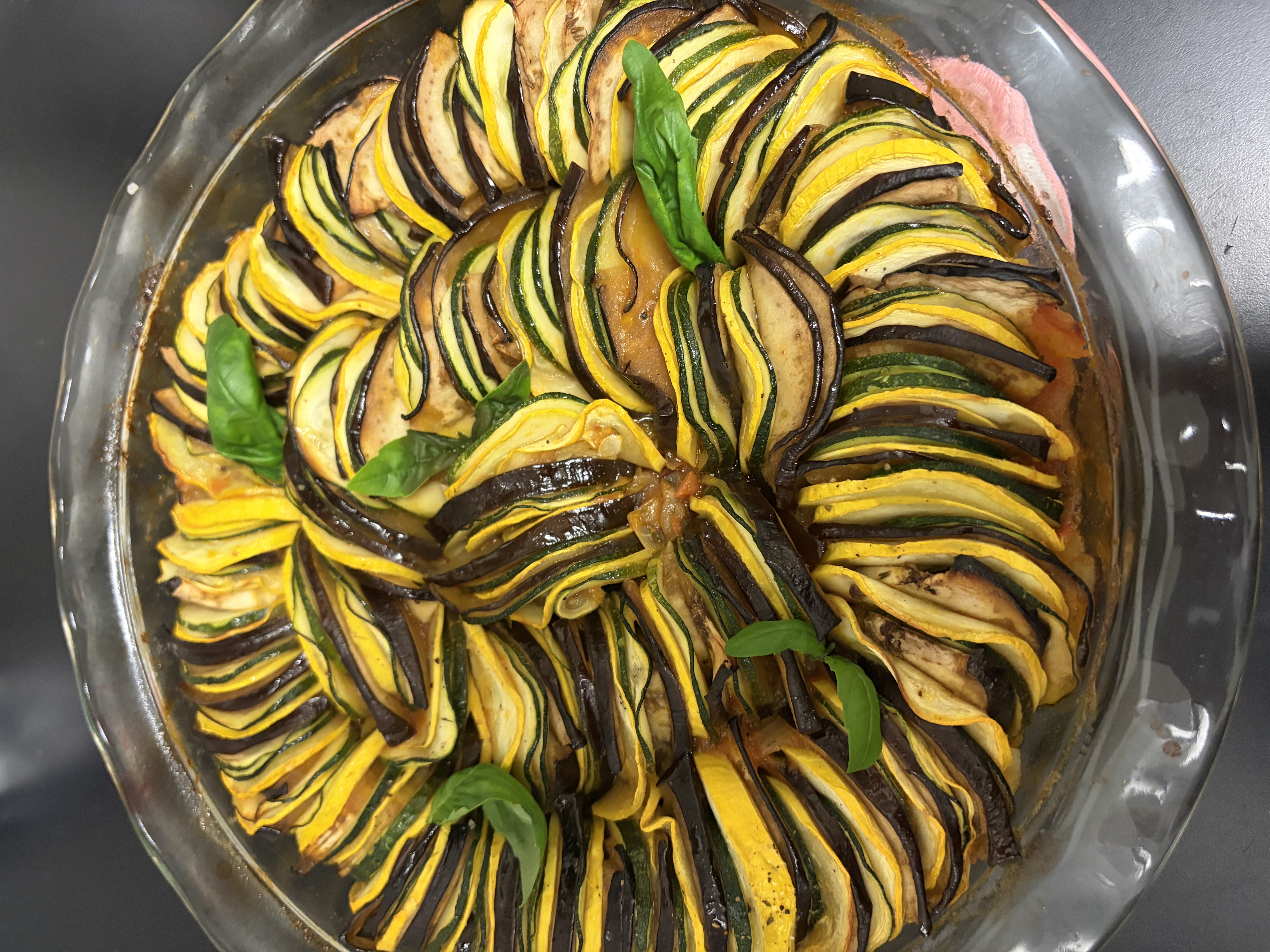
In a steel pot, Monica began cooking the beef until tender and creating an aromatic stew that filled the suite with a sweet, yet savory scent. Chopping away, my hands were busy making the ratatouille by thinly cutting the veggies and placing them neatly in a spiral against the glass container. Our vision came to life as our suitemates chipped in by putting together the salad and peeling pearl onions. 

Sweat on our foreheads, yet we were victorious. Thanksgiving dinner emerged after hours of our hard dedication and sore hands. Faint warm lights lit the table, our nametags marking our designated seats, and our plates of food waiting to jump straight into our stomachs. Around this table, we joyously discussed our plans for the upcoming break, where we would be, and what we were thankful for. Smiles erased the memory of our worst days throughout the semester, replacing them with the warmth of each other all in the same space. 

Photo by Alyssa Hong. Our homemade ratatouille after it came out of the oven.

Feeling full, I realized that my being was full of gratitude for the connections I fostered and everything I learned from the uncertainty I originally felt to the journey of friendship I ended with. With each day I lived in this suite, I learned something new about each and every person that I lived with. Something about their interests, religion, hobbies, philosophies, politics, you name it. Our little dinners, conversations, and game nights ignited a new found appreciation for our differences and similarities that all led us to the same place, at the same time. 

Thus, thankful cannot fully describe that sweet suite has left me with. 


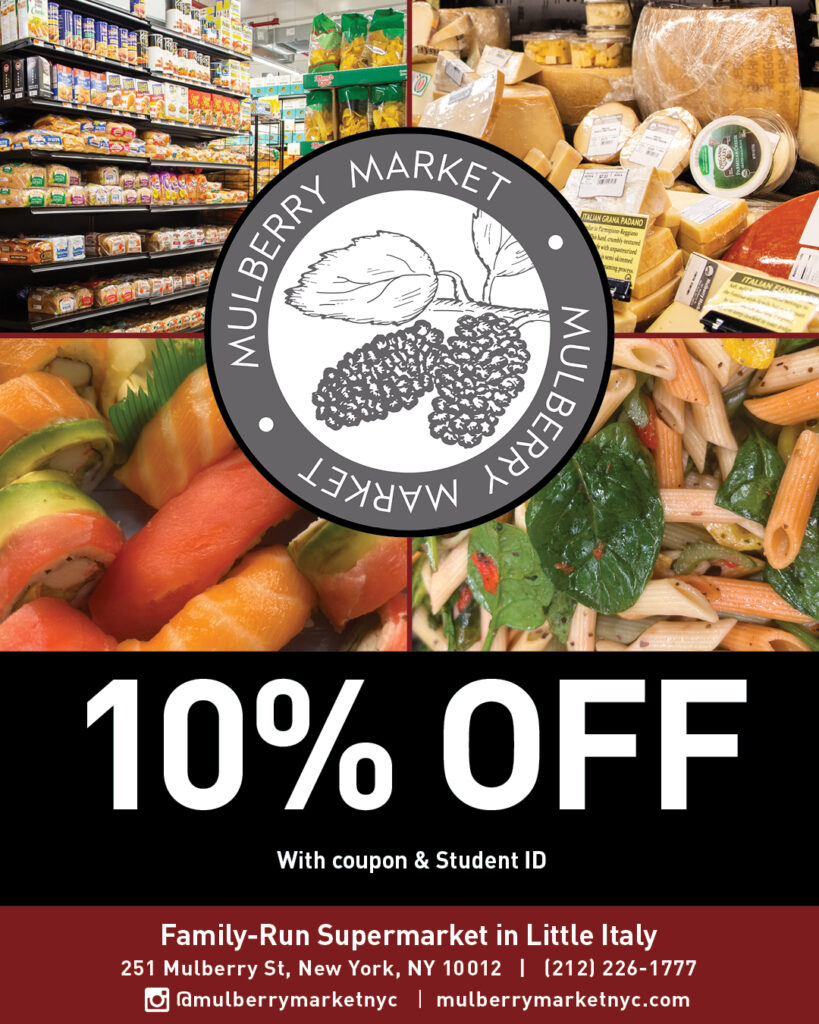
Looking to make a homemade meal or just grab groceries? Use this coupon at Mulberry Market to get 10% off your items!

By Alyssa Hong

Alyssa Hong is a rising Junior at Barnard College, studying Political Science with a minor in English. As a first-generation, low-income student, she writes about moving across the country for college and its adjustments. She utilizes entertainment, wellness/health/food, and fashion/beauty as methods to making new connections with others whilst always learning.


For over 25 years, the Campus Clipper has helped college students in New York City—and later in Boston and Philadelphia—save money and succeed in city life. We offer a digital coupon booklet with discounts on food, clothing, and services, plus an Official Student Guidebook with real advice on how to navigate college life in a big city. Our internship program lets students build skills, earn money, and publish their own e-books. Follow us on Instagram and TikTok @CampusClipper, and sign up for our newsletter to get deals straight to your inbox. To access the digital coupons, scan the QR code on our printed card—available in dorms, student centers, and around campus.
Share

Food, Culture & Experiences

Monday, July 20th, 2026

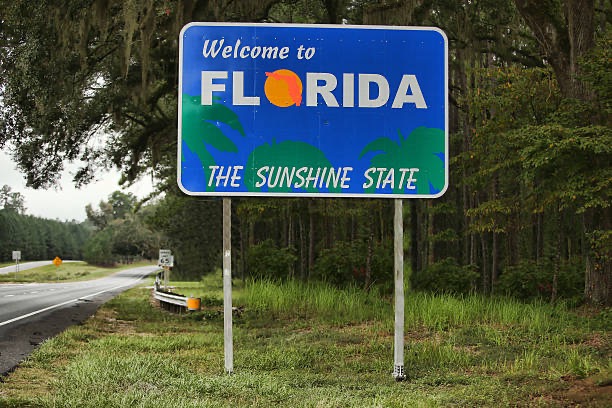
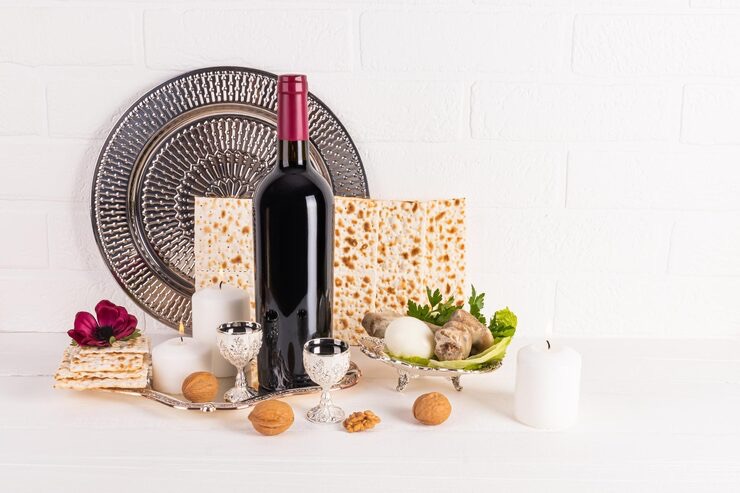
One holiday that always stood out to me was Rosh Hashanah, the Jewish New Year. It was a time of reflection, fresh beginnings, and spending time with family in South Florida. We would gather around the dinner table and enjoy symbolic foods that represented our hopes for the year ahead. Apples dipped in honey symbolized the wish for a sweet new year, while other traditional foods reminded us of the importance of gratitude and self-improvement. Although I didn’t fully understand the significance of these traditions when I was younger, I appreciated the opportunity to be surrounded by family and celebrate together. As I have grown older, I have come to realize that these traditions were not only about religion but also about creating memories that continue to stay with me years later.

Hanukkah brought a different atmosphere into our home. Each evening we lit another candle on the menorah until all eight candles burned together on the final night. The warm glow of the candles became a familiar sight throughout my childhood. Family members gathered together, shared meals, and celebrated traditions that had been passed down for generations. Like many children, I looked forward to the excitement surrounding the holiday, but looking back, I recognize that the greatest part of Hanukkah wasn’t the gifts or celebrations—it was the time spent together. Those evenings reminded me that traditions often become meaningful because of the people we share them with rather than the customs themselves.

Food was always at the center of these celebrations. Every holiday had its own dishes, each carrying a story that connected us to generations before us. As a child, I simply enjoyed eating the meals that appeared on our table. I rarely stopped to think about why certain foods were served or what they represented. It wasn’t until I became older that I realized recipes often survive much longer than memories. A single dish can preserve a family’s history, connect children with grandparents, and keep traditions alive even after people move across the world.

Growing up in a kosher household also taught me to pay attention to food in ways many of my friends never had to. Going out to eat wasn’t always as simple as choosing the closest restaurant. My family often researched restaurants in advance or planned meals around places that followed kosher dietary laws. Grocery shopping meant looking for kosher certification on products, something that became second nature to me. At school or birthday parties, I occasionally noticed that my meals looked different from those of my classmates, but because this lifestyle was all I had ever known, I rarely questioned it.

As I became older, I began to understand that every culture has its own traditions surrounding food. Some families avoid certain ingredients because of religion, others prepare meals based on centuries-old customs, and many recipes have been passed down through generations. What once felt unique to my own upbringing slowly became something I noticed everywhere I traveled. Although the specific foods changed from country to country, the reasons behind them often remained surprisingly similar: celebrating important moments, bringing families together, and preserving cultural identity.

Being raised by a mother who immigrated from the Middle East also shaped my understanding of culture in ways I did not fully appreciate until adulthood. Our home reflected influences from two different parts of the world. While I grew up in South Florida surrounded by American culture, my family’s traditions reminded me that our history stretched far beyond the United States. Through family stories, recipes, and celebrations, I learned that immigration is not simply about moving from one country to another. People bring their customs, values, languages, and traditions with them, creating a bridge between the past and the future.

As I started traveling, I found myself becoming more curious about the stories behind the meals I encountered. Instead of simply asking whether food tasted good, I wanted to understand where it came from. I found myself wondering why certain ingredients were common, how recipes had evolved over time, and what role those dishes played within local communities. Visiting another country became more than checking famous landmarks off a list—it became an opportunity to better understand the people who lived there.

One of the biggest lessons travel has taught me is that food serves as a universal language. Even when people speak different languages or come from different backgrounds, sharing a meal creates an opportunity to connect. Sitting around a table encourages conversation, storytelling, and hospitality in ways that few other experiences can. Some of my favorite travel memories are not necessarily tied to famous attractions but to the restaurants, cafés, markets, and family-owned businesses where I experienced a country’s culture through its cuisine.

Travel has also encouraged me to become more open-minded. Growing up, I naturally viewed the world through the lens of my own experiences. Visiting new places challenged those assumptions and introduced me to traditions that were completely different from my own. I learned that no single culture has all the answers. Instead, every community has developed customs that reflect its history, geography, beliefs, and values. Experiencing these differences firsthand has helped me become more understanding and appreciative of perspectives beyond my own.

Looking back, I now realize that my childhood prepared me for this curiosity long before I ever boarded an airplane. Growing up surrounded by religious traditions, cultural celebrations, and family recipes taught me that food has always been about much more than satisfying hunger. Every meal carries a story, every tradition reflects a community’s history, and every shared table offers an opportunity to learn something new.

Today, whenever I travel, I try to approach each destination with curiosity rather than expectation. I enjoy trying local specialties, learning the stories behind regional dishes, and observing how food brings people together. These experiences have deepened my appreciation not only for the countries I visit but also for the traditions that shaped my own upbringing. Although my perspective has evolved over time, I remain grateful for the values my family instilled in me. They taught me that understanding another culture often begins with something as simple as sitting down, sharing a meal, and listening to the stories that accompany it.

Are you looking forward to eating something nutritious? Well look no further, Try The Halal Guys when showing your student ID for 10% off. 

By Aaron Newman

Aaron Newman is an Education Studies major minoring in Digital Studies. Originally from Fort Lauderdale, he writes about relationships, entertainment and fashion. He also writes about the hardship and being optimistic about his struggles and looking forward to the present and future.


For over 25 years, the Campus Clipper has helped college students in New York City—and later in Boston and Philadelphia—save money and succeed in city life. We offer a digital coupon booklet with discounts on food, clothing, and services, plus an Official Student Guidebook with real advice on how to navigate college life in a big city. Our internship program lets students build skills, earn money, and publish their own e-books. Follow us on Instagram and TikTok @CampusClipper, and sign up for our newsletter to get deals straight to your inbox. To access the digital coupons, scan the QR code on our printed card—available in dorms, student centers, and around campus.

Share

The Value in It All: An Interview with Grace

Thursday, July 16th, 2026

A major part of growing older and becoming your own person is developing your own values and witnessing them transform over time. But while in college, one of the major challenges you may face is understanding what your guiding beliefs are and how to respond when they are challenged. No matter your background, once you find yourself separated from your home community—regardless of whether that’s by distance or by atmosphere—you’ll have to decide: According to which principles do you intend to live your life?

To help other “becoming” individuals reflect on how to determine which values are truly their own, I spoke with my friend Grace, a rising junior at California Baptist University who is as intrigued by discussions on belief as she is devoted to her own.

Grace and I grabbing coffee together in our hometown

She described the core principles that guide her life. The first she named “Optimism” and expanded, saying, “I like to think that I try to find the best in every situation and every person I come across…I think life is more enjoyable for you and for those around you when you choose to work through hardships with a little hope.”

She shared the verse 1 Corinthians 13:3-7, “Love bears all things, believes all things, hopes all things, endures all things.” Grace elaborated on how she aims to align her interpersonal approach with this verse, saying, “I don’t do any of these things perfectly, but I think it’s important to remember when we meet people… Seeing the best in people not only gives me a brighter outlook on life but can also help someone to know that someone else believes in them and wants them to be good… We should hope that tomorrow we can all be a little bit better than yesterday.”

Secondly, she mentioned minding this mantra: “Life is what you make of it.” She discovered its prevalence in her life through a comparison of her high school and college sophomore years. She explained, “My sophomore year of high school was very difficult… Coming into my sophomore year of college… Something about “sophomore” held a looming gloom about it.” But she remembered her mantra, and despite still experiencing a lot of difficulty, she realized that “the difference between high school and college was gaining the mindset that every experience holds something that we can benefit from.”

Sharing how her principles influence her perspective on the college experience, she illustrated the significance of paying attention to the people around you. She shared that “coming into college [she] kept to herself. Then, [she] met someone who just talked to everybody… And every time, without fail, that stranger walked away feeling so special, cared about, and heard… [She] saw how happy it made other people and how happy it made him.” So she adopted this particular interest in others and described it as “one of the best decisions [she] makes every day.” She learned to look beyond her academic focuses because “intentionally loving people doesn’t take away from [her] scholastics.”

To touch on areas that may be more difficult for students to navigate, I asked Grace to walk me through how she aligns her time with her beliefs. She explained that it’s about having a clear perspective of one’s values. For Grace, “her faith is first, so no matter what the day holds or how late it is, she makes sure it gets the time it deserves.” Then, she prioritizes spending time with other people and has found “having one-on-ones in coffee shops to be one of [her] favorite things to do ever.” Despite her fears that there may be awkwardness or that she may not even see the other person again, “[she] has never regretted it.”

As for standing by her convictions, Grace has come to “love putting [herself] in positions where [she] gets to listen to people [she] disagrees with.” She explained, “I’m very confident in what I believe, and so are other people, and I want to know why.” 

Of course, on the other hand, there’s the pressure to conform when it feels like you’re not on the same mental, emotional, or spiritual page as your peers. But Grace remembers that “when the courage for [her] convictions is from God, they are at their strongest.” She knows that “avoiding conforming isn’t easy, and [she] fails all the time…[but] something that gives [her] courage is that Jesus completely understands [her], always…[She] fails, and He picks [her] up and lets [her] try again and again.”

So regardless of your specific faith, spiritual, philosophical, or ideological bearing, if you’re looking to live more in tune with your convictions, take Grace’s advice. First, “decide what your values are” and determine their source. “Then, think: How can I put this into action? And do it.”


Do you value exploring the local food spots in your area?  Check out this 15% off student coupon at Love Mama!

By Lauren Gascon 

Lauren Gascon studies Media, Culture, and Communication at NYU and enjoys discussing people’s relationships with each other and themselves. When she’s not on campus, you can find her café hopping, browsing bookstores, or enjoying lunch in one of New York City’s many beautiful parks.


For over 25 years, the Campus Clipper has helped college students in New York City—and later in Boston and Philadelphia—save money and succeed in city life. We offer a digital coupon booklet with discounts on food, clothing, and services, plus an Official Student Guidebook with real advice on how to navigate college life in a big city. Our internship program lets students build skills, earn money, and publish their own e-books. Follow us on Instagram and TikTok @CampusClipper, and sign up for our newsletter to get deals straight to your inbox. To access the digital coupons, scan the QR code on our printed card—available in dorms, student centers, and around campus.
Share

Wandering Bookstores

Tuesday, July 14th, 2026
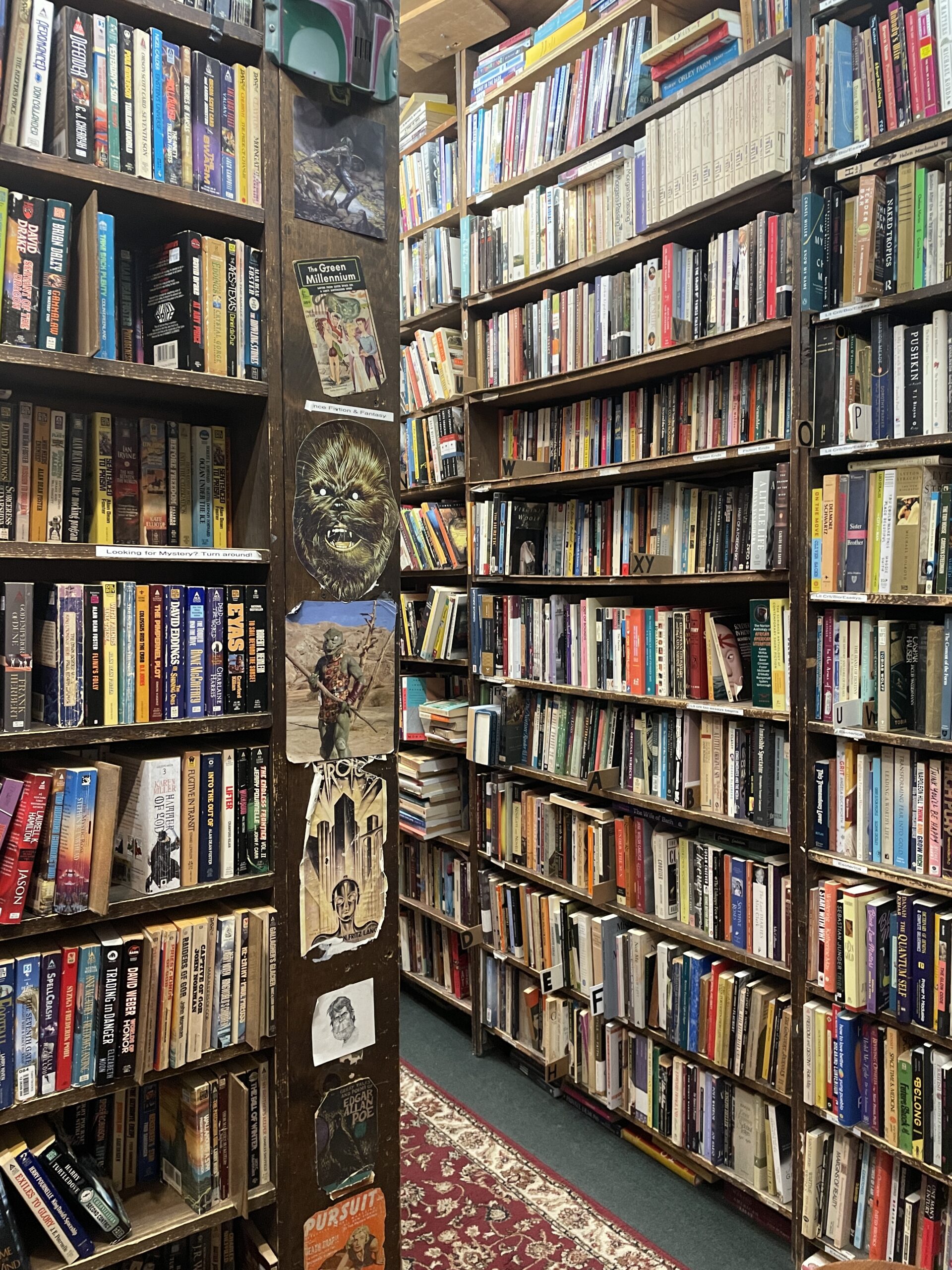
Photo by Alyssa Hong. This picture is of the used/rare book store in the Upper West Side!

Hands brushing the pages of books, I am perusing the discounted books on the cart outside the store one by one. Sunshine lights up the pages, wilting the older novels while guiding my eyes towards my next adventure. Thin edges are pinched by my fingers gliding to the next page. Bookstores are my favorite venture. 

We are in Soho — Monica and I had a great Thai lunch at Fish Cheeks, our favorite restaurant, and soon wandered the streets with our stomachs filled. As we exit Bond Street, we wander towards Prince Street to hit our most favorite bookstore: McNally Jackson. Opening the heavy glass door, our eyes flash to rows filled with books of many genres and stories. I look at her, she looks at me, and we lose each other in an instant. 

In the very front are the most popular books, I begin my quest here. Names I have heard before, some I have not, pique my interest in art, literature, philosophies, etc. Stories of immigrants hold my sight longer than the rest. Most of all, my horrible habit from childhood continues to dictate my adulthood: judging books by their cover. If the cover is not what I deem pretty, I will not even think about picking it up. Even in my college life, I have perpetuated this routine. So while I walk towards the center aisle of popular books looking for the aesthetically pleasing covers, Monica is browsing all the economics, math, and psychology books.

Our personalities and interests take form in our choices very clearly. She is highly analytical whereas I am very hypothetical. I have learned her focus on consumers, business markets, and all the in-betweens. She picks up books about game theory, talks about her future in finance, and shows up to all the networking events. I have learned to understand how she thinks. She uses her calculator to check prices and find the best deals. Her choices in which books she chooses shows it all. While these genres or types of books are often the ones I see her sitting down to read, sometimes she partakes in mystery. Problem solving is like second-nature to her. 

Finding the bench in the cooking section, Monica is, yet again, reading a consumer psychology book. I am holding a James Baldwin book, debating on my purchase. The lights are hitting her silhouette like a perfect picture — legs crossed, head planted in the book, and eyes following each line. With each step towards her, my mind cannot decide to interrupt her thinking or to let her carry on while I make another round throughout the store. Ultimately, I sat down next to her and opened the book to start reading. 

Here we are reading in McNally’s. It is a perfect day. Our stomachs full of delicious food to keep us fueled for the next day, the sky so clear, and us diving into our literature choices. Unbeknownst to us, three hours go by. Our ignorance to the time is blissful. We forget for a couple hours of the concerns that bother us back to reality. We travel into an alternate fictional reality that captures us for the day. 

Only when the sun begins to set do we realize how we lost track of time. Monica is tapping my book, only enough to gain my attention and not enough to startle me. Our eyes met; I know our time has come. Closing our books, I inquire about her book. 

“Is it any good? Are you gonna buy it?” 

“Yeah, it’s about consumer psychology. It tells me a lot about what people think when they are purchasing things and how it reflects in the markets.” 

Most of the time it is not as simple as this, but every time I learn something new from her about her interests. Sometimes I have no clue what she is talking about despite her dumbed down explanation. Never do I not learn something and connect with her in a new topic. 

If you ever need a stroll, wander in a bookstore — your next venture awaits you. Most of all, take a friend because you will have something to connect about and learn more about. You can learn so much about a person by discussing the type of literature they read or don’t read.


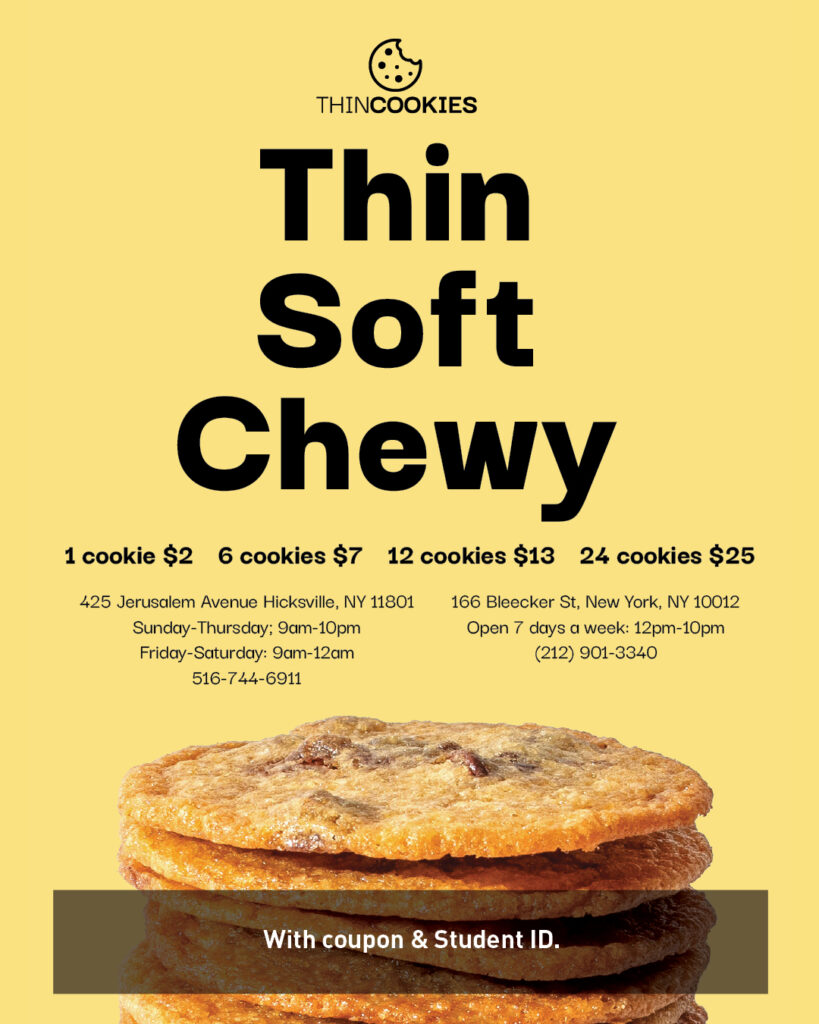
Wandering around always includes time for sweet treats. Use this discount to grab some thin cookies for your next adventure!

By Alyssa Hong

Alyssa Hong is a rising Junior at Barnard College, studying Political Science with a minor in English. As a first-generation, low-income student, she writes about moving across the country for college and its adjustments. She utilizes entertainment, wellness/health/food, and fashion/beauty as methods to making new connections with others whilst always learning.


For over 25 years, the Campus Clipper has helped college students in New York City—and later in Boston and Philadelphia—save money and succeed in city life. We offer a digital coupon booklet with discounts on food, clothing, and services, plus an Official Student Guidebook with real advice on how to navigate college life in a big city. Our internship program lets students build skills, earn money, and publish their own e-books. Follow us on Instagram and TikTok @CampusClipper, and sign up for our newsletter to get deals straight to your inbox. To access the digital coupons, scan the QR code on our printed card—available in dorms, student centers, and around campus.
Share

Study Skills and College Life

Friday, July 10th, 2026

As someone who used to struggle with study skills in high school, especially when preparing for AP exams, I often questioned my own abilities. Looking back, I realize that I wasn’t unintelligent I simply hadn’t yet learned how to study in a way that worked for me. At the time, however, it was easy to believe that my grades reflected my worth. That mindset and my self-esteem made me doubt whether I was capable of succeeding academically.

European Library

I was the type of student who usually did okay while in high school, but my performance often depended on how overwhelmed I felt. Before a major exam, I would spend hours stressing about what I didn’t know rather than focusing on what I had already learned. Sometimes all of that effort paid off, and I passed with a grade I was proud of. Other times, despite studying for hours, I still failed or performed below my expectations. Those moments were discouraging, but they also became part of my journey. Failure was never the end of my story—it became an opportunity to learn, grow, and discover what worked best for me.

As a neurodivergent person, I struggled not only with study skills but also with social skills at different points in my life. Throughout my teenage years, I often felt like everyone else understood things that came naturally to them while I had to work twice as hard to figure them out. Whether it was staying organized, managing my time, understanding social situations, or preparing for exams, many tasks required extra effort. For a long time, I viewed this as a weakness, but over time I realized that learning differently does not mean I deserved to learn less.

It wasn’t until I was around eighteen or nineteen years old that I really began teaching myself the skills I hadn’t fully developed earlier. I started paying attention to how I learned best instead of comparing myself to other students. I learned that everyone studies differently. Some people retain information by reading, others through writing notes, teaching concepts to someone else, watching videos, or practicing with questions. There is no universal formula for success. What matters most is finding a method that works for you rather than trying to copy someone else’s routine.

One of the biggest lessons I learned is that stress has a significant impact on education. When people think about academic stress, they often assume it only comes from homework, exams, or difficult classes. In reality, stress is much more complicated than that. A student’s home environment, financial situation, friendships, mental health, family responsibilities, and overall school environment can all influence their ability to focus and succeed. Sometimes a student is carrying burdens that no one else can see. It becomes difficult to concentrate on an assignment when your mind is occupied by challenges outside the classroom.

I wish more people understood that struggling academically does not always mean someone is lazy or doesn’t care. Sometimes students are doing everything they can just to make it through the day. They may be dealing with anxiety, depression, learning differences, financial hardship, or family issues while trying to keep up with assignments and deadlines. Showing compassion toward classmates and ourselves can make a tremendous difference.

Post Highschool and Transition to College

Over time, I also realized that effective studying isn’t about spending the most hours with a textbook open. It’s about studying intentionally. I found that breaking assignments into smaller pieces made them feel much less overwhelming. Instead of trying to memorize everything the night before an exam, I began reviewing material over several days whenever possible. Taking breaks, getting enough sleep, and giving my brain time to process information often helped more than cramming late into the night. While I still experience stress before important exams or projects, I now understand that managing stress is just as important as mastering the material itself.

College introduced a completely different academic environment. Professors expected students to take greater responsibility for their own learning, deadlines came quickly, and balancing multiple classes required stronger organization than I had experienced in high school. There were times when I questioned whether I belonged in college at all. Like many students, I experienced moments of self-doubt and uncertainty. However, every semester taught me something new—not just academically, but personally.

As I mentioned in previous chapters, my college experience has not been easy. I faced personal challenges, difficult situations, and periods where I questioned whether I had chosen the right place for myself. There were moments when I felt isolated, misunderstood, and overwhelmed by everything happening around me. Those experiences affected not only my education but also my confidence and mental well-being.

Everything began to change once I transferred schools. Transferring did not magically solve every problem, but it gave me a fresh start and a healthier environment where I could continue growing. Sometimes changing your environment can make a meaningful difference. A new campus, new classmates, and new opportunities allowed me to rebuild my confidence and focus more on my goals rather than the obstacles that had previously consumed my attention.

Looking back, I have learned that education is about much more than earning good grades. It is about developing resilience, learning how to adapt, discovering your strengths, and continuing to grow even when things become difficult. Every success and every setback has taught me something valuable. The challenges I faced with study skills, stress, and college life helped shape the person I am becoming.

If I could offer one piece of advice to students who are struggling, it would be this: don’t measure your potential by one exam, one semester, or one difficult chapter of your life. Everyone learns at a different pace, and everyone’s journey looks different. Ask for help when you need it, be patient with yourself, and remember that growth often happens gradually. You are not defined by your lowest grade or your hardest semester. What defines you is your willingness to keep learning, keep improving, and keep moving forward despite the challenges you face.

Today, I still continue learning better study habits and better ways to manage stress. Growth does not end after high school or even after college. It is a lifelong process. My journey has taught me that success is not about being perfect; it is about persistence. Every challenge I overcame strengthened my confidence, and every lesson I learned reminded me that progress is often more important than perfection.

Are you looking for something divine & tasty, well look no further Ferrara in the heart on the Lower East Side is offering 20% off your meal with your student ID

By Aaron Newman

Aaron Newman is an Education Studies major minoring in Digital Studies. Originally from Fort Lauderdale, he writes about relationships, entertainment and fashion. He also writes about the hardship and being optimistic about his struggles and looking forward to the present and future.


For over 25 years, the Campus Clipper has helped college students in New York City—and later in Boston and Philadelphia—save money and succeed in city life. We offer a digital coupon booklet with discounts on food, clothing, and services, plus an Official Student Guidebook with real advice on how to navigate college life in a big city. Our internship program lets students build skills, earn money, and publish their own e-books. Follow us on Instagram and TikTok @CampusClipper, and sign up for our newsletter to get deals straight to your inbox. To access the digital coupons, scan the QR code on our printed card—available in dorms, student centers, and around campus.

Share

Relationships and Learning Empathy

Thursday, July 2nd, 2026

Relationships have been one of the most rewarding and challenging parts of my life. Over the years, I have learned that no two relationships are the same, and each one has shaped me in different ways.

My relationship with each of my parents has always been different. My father and I have generally gotten along with ease, while my relationship with my mother has been much more complex. We often argue, whether over something small in the present or something that happened years ago. Although those disagreements can be frustrating, they have taught me that family relationships are rarely perfect. They require patience, communication, and a willingness to understand perspectives that differ from your own.

I would say being bullied has changed the way I view humanity at times and it used to make me feel like I didn’t have a purpose but I think as I did more reflecting why I am the way I am. I started going to therapy more and started diving into my past as hard and hurtful. The truth was I had to face it as a man and feel all my emotions instead of pretending my life was sunshine, rainbows, sunny and joy. My trauma and battle started when I was at the end of 4th grade when I found out I was going to be held back due to reading scores and was mislead and lied to and said I was in a transitional phase instead of telling me the truth by my old principal it isn’t something I talk about with people due to fear of being portrayed as dramatic or some sort of victimhood. At 10-11 years old I didn’t have a voice to stand up for myself and felt like I was silenced. This was something I didn’t think about for years but that is when my real battle with depression, anxiety and suicide ideation began in my early teens as young as 12 but after an attempt at 17 I was diagnosed with depression and anxiety through a diagnostic exam July 2022 and showed signs of severe trauma and PTSD. I can say I’m healthy, alive and no longer having those thoughts as of 4 years later post that traumatic event. Because of this I started a page called WrittenHopeHQ which is something I created to help teens and adults with suicide ideation, depression and anxiety so no one should feel alone like I did. I also created the infographic logo and symbol to represent something symbolic and healing. I would like to be more consistent with this page even though I started it a year ago and I would develop a concept to get people on board maybe do events where we talk about our feelings and overshare in a safe space so people don’t contain their thoughts alone or vent to ai tools like I have done so many times I’ve lost count. This restores wounds in the world and humanity to repair and heal. In Judaism this concept is Tikkun Olam which is by far my favorite one in Judaism, something I practice everyday. Tikkun Olam helps me restore my lenses of how I see humanity and how I can do my best to be kind and empathetic to people. 

WrittenHopeHQ Symbol

Growing up in a family with Holocaust survivors in my ancestry also influenced the way I think about empathy. As the great-grandson of Holocaust survivors, I have always believed that the phrase “Never Again” should apply to everyone not only Jewish people, but any group facing persecution, mass violence, or genocide. To me, those words represent a universal commitment to protecting human dignity, regardless of a person’s nationality, ethnicity, or religion. That belief has become an important part of how I understand justice and compassion.

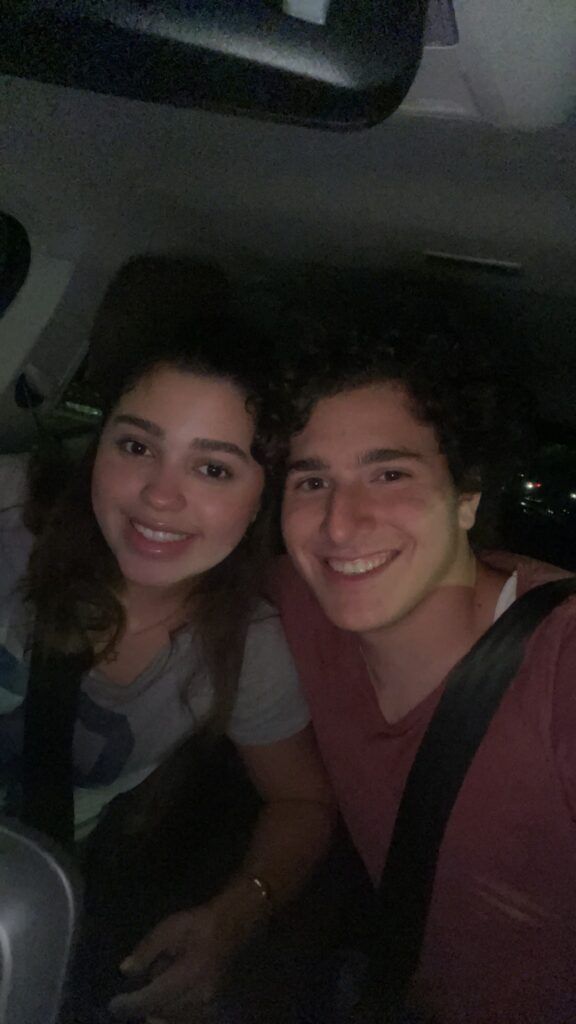
Friendships have also taught me important lessons. I have never been someone with a large circle of friends. Instead, I have valued a smaller number of meaningful relationships. My longest friendship has lasted six years with my friend Elizabeth. Although we are not as close as we once were, I am grateful that we still stay in touch despite having different political views. That friendship has shown me that disagreement does not always have to end a relationship if there is mutual respect.

6 Year Friendship With Elizabeth

Other friendships have been more uncertain. Sometimes I have questioned where I stand with people. Some friendships naturally became stronger through mutual effort, while others slowly faded over time. At first, I struggled with that reality, but I have come to understand that not every friendship is meant to last forever. People grow, priorities change, and sometimes life simply takes people in different directions.

Like many people my age, I have also found myself comparing my life to what I see on social media. There are moments when I mourn opportunities I feel I may have missed or compare my relationships to those of others. Over time, I have realized that social media often shows only the highlights of people’s lives rather than the full picture. Learning to appreciate my own journey instead of measuring it against someone else’s continues to be an important lesson.

One of the most difficult lessons I have learned involves forgiveness. I believe forgiveness has an important place in situations involving misunderstandings, honest mistakes, or poor communication. At the same time, I also believe that there are experiences that fundamentally change a relationship. Serious betrayals or violations of trust can leave lasting wounds such as emotional abuse, sexual harassment isn’t forgivable or something I tolerate which are things I unfortunately experienced but it has made me stronger. For me, learning empathy has also meant recognizing that people heal in different ways and that protecting one’s own well-being through healthy boundaries is sometimes necessary.

Moving from Florida to New York introduced me to people with a wide range of backgrounds and perspectives. As I continued questioning many of my own political beliefs, I found communities where I felt understood. Finding other Jewish people with similar perspectives made me feel less isolated during a period of significant personal reflection. Even today, I sometimes struggle with loneliness, but knowing those communities exist has reminded me that I am not alone.

One experience that had a lasting impact on me was meeting a Palestinian American and his Egyptian American wife while I was questioning Zionism. We spoke openly about history and our different backgrounds. During that conversation, he shared that he had lost many members of his family during the ongoing war in Gaza. Listening to his personal story reinforced for me the importance of empathy, not simply understanding ideas, but listening to the lived experiences of others, even when those experiences are painful. These conversations sparked a motivation for myself to be apart of peace groups with Israelis and Palestinians with confronting 

As I have grown older, I have realized that the relationships I value most are built on honesty, reciprocity, and meaningful conversation. I enjoy discussing ideas, learning from different perspectives, and forming connections that go beyond small talk. While not every relationship lasts forever, every relationship has taught me something about empathy, communication, and the kind of person I hope to become.

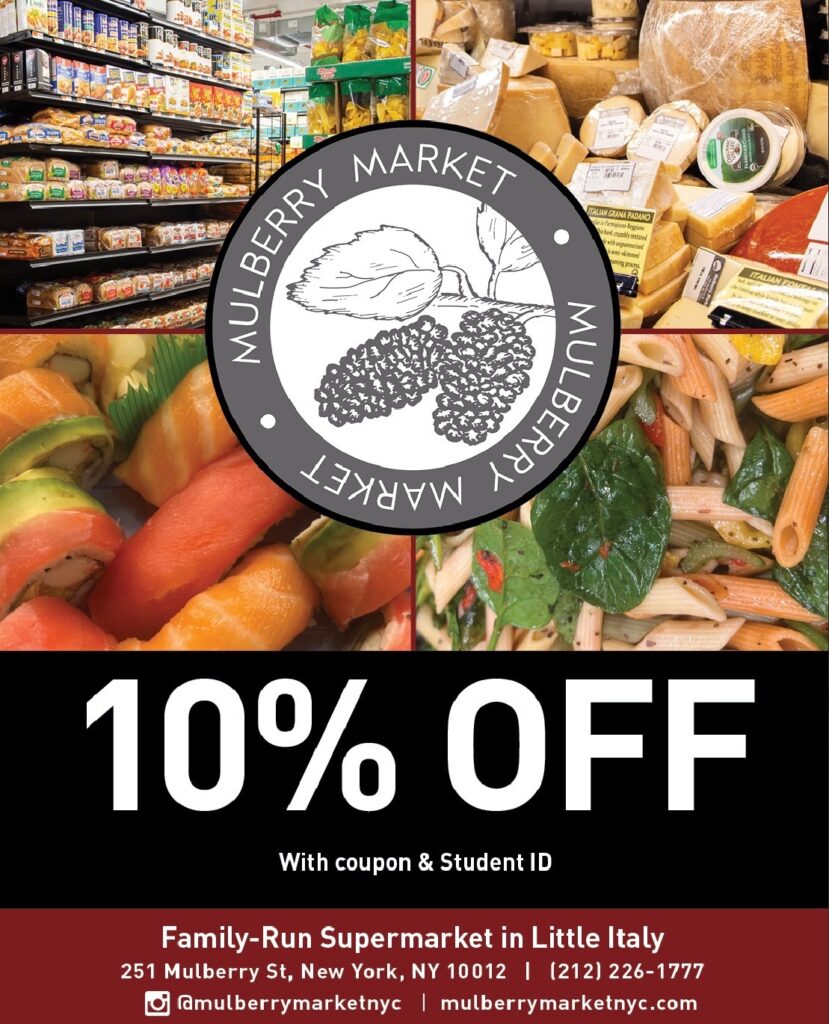
Need a late night snack check out Mulberry Market for 10% off!

By Aaron Newman

Aaron Newman is an Education Studies major minoring in Digital Studies. Originally from Fort Lauderdale, he writes about relationships, entertainment and fashion. He also writes about the hardship and being optimistic about his struggles and looking forward to the present and future.


For over 25 years, the Campus Clipper has helped college students in New York City—and later in Boston and Philadelphia—save money and succeed in city life. We offer a digital coupon booklet with discounts on food, clothing, and services, plus an Official Student Guidebook with real advice on how to navigate college life in a big city. Our internship program lets students build skills, earn money, and publish their own e-books. Follow us on Instagram and TikTok @CampusClipper, and sign up for our newsletter to get deals straight to your inbox. To access the digital coupons, scan the QR code on our printed card—available in dorms, student centers, and around campus.
Share