Rapping her way from Tumblr to mainstream, Kitty Pryde has been making quite a name for herself as of late. Adding to her slew of New York shows, she’ll be performing at Brooklyn venue 285 Kent on Friday.
There will be quite a couple of opening acts too, making the $5 price tag totally worth it.
Re:Mix Lab
The return of Re:Mix Lab signifies the beginning of autumn for us party goers. Even though we have to go indoors to party, it should still be worth it, right?
Well Re:Mix Lab give us two nights of worthwhile parties this weekend. On Friday ,Action Bronson and RL Grime hit the stage (RSVP here), and then multiple DJs hit the stage Saturday night, courtesy of Elektro magazine (RSVP).
Bud Light Lime Presents End of Summer w/ Swizz Beatz
We say goodbye to summer with a performance by Swizz Beatz at the South Street Seaport. Jermaine Dupri, ARAABMUZIK, and DJ Kiss are also scheduled to appear.
This one happens earlier in the day so it might make for a great warm-up before you head (to) the Re:Mix Lab party that Saturday night.
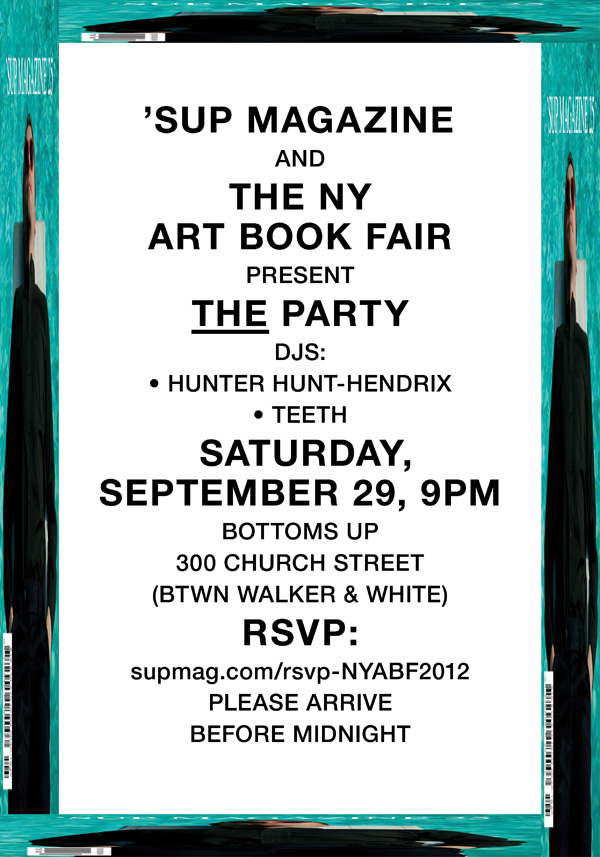
If you want to shy away from all the madness that’ll be going on in Manhattan this weekend, ‘SUP MAGAZINE is throwing a party in Brooklyn. It’s part of the NY Art Book Fair and I haven’t been to a boring art party yet, so this might be worth checking out. Make sure you RSVP.
Click here to download the Campus Clipper iTunes App!
Follow Campus Clipper on Twitter or keep current by liking us onFacebook.
Interested in more deals for students? Sign up for our bi-weekly newsletter to get the latest in student discounts and promotions and follow our Tumblr and Pinterest. For savings on-the-go, download our printable coupon e-book.
So many great things to do around this city this weekend! Just remember to wear a jacket while you enjoy the beautiful weather in store:
FAB! Festival 2012
The FAB! (or Fourth Arts Block) festival is a music, theater, and dance festival taking place on East 4th Street (between Bowery and 2nd Avenue). The festival will include many indoor and outdoor stages showcasing the three art forms that the festival is centered around.
Advertised as a family-friendly affair, activities will feature everything from world music performances to cooking demonstrations to open theater, art demonstrations, art activities for kids and screen printing, to trivia, and more. There is even a bike friendly tour that is free with RSVP. Find out more here and visit the website for more info.
Canteen’s Epic Brooklyn Book Festival
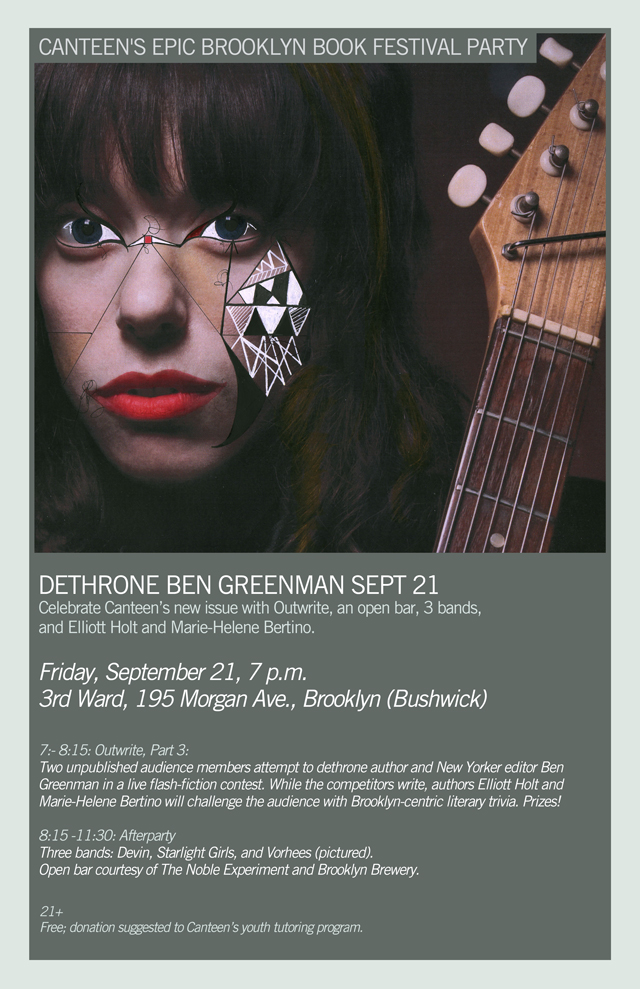
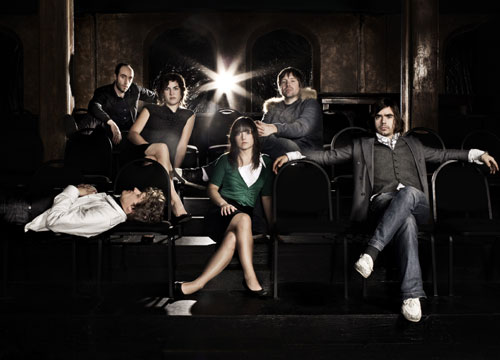
Literary magazine Canteen is throwing an awesome party tomorrow night. The event will feature live performances from 3 great bands (Devin, Starlight Girls, and Vorhees) plus a three hour open bar courtesy of The Noble Experiment and Brooklyn Brewery.
This event will totally be worthwhile and can be summed up with a simple equation: 3 live bands + 3-hour open bar = Friday night well spent. Be sure to “like” the event page and get there early.
Stars @ Mercury Lounge
Canadian band Stars will be playing a free show at Mercury Lounge this Saturday. It’s a thrillcall sponsored event, so to get in you need to download their app and get the tickets through there.
Brooklyn Book Festival
Literary celebration has been in full swing for about a week now and will be going on until the 23rd. Organized by the Brooklyn Book Council, the event features author readings and discussions. Attendees can sample the offerings of indie publications and even their own publications at the event. If you’re a writer or aspiring writer this is a great event to showcase your work to an audience you probably haven’t even thought of. Check out the website for more information.
Click here to download the Campus Clipper iTunes App!
Follow Campus Clipper on Twitter or keep current by liking us onFacebook.
Interested in more deals for students? Sign up for our bi-weekly newsletter to get the latest in student discounts and promotions and follow our Tumblr and Pinterest. For savings on-the-go, download our printable coupon e-book.
Fall is officially here! With the arrival of the season, outdoor entertainment tends to get scarce. Luckily, there are still some amazing events going on around the city, including a full weekend of festivities at Irving Plaza that will help bring in autumn just as it did summer: with tons of great parties and concerts.
Green Day at Irving Plaza
Punk rock legends Green Day will be performing a free show at Irving Plaza on Saturday the 15th. Given the popularity of the band and its status as punk rock royalty, I would’ve never dreamed of even hearing about a free Green Day show. The band is also rumored to be playing the Dookie album in its entirety.
Although the show is free, it doesn’t come without a price. Green Day are looking for their “number one fans” to come to show. In order to be eligible for tickets, one must not only “like” the Green Day Facebook page, but should also tweet with hashtags to show love for the band. Be sure to head over to the Green Day’s Facebook and Twitter pages while tickets are still available.
Heineken Red Star Access
Heineken’s Red Star Access is a five-city tour showcasing some of hip hop’s most popular talents. Saturday, September 15th will mark the day the Red Access tour makes its stop in New York City.
The star-studded lineup includes DJ Clark Kent, French Montana, and hip hop heavyweight Wiz Khalifa. Not only will this be a night full of great music, but also Heineken will be supplying free brews all night, making this show more than worthwhile. More information is available here; but get on it fast because the event is on Saturday!
All Star Weekend and Gym Class Heroes
Cap the weekend off at Irving Plaza (September 16th) with a performance by pop rock band All Star Weekend and the rap rock soundings of Gym Class Heroes. Kellogg’s Pop Tarts (yea, they’re getting involved in the free concert business) is sponsoring the event.
Like the Facebook page and be sure to stay tuned on how you can get tickets to the show…if they are still available!
That’s all for this week guys! Stay tuned to The Campus Clipper for more awesome free events next week, as well as coupons and deals on things you love.
Click here to download the Campus Clipper iTunes App!
Follow Campus Clipper on Twitter or keep current by liking us onFacebook.
Interested in more deals for students? Sign up for our bi-weekly newsletter to get the latest in student discounts and promotions and follow our Tumblr and Pinterest. For savings on-the-go, download our printable coupon e-book.
As young adults, we are prone to taking a “trial and error” approach to life. We know one of the many goals associated with college is the promise of a better life. We also know getting through college is a mission itself, filled with all types of twists and turns we never see coming. Here are a couple of concerns you may or may not have experienced, and some pretty good solutions to help keep your stress leveled.
Finances
Money will always be a major issue. Unless you hit the lottery or were born into royalty, you’re probably counting every penny you spend. Everything from getting to school to the afternoon snack craving can become a problem.
As college students we tend to want to blow our money on the first things we can think of. Saving is a minimal priority. HelpSaveMyDollars.com’s creator Scott Gamm developed a theory stating fifty percent of college students have 4 or more credit cards. An even more shocking statistic is that eighty percent of students fail to pay off their credit card bill.
The key is to keep an eye on your money and always track what you are spending. I’ve written an article entitled “College Savings Doesn’t Mean College Boredom” in which I talk about having fun in New York the cheapest way possible.
Social Life
Balancing school and anything else can prove to be quite complicated. Whether it’s a job or an internship, you will find you don’t have much time for anything else. Twenty three percent of full-time undergrads, who are 24 or younger, work 20 hours or more a week. With hours like that plus the 15 hours or more you plan to spend in classes and on after class activities (labs and group projects anyone?), you won’t have much time for anything else.
Although having any kind of social life can seem like an extra burden, it’s not impossible and is more than healthy for a college student. Someone paying you a visit after you come home from work is one way that comes to mind (because you know . . . you’ll be too tired to go out and all). Someone can come meet you at your job after your shift. Meeting people at school is also a good way to kill two birds with one stone. Trust me . . . you’ll be spending A LOT of time with these people, so you might as well get to know them. You might like them.
Professors
We’ve all heard it before, “I have to take Professor (place name here). He’s an easy A” or “I don’t want Professor (alchy). He’s always drunk.”
Okay . . . maybe the last one is just me, but you get the idea.
There are those out there who simply don’t care who ends up teaching them a specific course, but for many of us, there’s that one professor that just gets us. Early registration is the key to getting the professors you want, the classes you want, at the times you want to take them. Some schools even give you cash stipends for early registration, which is even more of an incentive.
Personally, I never understood math until I had this one professor. She never let me (or anyone for that matter) leave class until she was sure we understood the material. This may seem like torture but I didn’t fail a test that whole semester . . . . . So I guess it worked, at least in my case
Personal Problems
We all have lives outside of college and many times it’s hard for our personal issues to not get in the way. Students with children have to constantly worry about their kid as it will always be one of their top priorities. Students can be involved in relationships that just swallow up their time (and if this is you, you should really learn how to prioritize) among other things.
I’ve been in three different living situations ever since I started school and I’m working on a fourth and hopefully my last for a while. Going to school and not knowing if I’ll even have a home to come back to has definitely been one of the hardest things I’ve had to deal with in my life. All the “stay focused” and “keep your eyes on the prize” speeches never made any sense until I reached this period in my life.
Even though life can overwhelm you at times, it is important to know why you enrolled in this first place. It’s easy to forget why we started on this journey when all the unnecessary crap is constantly thrown in our face. Whatever the issue is, it’s important to know you have the strength, the tools and the support to get through whatever you’re going through. Also, you ARE working towards a better future and that’s more than most people can say.
Click here to download the Campus Clipper iTunes App!
Follow Campus Clipper on Twitter or keep current by liking us onFacebook.
Interested in more deals for students? Sign up for our bi-weekly newsletter to get the latest in student discounts and promotions and follow our Tumblr and Pinterest. For savings on-the-go, download our printable coupon e-book.
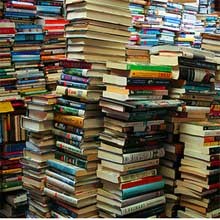
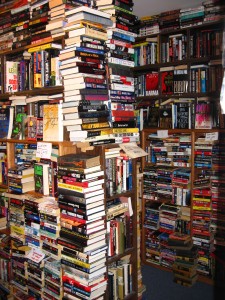
College savings are important. Just this month, I had to pack all of my books along with my essential goodies into a car and drive it almost 400 miles only to take the boxes back out and lug them into my parents’ house. It cost a pretty penny. The books are still unpacked and I don’t have space to store them anywhere. This got me thinking: why don’t I start selling on Amazon again?
While living in an apartment in Western New York, I sold books and video games, but mostly books. I made a nice chunk of change selling them, and got rid of things that I had no use for. Of course, I had to invest about $20-$30 to start in order to buy a nice Sharpie and bubble mailers in which to safely mail books, DVDs, CDs, and games. Towards the end, I got a bit lazy and decided to remove all of my listings on Amazon. This time, however, I plan to start up again.
Selling items online is a great way to make extra money and lighten your load. It is not as time consuming as people think it is. All you need is about 25 minutes (or less, depending on how many items you are going to sell) to punch in the ISBN numbers and the UPC code and just set a price that you are willing to sell the item at. You don’t want the selling price to be too low, because you won’t make profit. Try to avoid selling items at 99¢. Only large-scale sellers can afford to do that. You might reason that Amazon gives you $3.99 for shipping and handling, but they take a percentage of that and you have to mail the item too—out of your pocket. That’s not worth the money and time for you. I try for items that sell for $3.99 and up. Try to sell your books during back-to-school seasons. Prices skyrocket during these times. It’s actually pretty crazy. I have a book that I bought for $4.99 + S/H three years ago that is now sold on Amazon for $50.99. I don’t get it, but that’s $46 profit in my pocket.
Also, go to book sales if you want to make this a money-making hobby. I bought a fairly large amount of books at $1 each and profited off of them. I’ve found out (although it may be common sense) that older books can make more money, especially if they are OOP, or out-of-print. Some can go for as high as $250 if they are in great condition. Can you imagine paying over $200 for a paperback?
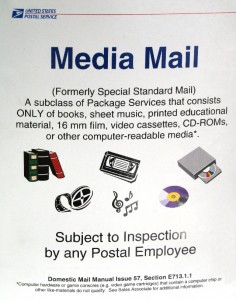
When you mail items like books, especially if they are large like chemistry textbooks, or textbooks in general, send them via Media Mail. It’s the cheapest way to send heavy books to your customer. Don’t bother with First Class or Priority unless the customer has paid the extra for faster delivery. Of course, there are instances where First Class is cheaper than Media Mail. Just ask the teller at your Post Office and they will tell you.
Now, what am I going to do when I have no books to sell? What am I going to do when I want to read books? Lucky for me, I live near a library. It was just this summer that I’ve come to understand how useful libraries are. I can order books—if the local library doesn’t have it—through the library system, and other libraries within that branch will send the books to the closest library to you for pick up, and best of all, it’s free. Well, not exactly free, but you don’t pay for the books, right? You can borrow as many books as you want as long as you have a library card.
I’m not sure about other libraries, but for the library I frequent, you have to show a proof of residence to that particular area. Just show a utility bill or your driver’s license and you should be able to sign up for a card fairly easily.
I can spend all day in a library. It’s a luxury that I can afford—because it’s free. Of course, university libraries are far more extensive, but I can’t complain—well, sometimes I do.
Owning books, of course, has its perks. There’s no due date, you can write in them, and you can take it out of your bookshelf and leaf through the pages for that certain paragraph or sentence at any time. But they do take up space, especially if you move around a lot. However, I don’t plan on selling all of my books. There are a couple that I will hold on to for a long time, if not, forever. These books represent my thoughts and ideas. These books have been read over and over again. Unfortunately, there are books that I do not have time for and have no interest in reading that have found themselves in my possession that I let go with a heavy heart.
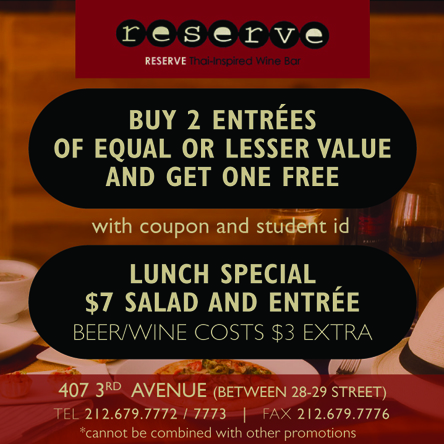
Sold some books, did you? Treat yourself and a friend to some delicious Thai food at Reserve!
Click here to download the Campus Clipper iTunes App!
Follow Campus Clipper on Twitter or keep current by liking us on Facebook.
Interested in more deals for students? Sign up for our bi-weekly newsletter to get the latest in student discounts and promotions and follow our Tumblr and Pinterest. For savings on-the-go, download our printable coupon e-book.
Growing up, going to “the city” (that is, New York City) meant dressing up in whatever dress I wore for Easter Sunday or Christmas Eve and going out to dinner at a Zagat-rated restaurant somewhere in Little Italy with my family. In those days, Mom and Dad paid. When I first moved to the city from Westchester four years ago, going out meant throwing on a shirt and skirt in hopes of looking somewhat decent on the line of an overhyped 18+ club that I or my roommates were “on the list” for, thanks to a Facebook group that boasted to keep us up-to-date on the hottest and cheapest NYC college-age nightlife. I quickly denied the existence of such a life.
pitfalls of fake IDs
When I turned twenty-one, I retired my once-used, two-years-expired fake ID that flaunted the image of a girl who looks absolutely nothing like me except for the fact that we are both 5’4” and have brown hair and brown eyes. At 5PM on my twenty-first birthday, I entered a heavenly paradise: Trader Joe’s Wine Shop. Knowing that I would, without a doubt, be carded there, I stood on line with two bottles of Three-Buck-Chuck and my awkward but somehow freeing sixteen-year-old smile staring at me from my driver’s license.
When it comes to going out, the city has much to offer besides Trader Joe’s Wine Shop. Bars are everywhere, nightclubs are plentiful, and parties often literally happen in the streets and under them in the subways. Having gone to Manhattan for college, I was faced with the challenge of the city in addition to traditional college distractions. Still, I believe that the ups outnumber and outweigh the downs when it comes to the typical college student’s desire to celebrate the weekend, weekday, or lack of knowing what day it is.
You can leave your apartment without a set destination. Don’t know where to go? Just go. Look for “two for one” signs. Follow crowds. Gravitate towards noise. Ask loud people you cross on the street where they just came from and hope they remember.
You meet people (whether you want to or not). Though you may unwillingly find out about a stranger’s hygiene, astrological sign, and pick-up techniques, you may also make some new friends or at least go home with an interesting story or characters for that screenplay you’ve been working on.
You don’t have to designate a driver. Subways, taxis, and sidewalks are a New Yorker’s best friends. Because few people going to college in the city have a car with them, there is no need to draw straws at the beginning of the night (though you may want to designate a pack leader to lead the way home if you’re sleepily returning at three in the morning).
Designate your shoes when you don't designate a driver. Walking in heels can be tough!
You can always find a place to eat. From cookies to dollar pizza to street meat to pretty much anything, food is always available and often cheap.
Nowhere is off-limits. Though you may have to wait a bit longer for subways to arrive the closer it gets to sunrise, every borough is at your fingertips. This also allows for you to try a new place when “the usual” just isn’t enough.
The bad news? Money doesn’t grow on trees, and, if it did, you still wouldn’t have any because you likely don’t have any trees growing on your fire escape. The city is always outside your door, always awake, and always hungry for your wallet. Plus, the fact that you may or may not already be going broke paying for a college education doesn’t help any.
However, if there’s one thing I’ve learned in the past four years, it’s that you should always be prepared. If you plan out at least part of your night ahead of time, you don’t have to pay much for a night of fun.
Eat dinner home. Instead of going out to eat, make dinner with some friends in someone’s kitchen or have a potluck dinner. This is often cheaper and healthier, and allows you to start the weekend celebration together and then head out when everyone is accounted for.
Leave yourselves a large tip with all the money you save when you celebrate at home with friends.
Buy your own alcohol. If you are 21 and drink, look online for which liquor stores or beer distributors have the best deals on your beverage(s) of choice, and hit them up before they close. Make your own concoctions, which can be fun! And, if you do go out afterwards, you’ll probably be less tempted to spend money on overpriced drinks.
Arrive early. Many locations (bars and clubs alike) that charge cover fees charge differently according to what time it is. If your usual bar has a good happy hour, meet up with a few friends for cheap drinks. If a club says that admission is free before ten o’clock, consider getting there early. Don’t forget to account for the time it takes to wait on line! Also, when possible, be female—you’ll probably pay less to get in to some places.
Have your own dance/karaoke/movie/theme party. Sometimes a night in can be even more rewarding than a night out.
Take advantage of your college or university. While you might associate school events with middle school dances when the sexes stood on opposite sides of the room and stared at their feet or giggled in circles, school-sponsored events can often be fun. The people putting them together are probably either paid to do it (and probably at least somewhat good at it) or they are college students just like you with similar ideas of fun. Check your school events calendar, as well as any deals that your school and local businesses offers like student-price movie tickets, coupons, brochures, and other student savings. You’ll be surprised what you can find!
It's who you're with that counts most.
Of course, there is no perfect formula for saving money, but over time you should discover what works for you and learn your own methods along the way. While you’re in college, remember that you’re in college. Remember that you’re not the only one concerned about saving money while having fun, that there are whole schools of students worried about the same thing. In this realization you can find your savior—your friends. No matter where you’re going or what you’re doing, surround yourself by good people and you can’t go wrong.
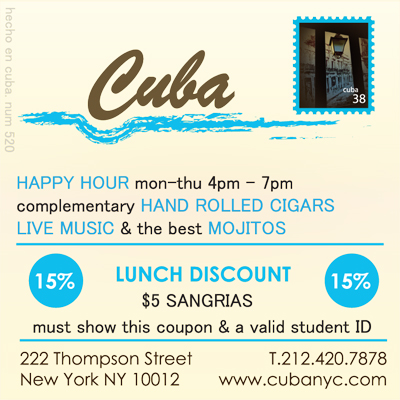
Take advantage of a great happy hour at Cuba!
———————————————————-
Carina, New York University. Read my blog and check out my Twitter! FOLLOW ME!!
Click here to download the Campus Clipper iTunes App!
Follow Campus Clipper on Twitter or keep current by liking us on Facebook.
Interested in more deals for students? Sign up for our bi-weekly newsletter to get the latest in student discounts and promotions and follow our Tumblr and Pinterest. For savings on-the-go, download our printable coupon e-book.
The opening ceremony for the 2012 Summer Olympics was held on Friday, June 27th across the pond in London. I, along with billions of people from around the world, witnessed a bizarre spectacle of British history (mostly all happy stuff, no Spanish Armada destroying the British fleet, or the British invading India). It ranged from coal miners emerging from a cave(?) and then moved on to Mary Poppins and a parody of James Bond. The ending, I thought was quite spectacular, considering that London seemed to embrace the dubstep/grime culture that’s been so central to their youth. The social media thing was clever in a way that did not alienate the majority of viewers—except for men and women hailing from certain countries that limit freedom.
Since the opening ceremony, I (like many others) have been keeping an eye on medal counts, and I felt that there was something a bit amiss between the initial celebrations and the celebrations on the podium.
I took a look at the 2008 Beijing Olympics and the current medal standings at London. The New York Times actually has a pretty cool interactive map of the medal winners from previous Olympics that, interestingly, lists the countries by number of medals won, not by the number of gold medals won (which would have put China in first place, not the United States).
Here are the current top 10 medal-winning countries from the 2012 Summer Olympics in London:
Here are the top 10 medal-winning countries from the 2008 Summer Olympics:
…and the 2008 interactive map provided by the New York Times:
Do you see a difference? There are obviously countries that consistently dominate in the Olympics. Although it’s still very early in the Olympics 2012, by an extrapolation of data from previous Olympics, it’s pretty clear which nations will be in the top 10 at the end of the Olympic games.
Here are the top 10 countries from the 2004 Summer Olympics in Athens:
…and the 2000 Summer Olympics in Sydney:
Interesting, isn’t it?
How about one more, from the 1996 Summer Olympics in Atlanta:
Time and time again, you see the same countries place in the top 10. Obviously, the United States hasn’t placed lower than No. 2, and I guarantee that this summer, the US will place first or second (probably second) with China.
But, this isn’t a medals race, no way. The media might focus on the medal count—I mean, we’re all suckers for high numbers—but really, this is a celebration of the achievements these athletes have accomplished.
This is a celebration of the world.
The Olympic Committee has a commission called “The Commission for Culture and Olympic Education” for support and promotion of health, peace, and a better world through cultural exchanges and recognizing cultural diversity.
The Olympic games moved from a competition to an exhibition, successfully incorporating the elements of the arts into the mix. It embraced the presentation of culture through the subjective, the incorporeal attitudes of certain cultures depicted only though the means of sculptures or paintings.
In its very essence, with countries showcasing their best athletes, the participants of the Olympic games are not only competing against one another, they’ve become participants of a global museum; that is, the best athletes are watched and scrutinized and admired, not just as men and women with incredible athleticism, but as part of the cultural exhibit put on show for the world. The athletes become, basically works of art, rather, “sculpture-esque,” and are canonized into the halls of the Olympians.
Click here to download the Campus Clipper iTunes App!
Follow Campus Clipper on Twitter or keep current by liking us onFacebook.
Interested in more deals for students? Sign up for our bi-weekly newsletter to get the latest in student discounts and promotions and follow our Tumblr and Pinterest. For savings on-the-go, download our printable coupon e-book.
I turned on FOX television network’s reality TV show Take Me Out one Thursday night after seeing Ingrid Michaelson tweet about it. Having only caught the last half hour (which, factoring in commercial breaks, means I saw maybe about fifteen minutes), I was in that weird, bad-reality-TV mood and threw the remote to the other side of the couch. I proceeded to watch The Choice.
Hosted by Cat Deeley, the English girl with the nice legs who’s also hosted Dancing with the Stars, this episode starred Pauly D from The Jersey Shore, recording artist Romeo, Olympic skier Jeremy Bloom, and actor Jason Cook. The four celebrities sat in chairs facing the audience and away from the stage—if you’ve ever watched The Voice, it’s the same idea (and not coincidentally, because apparently The Choice is a parody of NBC’s more viable show). The concept of the dating show is essentially to give “regular” people the chance to have a dream date with a celebrity, based off of their personality and not their looks.
This latter aim is an ironic one because the show very obviously fails to achieve its don’t-judge-a-book-by-its-cover facade. First off, the pre-show contestant selection process seems to weed out anything-but-decent looking people, all who have clearly put a lot of effort into their appearances. Secondly, during the show, the “blind” celebrities are allowed, very early on, to see the contestants, and can easily choose according to their physical preferences.
Like any date, The Choice starts off with introductions: all the chairs are turned and a contestant’s name is announced. A large recorded silhouette of her body is displayed (I mean large, like the-wizard’s-face-in-the-Wizard-of-Oz large) while she attempts to show off how much she can shake her hips or grind or flip the hem of her dress. Then the walls of Oz part and she walks out as if auditioning for Toddlers and Tiaras, striking a pose at the end of her catwalk like a supermodel in training. The crowd cheers and often influences the choice of the celebs before anyone hears her speak. When she does open her mouth, she usually shouts as if she wasn’t already hooked up to a microphone. She describes herself in an over-rehearsed speech in terms of her personality and oftentimes also her looks, which is yet another step that makes the dates not-so-blind. Clichés, pick-up lines, and the corniest things you’ve ever heard fly across the stage in attempts to tickle the ears and other body parts of the lucky four celebrities.
Depending on who is in the chairs, there is a varied amount of room for sleaziness—while Pauly loved the girl who just got a stripper pole in her bedroom to exercise, Jeremy Bloom was all about the girl who liked to hang out with her grandma. The celebrity cast seemed to have been carefully chosen to present such a variety, which was a good thing because it left a chance for the small percentage of contestants who didn’t give hints about their love for giving oral sex.
The “blind” portion of the dating show can, from here forward, completely be tossed out the window, since the girls who least appeal to the celebrities physically can simply be eliminated within the next two rounds. Such is the case more often than not, and understandably so.
If more than one celebrity turns their chair for a contestant, then the decision-making power changes hands. It is then the celebrities’ turn to woo, which they are no rookies at, given their just-below-A-list statuses. While Pauly D described himself as “fun, ambitious, and trustworthy,” Romeo attempted to work his magic by remarking that looking at his contestant was “Better than looking at a Picasso.” The ladies were wooed in both cases, though the second girl probably shouldn’t have bought it because the most famous Picassos look like this.
Team Pauly standing beauty-contest style
The first round takes up the first half hour of the show, so after a hefty commercial break, round two commences. Once each celebrity has assembled a steamy team of three, the celebrities take turns asking their dates questions for fifteen seconds at a time—which is, obviously, the perfect amount of time to get an accurate impression of someone. Life or death questions like “Would you rather eat a bag of jalapeños or drink a beer that someone just dropped a cigarette into?” and stress-inducing demands like “Tell me a joke” put the girls on the spot as they stutter over their words. When they find a second of silence, the girls spit questions back at the celebrities which are often answered by another question. This is by far the most chaotic round and it doesn’t seem to achieve much except reveal a contestant’s choice of filler words.
When each girl has been asked two questions, the celebrities then eliminate one girl from their team of three. The last fifteen minutes (with, of course, another five-minute commercial break in the middle) revolve around the third and final round in which Cat Deeley reads a question to the contestants individually. After both girls have answered the question, the celebrity goes up on stage and chooses between the two, carrying her back to his chair on his arm so that he can whisk her off on a celebrity dream date.
This round proved to be very funny in the episode that I watched. When Cat asked Jason’s team, “What would you prescribe Jason if he came to you with a broken heart?,” the darker skinned girl replied “Coffee for your cream” (which doesn’t really make sense, unless cream has healing properties that I don’t know about). Ironically, when the second girl came out from backstage, her answer was “a lot of chocolate.” The crowd laughed and the poor girl was so confused that she almost stopped her answer there.
Pauly's unsurprising choice for a date
Jason, of course, couldn’t not pick the first girl after the chocolate comments, and so the commercial break that preceded his big decision was the least anticipation-filled commercial break ever. Completely unsurprising also was Pauly D’s choice, which anyone who has watched The Jersey Shore could easily predict from the end of round one. Despite the fact that the second girl on his team gave a fuller answer that actually made sense, he claimed, once on stage, that “If you looked up my type in the dictionary, there’s a great big picture of Elyse,” and chose the first girl.
Later episodes have featured female celebrities with male contestants and, from one other episode I regrettably watched, have the potential to be slightly less hectic than this first premier episode. Still, the main rule seems to be that if you want to win a date with a celebrity, your success depends on who the celebrity is. If you want a date with someone who is ambitious and career-focused, show interest in things that are relevant to him, like music. If you’re aiming for a date with someone with a sense of humor, make them laugh, even if the laughs are a result of coincidence. If you want to date someone sweet who cares about their family, show them that you are nice and family-oriented and be someone who he/she would want to take home to Mom. And, if you want to date someone who loves to party, look like someone he would want to take to the club and then, perhaps, home to his bedroom.
Then again, if you want to not blend into the crowd and be like every other date, just be yourself, give specificity in your answers that distinguish you from others, think on your feet, be memorable, and be real.
But perhaps the most valuable lesson from this show can be taken from the contestants that do not “win” the date. The dating world is crowded and competitive, and just because you may not be a particular person’s pick of the litter, doesn’t mean that you should give up. Sometimes you don’t stand a chance against the odds when someone has a “type” that you don’t fit into or when a simple coincidence sways them the opposite way. Most of the time, the reasons for not being “selected” are less obvious; but no matter what, it is important to remember that just as there are a million options out there for the other person, there are many options for you as well. Real life dating is more than a three-step process, but if you keep at it you may find that one day you have a dream date with the Choice of your own.
——————-
Brighten your smile with this great student discount coupon so that you can dazzle your date the second you meet eye-to-eye!
———————–
Carina, New York University. Read my blog and check out my Twitter! FOLLOW ME!!
Click here to download the Campus Clipper iTunes App!
Follow Campus Clipper on Twitter or keep current by liking us on Facebook.
Interested in more deals for students? Sign up for our bi-weekly newsletter to get the latest in student discounts and promotions and follow our Tumblr and Pinterest. For savings on-the-go, download our printable coupon e-book.
Created by Michael Patrick King and Whitney Cummings, the nationally-syndicated show on CBS, 2 Broke Girls, manages to transcend the thin line that constitutes political correctness. It wholeheartedly—for cheap laughs, nonetheless—embraces ethnic stereotypes and sexism and, by doing so, further solidifies it in the audience’s consciousness.
King was in a heated debate with the show’s creators in a panel discussion about the racial and sexual overtones used throughout the show:
“The big story about race on our show is that so many are represented,” King said. “The cast is not only multi‑ethnic, including the regulars and the guest stars, but it’s also incredibly not ageist. We represent what New York used to be and what is currently very much still alive in Williamsburg, which is a melting pot.”
On the show’s Asian character, Han Lee, King said:
“I like Han. I like his character. I like the fact he’s an immigrant. I like that he’s trying to fit into America. I like the fact in the last three episodes we haven’t made an Asian joke, we’ve only made short jokes … Would you say the ‘blonde rich bitch’ is a stereotype? Would you say that the tough‑ass, dark, sarcastic‑mouthed waitress is a stereotype? I like all of them.”
King uses his sexuality to try to defend his use of stereotypes, saying, “I’m gay! I’m putting in gay stereotypes every week. I don’t find any of it offensive, any of it. I find it comic to take everybody down.”
King conveniently forgets, however, that Asian stereotypes were extremely hateful up until the 1960s, when both black Americans and Asian Americans were finally given the right to vote and participate in civic duties.
There were a string of riots against the Chinese in the early and late 19th century by Americans. In Los Angeles in 1871, seventeen Chinese were massacred in broad view of public eyes. In fact, the public enthusiastically took up violence along with the perpetrators. “Hang them!” was a common phrase exclaimed by the bystanders and “as the Chinese were hauled up, a man on a porch roof danced a jig and gave voice to the resentment many Americans felt over the Chinese willingness to work for low wages. ‘Come on, boys, patronize home trade,’ the man sang out.” Seventeen Chinese men were lynched in front of men, women, and children. (Scharf, J. Thomas, “The Farce of the Chinese Exclusion Acts,” The North American Review. Jan. 1898. Volume 166, Issue 494, pp. 85-98.)
I’m surprised that the show doesn’t have Lee wear some “traditional” Asian attire and have him speak in a farcical “Chinese”language to further drive him from the realm of the American. When King says, “I like the fact in the last three episodes we haven’t made an Asian joke, we’ve only made short jokes,” he means, Asians are short, so we’re going to run with that. The New Yorkercalled the show “so racist it is less offensive than baffling.”
Look at successful comedies out on television now: How I Met Your Mother pokes fun at contemporary social life with complex characters (Barney Stinson is an enigma), New Girl shows character-layering while still allowing Zooey Deschanel be her bubbly self, Modern Family portrays all likable characters who, although they may follow some stereotypes, are able to present complexity, and the cast of the long-cancelled Arrested Development consists of diverse characters all with their own specific personalities, not just a quick scheme to establish what’s already known in our collective consciousness.
“Every time Han gets to say something on 2 Broke Girls, the undercurrent is that it’s funny because it’s broken English. Plus he’s really short and geeky and non-sexual (there may have been other stereotypes to plop on top of him, but maybe creators Whitney Cummings and Michael Patrick King thought too much was enough, which would certainly stick with the general theme of the show). In any case, what CBS is doing every Monday night is trotting out one of the most regressive and stunning racist devices a network has produced in five or more seasons.”
King does admit that he wants to flesh out the supporting characters, but that’s what stereotypes create—one-dimensional figures for the sake of cheap, unwitty and predictable laughs. Count the number of times you hear the laugh track played throughout the show—you’ll understand what I mean.
I’m surprised the show hasn’t ended up yet as two broke writers. Michael Imato and Michael Anderson call the show “creatively bankrupt” and “just bloody awful.” I also found a comment on Grantland to be very poignant:
—————–
Experience the real deal of culture at Fuji Sushi with this student discount coupon from Campus Clipper!
Click here to download the Campus Clipper iTunes App!
Follow Campus Clipper on Twitter or keep current by liking us on Facebook
Interested in more deals for students? Sign up for our bi-weekly newsletter to get the latest in student discounts and promotions. For savings on-the-go, download our printable coupon e-book!
My first time was in a Kmart. My best friend and I were walking around a shopping center near home, looking to kill time after school before starting our homework. We stumbled across the section of discounted books and could not help but pause to giggle at the shirtless, six-packed Fabios on white horses holding women in flowing white dresses (I’m not sure if any of the books actually had that cover, but I wouldn’t doubt it). Once I saw the “2 / $6” stickers on some of the books, I knew that I would be making a purchase that day.
Beth purchased The Millionaire’s Inexperienced Love-Slave while I went for The Glass Slipper and Pure Temptation, which flaunted a muscly man with medium-length brown hair lounging under satin sheets with his arms thrown back as if he thought that he was posing for a dictionary entry of the novel’s title. When we got to the registers with our books, I found out that the bargain price stickers on my two books were lies, and that I would be making the cheapest purchases of my life: books that cost a penny each. I suspected two things: first, that there was a glitch in the register system, and also that the books were even worse written than originally suspected, with its writing perhaps as cheap as my receipt suggested.
Romance novels have been referred to as “smut” and female pornography due to the sexual content that some books contain. However, while some books certainly do contain explicit scenes, others contain nothing more than hand-holding and church-rated kissing. Happy endings, which usually lead to marriage, are essentially required by the genre (Romeo and Julietis one of the most famous unhappily-ending romances); there are, by definition of the romance novel, requirements concerning plot. If the storyline can only be damaged without the sexual elements, the novel is most likely to be classified as an erotic romance novel (example: Fifty Shades of Grey).
Though I’ve held myself back from reading the Fifty Shades of Grey trilogy in public, not as daring as the several women in whose laps the books can be found on the train I take every day (I’m sure there are some with the e-book, too), I have a steadily increasing amount of experience with this division of women’s fiction. Apart from my internship with the Campus Clipper, I work with a literary agency. Having only found a small amount of information about the agency before my interview with the company, I resorted to thinking that the agency specialized mainly in helping authors publish romance novels, since most of the information I found suggested so. It turns out that while the agency does do this, it is by no means a romance-only agency. Regardless, I checked out a few romance novels the library, hoping to familiarize myself with the type of writing that the agency represents before I started working there.
My mother was recently recommended the now-infamous Fifty Shades of Grey trilogy, and she suggested that I also read it to bone up (no pun intended) on the genre as well as current popular reads. Now done with the first book, she is admittedly a little uncomfortable with this suggestion to her youngest daughter.
Ironically, despite being among the least respected, romance is the most popular North American genre, consisting of almost 55% of paperback books sold in 2004 (e-books are becoming increasingly popular in romance sales, particularly for erotic romance, probably because it allows discretion). About 91% of the consumers are women. While the stigmas that can come with the romance genre seem to be taken lightheartedly by the general public, there are those who are enraged by the books. While some argue for the sake literature, others believe that the books are immoral, degrading, and even dangerous.
What makes these books so appealing and popular? The Fifty Shades trilogy, the first of which was published in June 2011, has gone viral, surpassing the Harry Potter series as the fastest-selling paperbacks. But surrounding the book’s rise on the best-seller charts is a load (I can’t help myself) of controversy. The male protagonist’s appeal to BDSM makes the novel more risqué than the average romance, and the popularity of the trilogy has some worrying about the implications that the book gives about what is okay in the bedroom (or the setting of choice).
One woman wonders, “Do middle-aged women, the main audience for this book, really view the threat of violence as an aphrodisiac? And isn’t it dangerous to turn a BDSM-addict into a romantic hero? Would we want our daughters dating Christian Grey?”
Comments such as these might be related to concerns in the 1860s, when critical attention was focused on romance novels because the female reader was believed to be susceptible and vulnerable to ideas. It was believed during this time and for decades later that women should be reading more wholesome works like those that taught them about a moral society and how to be humble homemakers.
EL James’ books are by no means the first romance or erotic romance novels to be published. Fifty Shades has not invented anything new in either the world of literature or the world of sex, or even BDSM for that matter. People could just as easily get ideas from these books as from another million sources. Also, as critic Caroline Lucas argues, just as in the 1860s, readers can exercise “resistant reading,” choosing which ideas they will and will not adopt from a text. Besides, from what I understand, the trilogy distinguishes between BDSM and abuse, and never implies that abuse is okay.
Romance novels have been around for quite some time. According to RadioLab’s podcast “The Greatest Hits of Ancient Garbage,” the most common finding in a landfill of ten centuries of ancient Egyptian garbage is papers of a romance novel (you can hear snippets of it read at 16:13 on the podcast). Though it took an archaeology expedition to make this discovery, we can more easily find early evidence of romance in print such as in Medieval tales of courtship and chivalry and Renaissance literature such as plays and poems by Shakespeare. The Romantic Period shifted the focus towards courtly relationships ending in marriage, which is where most modern romance novels still end.
One major distinction of these earlier works from the modern ones is that most early works were written by and for men of a patriarchal society and from a male character’s point of view. The first best-seller romance novel was written during this time, in 1740 with Samuel Richardson’s Pamela. Written from the heroine’s viewpoint for a change, it sold like wildfire.
Light, enlightenment, or phallic symbol?
Jane Austen and Charlotte Brontë are two well-known Victorian romance writers, and though it can be argued that the sexuality in their romances is more subdued, I ask you to look at the symbolism within their work. I remember being a sophomore in high school and shaking my head in fear every time my English teacher suggested phallic symbolism in Jane Eyre. (Also, I suggest a look at Andrew Marvell’s 1650s poem “To His Coy Mistress” which might be summed up colloquially as “Stop being prude, let’s bang.”)
Such novels, particularly those written by female writers, helped to pave the road for women’s literature, introducing characters that were strong and generated sympathy for the condition of women in society. They often suggested a female quest for freedom and independence. As women outside of the fictional world of novels began to experience freedom for themselves and became literate, more liberated romance novels emerged.
Perhaps the most free expression in romance novels can be found in erotica, where authors have to have a decent set of balls to write without restriction (many just have a decent pseudonym instead). Renowned writer Anaïs Nin, after having drafted an apparently-withheld draft, was once told by her agent to “Leave out the poetry and descriptions of anything but sex.” The result was Delta of Venus, which has apparently been forgotten about in the midst of the Fifty Shades outrage.
Working at the literary agency, I have gained a greater respect for romance writing and those who can write romance well and, yes, for those who can write decent sex scenes (hey, if you’re going to convince me that the character is having the best sex of her life, you better not describe the same thing again and again). Perhaps the most notable feature of modern romance novels is the ease of the read. Unlike an Austen or Brontë romance, the writing of a typical modern romance should be taken plainly and doesn’t feel heavy or make the reader think too much.
But this mindless reading is the reason why literary critics everywhere tend to bash romance novels, saying that they lack merit or do not contribute to the world of literature. Unfortunately, this also paints a bad image of romance readers such that makes them look unintellectual and jaded, ironically bringing the representation of the romance reader back to where it was when women were still generally accepted as the lesser sex.
Some scholars believe that romance novels create submissive readers by showing the female protagonists ignoring issues other than love and marriage. But if we colloquially distinguish our “love life” as a “separate” life, why can’t we have books that also do so? Are mystery novels ignoring everything but unsolved murders? Do fantasy books ignore everything but magic?
Those who argue in favor of romance novels say that they are socially significant because they offer insight into human (usually female) ideals. Whether written on ancient papyrus paper, hidden under a Victorian pillow, or proudly displayed on a Metro North train, it is clear that these ideals, no matter how controversial, have been popular for a long, long time.
While I can’t exactly argue with the assessment of the quality of typical modern romance writing, I will say that not everything that is written strives to contribute to the same world as Hemingway and other literary greats. Sometimes people write and read just for enjoyment. Romance novels are like the flashy sequin shirts worn to a club or the French fries ordered as a side to a salad—not meant to be taken seriously, but meant, instead, to be fun, a sort of escape. In fact, romance novels have experienced a rise in the current recession, just like Margaret Mitchell’s Gone with the Winddid during the Depression. Lawyer and book-blogger Jennifer Lampe says, “Given the general dismay and gloominess, reading something like a romance with a happy ending is really kind of a relief.” And that’s what modern romance novels are really about. Romance novels are written to be enjoyed, not to enlighten, and they are, simply, about pleasure—the pleasure of reading.
———————————————————
Carina, New York University. Read my blog and check out my Twitter! FOLLOW ME!!
Click here to download the Campus Clipper iTunes App!
Follow Campus Clipper on Twitter or keep current by liking us on Facebook.
Interested in more deals for students? Sign up for our bi-weekly newsletter to get the latest in student discounts and promotions and follow our Tumblr and Pinterest. For savings on-the-go, download our printable coupon e-book.
Intern Brenna Sheets from Emerson College is joined by fellow students Amber Call and Grace Rubin to discuss the reality of dating in the digital age. Whether you're an undergrad grinding through finals or a grad student juggling class, TA positions, and a work schedule, adding dating to the mix can feel like an unpaid […]
Intern Brenna Sheets from Emerson College is joined by Cambridge Natural's Emily K. to discuss natural health and wellness in the modern age. They discuss how supplements and herbal teas are being used, marketed, and perceived in our fast-paced, wellness-obsessed society. Is our reliance on these products a sign of empowerment—taking control of our health […]
Intern Brenna Sheets from Emerson College leads today's discussion on self-care and wellness in college. With fellow interns Aidann Gia (Pace University) and Agatha Edwards (Brandeis University), the group discusses what American culture says about self-care, everyone's favorite wellness activities after a stressful week, what gets in the way of students prioritizing themselves, and the […]
Intern Katie leads today's discussion. We talk about the pandemic's effect on college students, since current juniors and seniors' college experiences have been largely defined by the pandemic. We discuss what it was like being sent home from college in 2020, navigating online classes and extracurricular activities, and the lessons we've learned from this whole […]
Welcome back to a new season of the Campus Clipper podcast!Intern Megan leads today's discussion. We talk about the activities that inspire creativity in our cities and how to balance creative hobbies with schoolwork and internships. We also discuss the uncertainty and insecurity that we often feel when putting our creative work out in the […]
Intern Ehani leads today's discussion. We talk about the films, series, books, and other art that has touched our hearts, even when the world makes us want to be dark and cynical. We also discuss what role our passions have in our lives, and what passion means to us. Mentioned in this episode:Call Me By […]
In this episode, our interns talk about going to college in a big city - from the cultural advantages to how they deal with the expensive cost of living. We also share our favorite things to splurge on. Mentioned in this episode:The Whitney MuseumThe Tenement MuseumTips for budgeting (even when you're not the budgeting type)Check out […]
In this episode, our publishing interns talk about why they love writing and how they use writing and creativity as a tool for personal development and mental health. Check out our publishing interns' writing on the Campus Clipper Blog. This episode was recorded at the new East Village, NYC location of Marinara Pizza. Click this […]























 But perhaps the most valuable lesson from this show can be taken from the contestants that do not “win” the date. The dating world is crowded and competitive, and just because you may not be a particular person’s pick of the litter, doesn’t mean that you should give up. Sometimes you don’t stand a chance against the odds when someone has a “type” that you don’t fit into or when a simple coincidence sways them the opposite way. Most of the time, the reasons for not being “selected” are less obvious; but no matter what, it is important to remember that just as there are a million options out there for the other person, there are many options for you as well. Real life dating is more than a three-step process, but if you keep at it you may find that one day you have a dream date with the Choice of your own.
WEB.jpg)


.jpg "Fuji Sushi")
 Romance novels have been referred to as “smut” and female pornography due to the sexual content that some books contain. However, while some books certainly do contain explicit scenes, others contain nothing more than hand-holding and church-rated kissing. Happy endings, which usually lead to marriage, are essentially required by the genre (
 withheld draft, was once told by her agent to “Leave out the poetry and descriptions of anything but sex.” The result was