Archive for September, 2026

Reflecting on the Arts and Health as a Social Practice: A Review of NYU’s Evidence to Action Symposium

Wednesday, September 30th, 2026

This past Saturday marked the last day of the United Nations General Assembly’s Healing Arts Week, an annual series of events organized in appreciation of the arts’ global incorporation in the cultivation of health and wellness. As a student at NYU, I had the privilege of learning about and attending The Launch of the Jameel Arts & Health Lab’s Lancet Global Collection on Arts and Health, which took place last Tuesday, September 22, at the NYU Skirball Center for the Performing Arts.
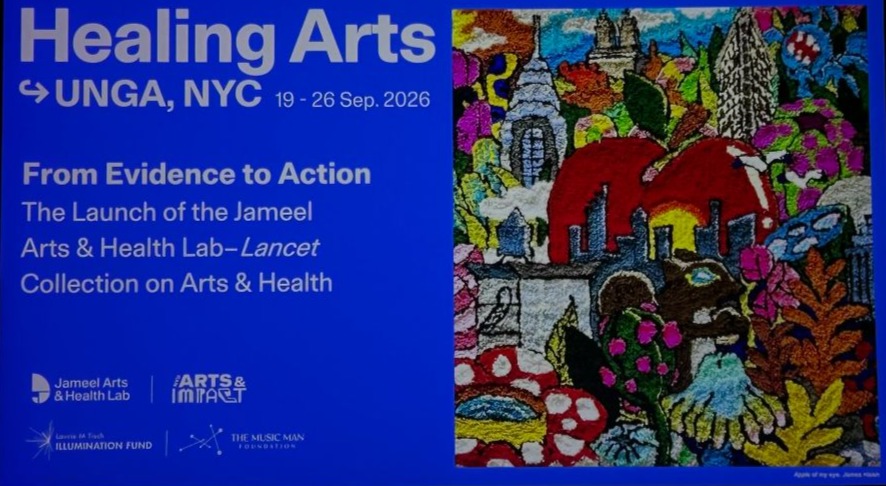
The opening presentation slide to the launch of the Lancet Collection on Arts and Health

Recently, this idea of expanding the role of artistic practice in supporting mental and physical wellbeing and recovery has become a recurring point of consideration in my day-to-day life. So despite this event being promoted as a “research symposium”, I was drawn to the opportunity to more thoroughly explore and discuss this intersection between art and health research, policy, and practice. Though, it did also help to encourage me that musician Jon Batiste—eight-time Grammy award winner and co-composer for the Pixar movie Soul—was scheduled to perform and join in conversation with artist, neuroscientist, psychiatrist, and professor at Yale School of Medicine, Dr AZA Allsop; founding Director of the Louis Armstrong Center for Music and Medicine at Mount Sinai Health System, Director of the Department of Music Therapy at Mount Sinai Beth Israel, and Professor at Icahn School of Medicine at Mount Sinai, Dr Joanne Loewy.
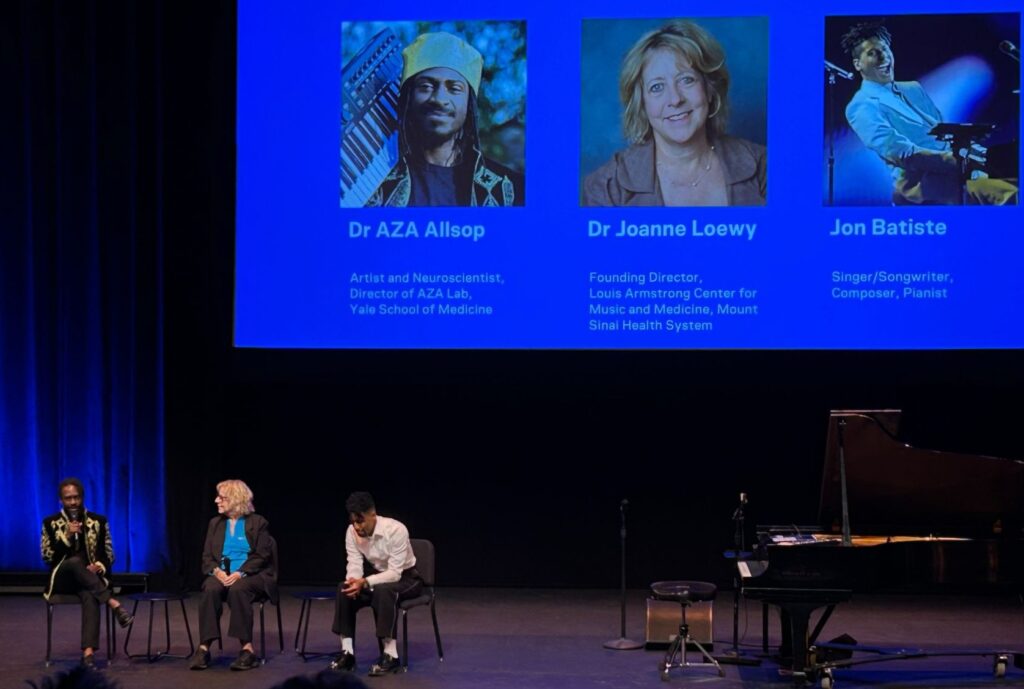
Discussion panel with Dr. Joanne Loewy and Jon Batiste led by Dr. AZA Allsop

The event began with NYU Provost Georgina Dopico welcoming the audience and introducing them to the collection’s contributors and the global arts and health movement afoot that is evolving from a discussion of whether the arts can be implemented to health “policy and systems at scale” to how. Following Dopico, Senior Advisor for the Cultural Life Office of the Deputy Mayor for Economic Justice, Sarah Calderón, drew attention to the major questions driving the movement: “Who has access to the systems that make healthy living possible?” and “How does healthy living go from being ‘a privilege’ to ‘a public good’?” Then, to close the program’s opening remarks, Stephen Stapleton, Co-Director of the Jameel Arts & Health Lab, shared about the Lab’s global impact on research—and the collaboration between artists and scientists in a space where they must treat each other as equals—outreach—and encouraging communities to engage with art and health initiatives—policy and increasing opportunities for artists, healthcare professionals, and researchers to improve and expand their practices.

After this, it was time for Batiste, Loewy, and Allsop to take the stage to provide the event’s keynote presentation. Their expertise—and the focal point of their discussion—lay in utilizing Social Music as a Prescription for Maintaining Wellness. Expanded upon in a peer-review paper published by the pair, social music was first theorized by Batiste and refers to, as noted in a press release by Mount Sinai on the paper’s publication, “participatory, culturally rooted musical experiences that foster connection, expression, and collective release.”
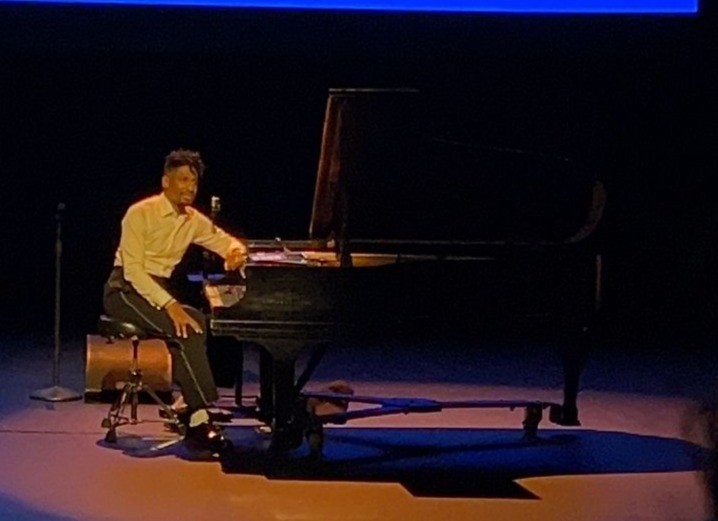
Jon Batiste addressing the audience while opening the keynote presentation

Batiste began sitting at a piano, opening by playing a blues tune because “in it is a sense of play,” and “the connection between the idea of music to transform and music to play is very important.” During his short performance, he invited the audience to join him in singing a song he composed for Soul. It was a beautiful, though brief, moment when members of a community—and one that may be commonly misunderstood as being deeply serious—connected with one another through song. Loewy then took a few moments to speak on the capacity of music to “help people back”, to ground them after life experiences that may be intensely difficult to process. She nodded to Batiste’s “Love Riots” as testaments to the power of social music to uplift and restore the human spirit. Finally, these two researchers sat down with Allsop for a short round of Q&A in the form of a “fireside chat” to round out their understanding of social music and the relationship between the arts and health for the audience.

Unfortunately, I wasn’t able to stay for the entirety of the event—I missed the Lancet Launch Performance and Panel, Performance by the New York Vocal Collective, and closing remarks—but this experience was still as inspiring as it was informative. I’m indescribably grateful for the spontaneous curiosity that encouraged me to buy a ticket. It taught me to view interdisciplinary research and practice in a new light, to nurture a spirit of constant interest, and to seriously consider my own relationship to art and health and role in encouraging others to reframe their understanding of the possible applications and affordances of both.

Most importantly, I learned the importance of undergraduate students getting involved with the events that are being held by their universities despite those opportunities not seeming to directly be relevant to their experiences. This event may have been organized with researchers, artists, and health industry professionals in mind, but the fact that the university still opened it up to undergraduate students is a testament to how we are valued as members of the citywide and global community and are being invited and implored to remain aware of and become involved in the social movements and initiatives taking place beyond our campuses.


Works Cited

“Mount Sinai Study Advances “Social Music” as a Prescription for Better Health Outcomes.” Mount Sinai Health System, 26 Mar. 2026, https://www.mountsinai.org/about/newsroom/2026/mount-sinai-study-advances-social-music-as-a-prescription-for-better-health-outcomes. Press release.
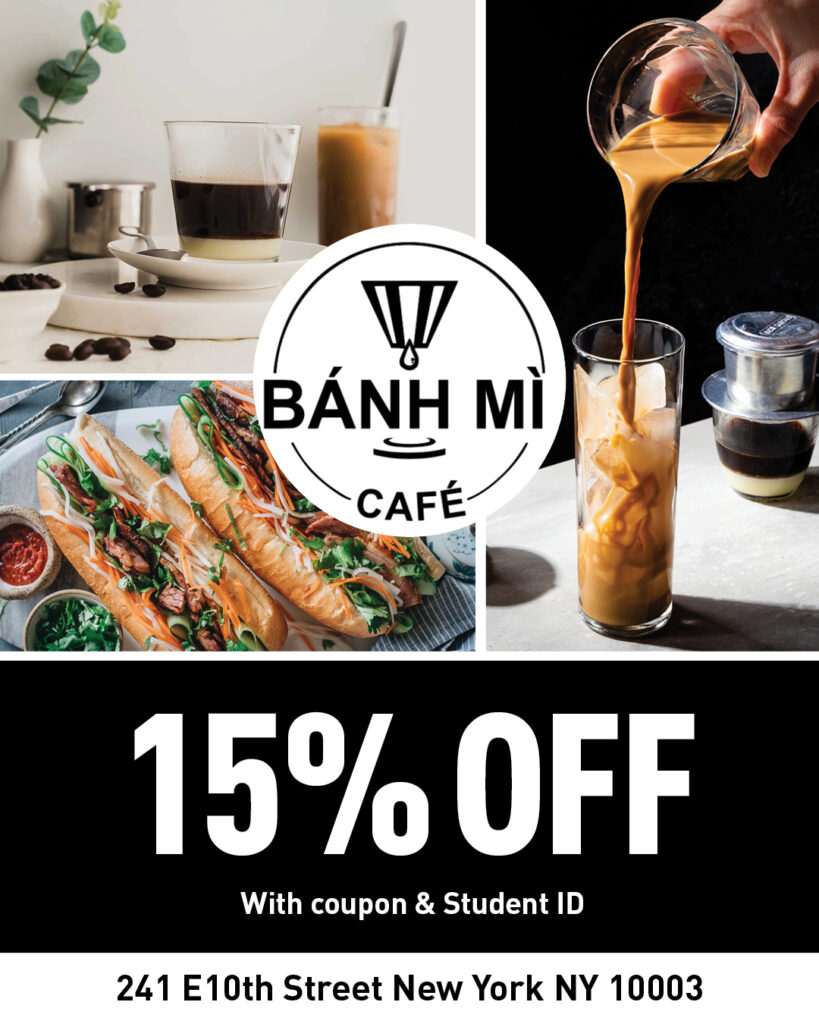

Looking to get better connected with the citywide community? Well, trying out new cafes is a great place to start! Stop by Banh Mi Cafe today and enjoy 15% off with this student discount.

By Lauren Gascon 

Lauren Gascon studies Media, Culture, and Communication at NYU and enjoys discussing people’s relationships with each other and themselves. When she’s not on campus, you can find her café hopping, browsing bookstores, or enjoying lunch in one of New York City’s many beautiful parks.


For over 25 years, the Campus Clipper has helped college students in New York City—and later in Boston and Philadelphia—save money and succeed in city life. We offer a digital coupon booklet with discounts on food, clothing, and services, plus an Official Student Guidebook with real advice on how to navigate college life in a big city. Our internship program lets students build skills, earn money, and publish their own e-books. Follow us on Instagram and TikTok @CampusClipper, and sign up for our newsletter to get deals straight to your inbox. To access the digital coupons, scan the QR code on our printed card—available in dorms, student centers, and around campus.

Share

Fluffy Cats and Little Wins 1: First and Foremost, You

Tuesday, September 29th, 2026

I struggle with putting myself first. I would argue many people do nowadays, when we’re more socially connected than ever. But even as a child, when you’re supposed to have this immense sense of ego and self-righteousness, I was the one the other kids went to when they needed to be heard. I listened to this boy Nathaniel’s story, and let him cry on my shoulder during recess. He thanked me at the end and left. It was around this age that I started really developing depression. I was around 8 years old.

In any case, I grew up with a ton of therapy because I evidently needed it from a young age. I’ve gone through major life changes and challenges with my trusty therapist, who I’ve been seeing since I was 16. I’m 20, a few months shy of 21 as I write this. There are so many things to learn from therapy, or more broadly, introspection and sitting with your thoughts from a third-person perspective. First and foremost, you learn about you and how to put yourself first in the most helpful way possible. For me, and for most people around me, that means prioritizing your mental health.

Wellness is not just about sleeping, exercising, or eating. It’s all the small things you do to care for how you feel on the inside and how to identify what you’re feeling or what you need. Developing self-worth and self-awareness takes time. It’s hard to ground yourself when emotions are high or when you’re low on energy. I know firsthand. Since I was little, I’d struggled with panic and anxiety attacks more often than the average person, and had to learn very early how to calm down. It’s scary, having a panic attack. During the worst ones, my hands and feet go numb; I’m prone to collapsing from a loss of feeling in my limbs, and the world whirls around me like a kaleidoscope. I still struggle with panic attacks every once in a while, but they are much more manageable as I learned how to recognize what they feel like from their onset and can get myself grounded faster. Years ago, a school nurse taught me a grounding technique where you touch your thumb to each of the rest of your fingers while counting to four each time you go through them.

I had to learn to find things that added to my sense of self in every little thing I did, or I would burn out of motivation too quickly and would never follow through. My passion only carried me so far into the hard work that I did. So I found small things I realized I enjoyed and paid more attention to them. The way the keys sound when I’m typing really fast or the sensation of them depressing under my fingertips (I’m enjoying this right now!) keeps me focused on what I’m working on without draining too much motivational energy. In fact, with every press of the key, it creates more motivational energy to pour into the task at hand.

It’s little things like this that I’ll be focusing on in this small eBook. Use it as a guide to follow your heart and your passions, not in the big ways that everyone talks about, like career, school, and hobbies, but in the quieter aspects of life that appear along those hard kinks in the road. Use it to pay attention to what you’re actually doing and the activities you’re participating in, the butterfly effects you are both a part of and creating. Hopefully, it’ll help you prioritize your wellness in a way that makes you feel like you’re prioritizing it at all—it just becomes the leading purpose in your life.

In sum:

  • Focus on putting your wellness first.
  • Wellness does not just mean physical health!
  • Find the little things that bring you joy and motivation.
Share

At Ghoroa, Finding Home in New York’s Little Bangladeshes

Tuesday, September 29th, 2026

Before a road trip could really begin, there was always breakfast.

On early mornings, my family would sometimes stop for stir-fried potatoes, warm paratha, and sweet halwa before leaving Brooklyn. Half-awake in the backseat, I would tear pieces of paratha with my hands, moving between sweet and savory bites while watching the city slowly disappear through the window as the familiar streets gave way to highways. Years later, I still think about those breakfasts and find myself craving that oily feeling on my fingertips. 

That is part of what makes Ghoroa so meaningful to me, with locations in both Jackson Heights and Kensington, two New York neighborhoods with deep Bangladeshi roots. For me, the Kensington location carries an especially personal connection. I grew up in the neighborhood, so walking into Ghoroa feels a little like walking into a memory.

Established in 2004, Ghoroa has become a neighborhood staple. People come in after long days, families gather around tables, and plates arrive with the unmistakable confidence of food meant to be shared. It is also remarkably affordable by New York standards: nothing on the menu exceeds $35, with most dishes being in the $10-20 range, and the portions are extremely generous. 

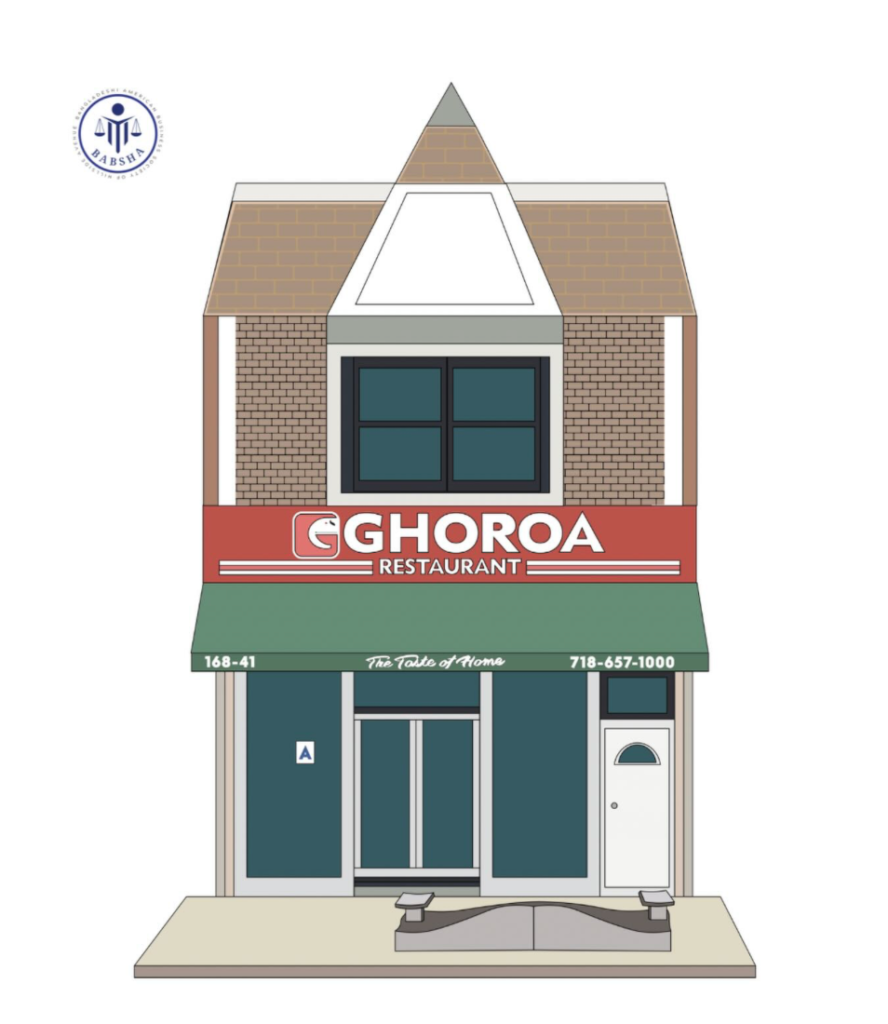
Illustration of Ghoroa Restaurant by BABSHA

I would start with the beef tehari, a close cousin to the biryani but with a more fragrant aroma and more subdued spice. The classic roast and pulao is a must have — it pairs tender chicken with a rich, yogurt-based curry and rice. And, if you make it there on a weekend, look for the kacchi biryani, the traditional Bangladeshi style biryani born in the capital, Dhaka. 

But Ghoroa’s real charm is not just what comes out of the kitchen, but who is behind it. Moms and Aunties. Women who seem to possess the ability to cook for fifty people without breaking a sweat. They are making the food that reminds people of home, even when home is thousands of miles away.

For New York’s immigrant communities, food can make thousands of miles feel like a manageable distance. A plate of rice and curry can carry memories of a city left behind. Restaurants become gathering places, and for someone who has never been to Bangladesh, sitting down to a plate of tehari can be a small way of stepping into that world.

And that is the magic of food; you do not need to share someone’s history to share their table.

And if you find yourself in Jackson Heights, you might as well commit to the adventure. Make a whole food crawl out of it. Start with Bangladeshi tehari at Ghoroa, wander around for some Nepali momos, and wash it all down with an Indian mango lassi. Or, if you are at the Kensington location, grab your food to go and take the roughly 15-minute walk to Prospect Park, find a patch of grass, and turn lunch into a scenic afternoon.

You can start with a dish that is completely unfamiliar, wander through a neighborhood shaped by generations of immigrants, and end up sitting in a park eating food from a culture you may know very little about. New York makes that possible. Food gives you an easy way in. You can start with curiosity, stay for the conversation, and leave with a new favorite dish or just a better understanding of the people that make up the city around you.

So bring a friend. Bring your family. Come hungry. Ask what you should order. Try something you have never had before!


Craving something sweet? You have plenty of options with your school ID.

By Sameena Saudah

Sameena Saudah is a student at NYU studying Nutrition and Dietetics. Outside of calculating macronutrients, you can find her enjoying a good book or trying to fulfill her lifetime goal of trying a new restaurant every week.


For over 25 years, the Campus Clipper has helped college students in New York City—and later in Boston and Philadelphia—save money and succeed in city life. We offer a digital coupon booklet with discounts on food, clothing, and services, plus an Official Student Guidebook with real advice on how to navigate college life in a big city. Our internship program lets students build skills, earn money, and publish their own e-books. Follow us on Instagramand TikTok @CampusClipper, and sign up for our newsletter to get deals straight to your inbox. To access the digital coupons, scan the QR code on our printed card—available in dorms, student centers, and around campus.

Share

Finding Friends in the City: Notes from an NYC Newcomer

Tuesday, September 29th, 2026

In a city as busy and bustling as New York, it can be incredibly difficult to find your community. You may be asking yourself, ‘how could I possibly feel lonely in a city with so many people?’, but I assure you it’s a very common and normal occurrence, especially for NYC newcomers. 

I grew up in the midwest and spent twenty-three years of my life living in Wisconsin, attending undergrad at the University of Wisconsin-Madison and staying very close to home. Simply put, I just wasn’t ready to leave. I had my community, my friends, and my family, all people whom I loved, so really what more could I ask for? But after graduating college and preparing for graduate school, I decided it was time for a fresh start, and now here I am in New York City as an MFA student! 

As students, we’re often told by staff and faculty that the best way to meet new people is to attend university events, and at first I was honestly a bit skeptical. I didn’t attend a lot of events in college, and I assumed my classes would be enough to build my community. But I took a chance the second week of classes and attended a student reading for the creative writing program at one of the local bars. I didn’t know a lot of people, and being from the midwest I felt a bit like an outsider. But I quickly realized that the hardest part – pushing myself to attend that event, to get out of my comfort zone – was over and I ended up striking up a conversation with some fellow students and talking with them for the rest of the night!

Study groups are another great way to build your community. Through my classes, I’ve been able to find people with similar goals and interests as me, and studying together can really foster a sense of comradery. Until coming to the city, I didn’t fully realize the importance of finding those people who want the same things as me, who share the same goals and aspirations. But, as we all know, NYC is filled with so many people chasing so many different dreams, and building those connections has been essential to my work and well-being, especially as someone who’s new to the city.

I think we can all agree that school can sometimes feel like a chore, even when we’re studying something we’re really passionate about. I’ve found that one of the best ways to blow off some steam is to hang out with your friends after class. This simple act has really helped me decompress after a long day, and just reflecting on the shared experience of attending class together has really brought me closer to my classmates. I even joined a group chat with my graduate program made specifically for hanging out or grabbing a drink after class, and it’s been one of the most successful ways I’ve built my community. Exchanging numbers and making group chats can be extremely advantageous when finding your people, especially in this current age of technology, and I’ve made it a point to get my classmates’ contact info as much as possible.

Moving to New York has proven to be one of the best decisions of my life, and I have my friends to thank for that. Finding your people is so crucial in such a big city, and though it can be overwhelming when starting out, I promise it’s all worth it. Every step I’ve taken to build my community has helped me learn and grow as a person, and I couldn’t have built the connections I have without putting myself out there and taking a chance.

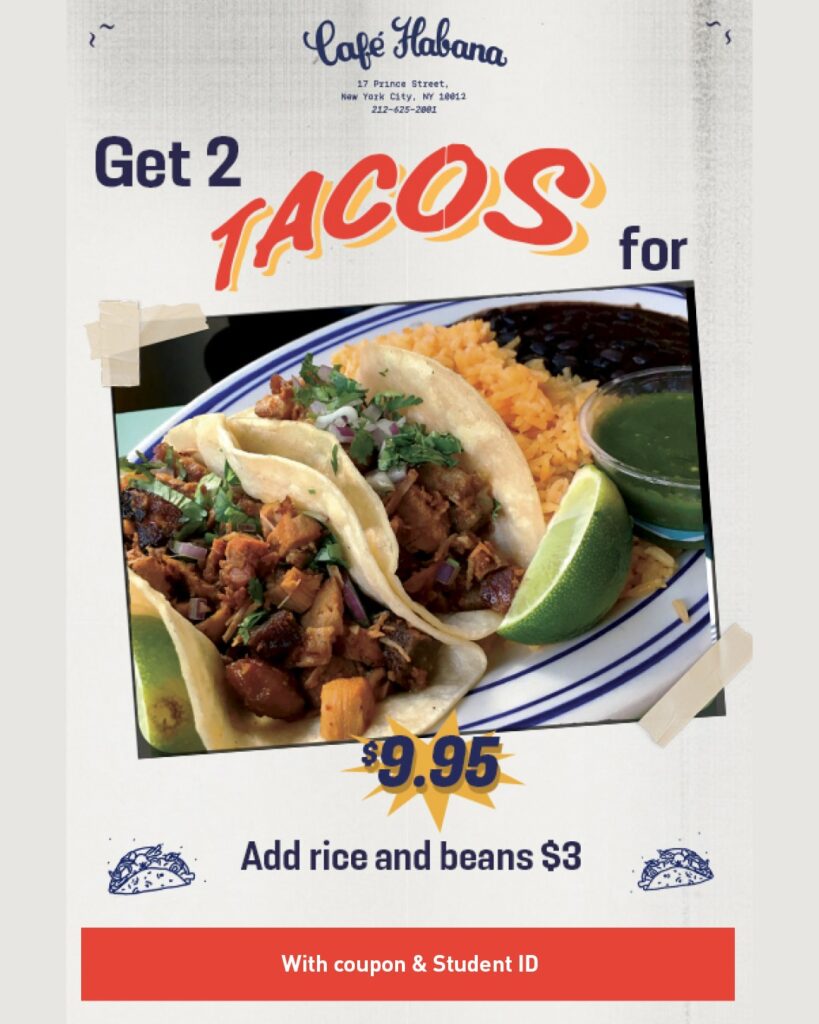
Looking for an after-class taco spot for you and your friends? Use this coupon for a discount at Café Habana!

By Katrina Kallas

Katrina Kallas is a first-year graduate student at The New School, studying creative writing with a concentration in fiction. Originally from Wisconsin, they enjoy writing about relationships, friendships, and personal values. In their free time, they write fictional stories on a variety of topics and hope to publish a novel after they graduate. 


For over 25 years, the Campus Clipper has helped college students in New York City—and later in Boston and Philadelphia—save money and succeed in city life. We offer a digital coupon booklet with discounts on food, clothing, and services, plus an Official Student Guidebook with real advice on how to navigate college life in a big city. Our internship program lets students build skills, earn money, and publish their own e-books. Follow us on Instagram and TikTok @CampusClipper, and sign up for our newsletter to get deals straight to your inbox. To access the digital coupons, scan the QR code on our printed card—available in dorms, student centers, and around campus.
Share