
Posts Tagged ‘making changes’

Making Decisions and Changing Your Mind: An Interview with Emerson

Thursday, June 18th, 2026

Being a new adult, you become very familiar with feeling pressured to lay out a foolproof plan for your future and execute it perfectly. Maybe your loved ones have tried to encourage you by stating that “it’s unfair to expect an eighteen-year-old to have their whole life figured out.” However, when placed in a collegiate space—where every student feels this weight, fronts that they have it all together, and, in turn, feeds the insecurities and uncertainties of their peers—it is easy to deceive yourself into believing that you are falling behind, incapable of achieving your goals, or trapped by the direction you have determined for yourself.

For the entirety of my first two years at NYU, I wrestled with these convictions. Thankfully, I wasn’t alone. During a debrief with two of my high school friends, one of them shared that while we were apart for the academic year, she was navigating her own period of change, self-doubt, and uncertainty. So while reflecting upon what may be the best course of action for a student interested in revising their four-year or postgraduation plan, I decided to ask Emerson for advice as someone who had undergone the revision process herself.
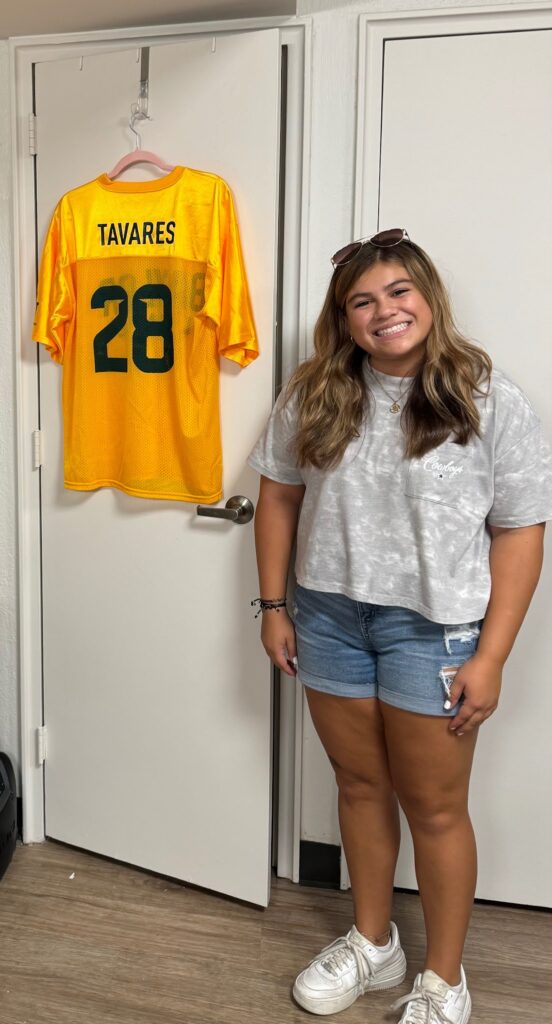
Moving into her freshman dorm, Emerson snapped a photo with her Baylor Line jersey

Now a junior at Baylor University majoring in accounting, she had originally intended to major in psychology and follow the pre-med track on her way to becoming a psychiatrist. The academic tasks demanded of her during her freshman year forced her to reflect upon her vision for life after graduation. She expanded upon her change of heart, sharing that “after the first year of college, I realized that science wasn’t something I loved, and it’s something that you have to love to be able to stick it out.” She remembered her interest in the business class she took that spring semester and, going into her sophomore year, decided to declare a business major.

Naturally, there was a hefty amount of wrestling with her own self-determination before shifting gears. She admits that she had likely sensed that she had no true desire to pursue a heavily science-oriented career by the end of her freshman fall semester. However, at the time, she was thinking, “This is what I told my parents, my friends…this is what everyone thinks that I’m going to do.” Though, despite her instinctual worry that they may be shocked or angry, it turned out that her loved ones were more than willing to encourage her new endeavor, and she explained that deep down she knew her parents would understand. Once she accepted that it was time to pursue a different path, Emerson’s friends, particularly her roommate, who was already part of the business program, and Baylor’s Major Exploration and Success and business advisors helped guide her transition.

Emerson still plans on extending her credentials beyond a bachelor’s degree. In fact, the program she is currently enrolled in will allow for her to graduate from Baylor in 2028 with a master’s degree. But beyond the security and stability that her career shift offers, it also equipped her with a new perspective on failure, success, and making decisions across life’s facets.

As a young adult, it can be easy to equate changing your mind with failure and to approach it with fear. However, looking back on her initial approach to change, Emerson learned to recognize that she didn’t fail. Rather, “what [she] had originally thought was going to be good for [her] actually [wasn’t],” and it’s okay for her to change her mind if it means finding a path that is better suited for her. 

Other than academic or professional decisions, Emerson has found herself navigating new terrain in her friendships and faith. To become better decision makers, she advises incoming freshmen to build steady support systems and develop a willingness to experiment with the unfamiliar—new relationships, interesting clubs, or different majors—even if this involves failing. Ultimately, as Emerson’s undergraduate journey thus far exemplifies, what is at first perceived as a failure may soon become an indication of better-aligned pathways, leading to a much more fruitful college experience.


Deciding to try out a new look? Experiment with this 10% coupon!

By Lauren Gascon 

Lauren Gascon studies Media, Culture, and Communication at NYU and enjoys discussing people’s relationships with each other and themselves. When she’s not on campus, you can find her café hopping, browsing bookstores, or enjoying lunch in one of New York City’s many beautiful parks.


For over 25 years, the Campus Clipper has helped college students in New York City—and later in Boston and Philadelphia—save money and succeed in city life. We offer a digital coupon booklet with discounts on food, clothing, and services, plus an Official Student Guidebook with real advice on how to navigate college life in a big city. Our internship program lets students build skills, earn money, and publish their own e-books. Follow us on Instagram and TikTok @CampusClipper, and sign up for our newsletter to get deals straight to your inbox. To access the digital coupons, scan the QR code on our printed card—available in dorms, student centers, and around campus.


Share

Time for Revision

Saturday, December 31st, 2016

Image Credit: https://www.helpingwritersbecomeauthors.com/category/editing-your-novel/page/2/

Image Credit: https://www.helpingwritersbecomeauthors.com/category/editing-your-novel/page/2/

Yay! You’re finished! Congratulations. Pour yourself a nice flute of champagne and relax. You’ve earned it. You just wrote a novel.

If you just wanted to write a novel to write a novel and maybe brag about it to some people, then by all means, get on with it. If you want to share it with some of your closest literary friends or maybe send an excerpt to the New Yorker or Atlantic Monthly—still take your time enjoying the champagne. Put the whole thing out of your mind for at least a few days. When you’re still in the mindset of cranking out the words, it’s easy to get attached to passages or characters that actually drag down your writing. After a nice rest, prepare yourself for the revision cave.

 The Writing

Now’s the time to look carefully at your writing, its mechanics and logical constructions. Style has nothing to do with it; it’s strictly a close, word-by-word reading. Check your diction. Do you really need to use “twirl” twice in one short paragraph when you envision two different motions (other words: “swirl,” “spin,” “turn,” “stir”)? Do you really need to use different speech tags (said, shouted, murmured, whispered, accused, countered, replied, yelled, etc) when the characters are having a superficially low-key conversation and everything is actually just “said”? Jeffrey Eugenides raises a similar complaint about Oscar Wilde’s diction in The Picture of Dorian Gray; Wilde doesn’t abuse his thesaurus, he merely dramatizes everything. No one ever just sits, everyone “flings himself down” on something. If Dorian is uncomfortable, he always does things nervously, and when he’s nervous, he always twitches. Pick the right word for the right image.

 The Arc

Go through and, at the end of each chapter or section or what have you, record the characters’ progressions in that section, how it fits into their overall transformations, and major plot developments. If a character regresses at some point, does it make sense? People regress all the time. There’s usually an impetus. You can’t crowd everything under the umbrella of “it’s the character” just because that’s how they were at the start. Even if you’d prefer to keep a character static, make sure the justification comes through. Laying out developments in this outline can also help you pinpoint trouble spots in pacing.

 Excise, Excise, Excise

Just because it’s a novel and you can make it as long as you want doesn’t mean you need to devote lines to everyone’s hair color and outfit or the entire layout of a room. Of course, there will be parts that need more clarification, but for the most part, you can afford to cut out entire paragraphs without confusing anyone. Whatever you leave in has to have a purpose. You don’t necessarily have to follow Chekov’s Rule, but if you’re going to spend the time to note what your characters order from Starbucks, then their orders have to mean something. Hot chocolate? Iced coffee during a Russian winter? Drip coffee instead of a latte? Americano instead of drip coffee? In real life, that doesn’t indicate anything significant, but in a novel, it matters (unless your point is that it doesn’t actually matter, in which case you have more thematic issues to sort anyway). Oh, and that huge existential monologue/soliloquy with some beautifully flowery phrases you wrote in a feverish haze of inspiration can stand to lose half its length. Hemingway says of his writing process, “I write one page of masterpiece to ninety-one pages of shit. I try to put the shit in the wastebasket.” We’re not all minimalists like Hemingway, though. Hold onto some of your pretty, introspective bits. The good bits.

 Sidebar:

If you need a break or want to procrastinate even more, spend some time on www.reasoningwithvampires.tumblr.com, a snarky passage-by-passage critique of Twilight. It’s an equal opportunity hater with regards to all the things people find wrong with Twilight, so be forewarned…but definitely pay attention to perhaps the most indisputable problem with the series: it’s just not well written. There are periods of rampant thesaurus abuse; there are periods of predictable diction; there are moments when the limited first person is suddenly omniscient; there are illogical sequences of action, in which someone walks away and suddenly reappears to respond to something; there are sloppy (rather than stylistic) comma misuse. (What’s the difference between a sloppy and a stylistic one? In Twilight: “He lay, smiling hugely, across my bed, his hands behind his head, his feet dangling off the end, the picture of ease.” In Joan Didion’s “Goodbye to All That”: “It is easy to see the beginnings of things, and harder to see the ends.” Didion said in an interview, “every word and every comma and every absence of a word or comma can change the meaning, make the rhythm, make the difference.” Sometimes you have to earn the right to flaunt grammar. Life’s not all fair.) Forget Bella and Edward’s questionable status as “heroine” and “the best dark brooding boyfriend ever.” When your words and their order distract a reader from the throwaway details they describe, something is wrong.

By Robin Yang


Robin Yang was one of the Campus Clipper’s publishing interns, who wrote an e-book on how to write a novel. If you like Robin’s writing, follow our blog for more chapters from this e-book. We have the most talented interns ever and we’re so proud of them! For over 20 years, the Campus Clipper has been offering awesome student discounts in NYC,  from the East Side to Greenwich Village. Along with inspiration, the company offers students a special coupon booklet and the Official Student Guide, which encourage them to discover new places in the city and save money on food, clothing and services.  

At the Campus Clipper, not only do we help our interns learn new skills, make money, and create wonderful e-books, we give them a platform to teach others. Check our website for more student savings and watch our YouTube video showing off some of New York City’s finest students during last year’s Welcome Week.

Become a fan on Facebook and follow us on Twitter and Instagram

Share