
Posts Tagged ‘choosing a major’

Making Decisions and Changing Your Mind: An Interview with Emerson

Thursday, June 18th, 2026

Being a new adult, you become very familiar with feeling pressured to lay out a foolproof plan for your future and execute it perfectly. Maybe your loved ones have tried to encourage you by stating that “it’s unfair to expect an eighteen-year-old to have their whole life figured out.” However, when placed in a collegiate space—where every student feels this weight, fronts that they have it all together, and, in turn, feeds the insecurities and uncertainties of their peers—it is easy to deceive yourself into believing that you are falling behind, incapable of achieving your goals, or trapped by the direction you have determined for yourself.

For the entirety of my first two years at NYU, I wrestled with these convictions. Thankfully, I wasn’t alone. During a debrief with two of my high school friends, one of them shared that while we were apart for the academic year, she was navigating her own period of change, self-doubt, and uncertainty. So while reflecting upon what may be the best course of action for a student interested in revising their four-year or postgraduation plan, I decided to ask Emerson for advice as someone who had undergone the revision process herself.
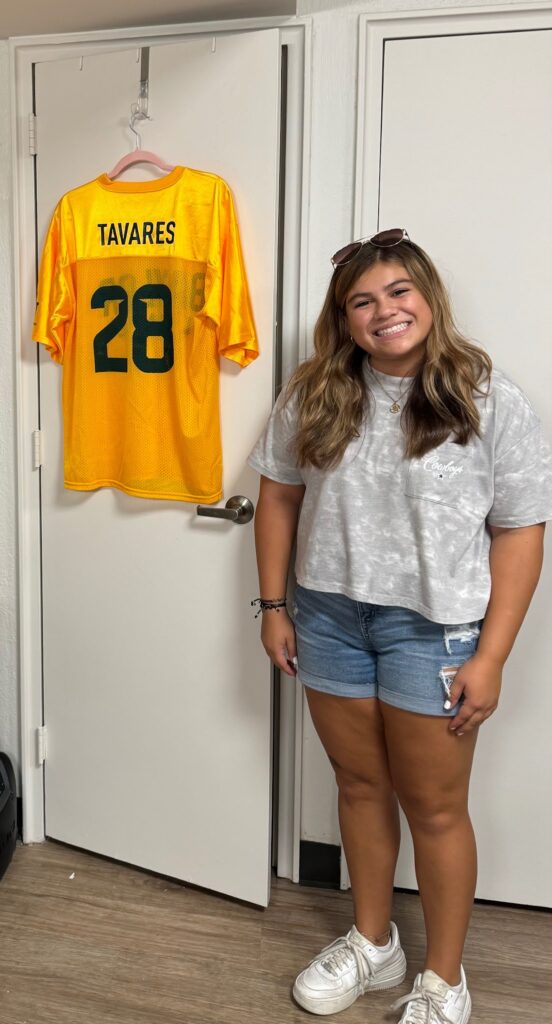
Moving into her freshman dorm, Emerson snapped a photo with her Baylor Line jersey

Now a junior at Baylor University majoring in accounting, she had originally intended to major in psychology and follow the pre-med track on her way to becoming a psychiatrist. The academic tasks demanded of her during her freshman year forced her to reflect upon her vision for life after graduation. She expanded upon her change of heart, sharing that “after the first year of college, I realized that science wasn’t something I loved, and it’s something that you have to love to be able to stick it out.” She remembered her interest in the business class she took that spring semester and, going into her sophomore year, decided to declare a business major.

Naturally, there was a hefty amount of wrestling with her own self-determination before shifting gears. She admits that she had likely sensed that she had no true desire to pursue a heavily science-oriented career by the end of her freshman fall semester. However, at the time, she was thinking, “This is what I told my parents, my friends…this is what everyone thinks that I’m going to do.” Though, despite her instinctual worry that they may be shocked or angry, it turned out that her loved ones were more than willing to encourage her new endeavor, and she explained that deep down she knew her parents would understand. Once she accepted that it was time to pursue a different path, Emerson’s friends, particularly her roommate, who was already part of the business program, and Baylor’s Major Exploration and Success and business advisors helped guide her transition.

Emerson still plans on extending her credentials beyond a bachelor’s degree. In fact, the program she is currently enrolled in will allow for her to graduate from Baylor in 2028 with a master’s degree. But beyond the security and stability that her career shift offers, it also equipped her with a new perspective on failure, success, and making decisions across life’s facets.

As a young adult, it can be easy to equate changing your mind with failure and to approach it with fear. However, looking back on her initial approach to change, Emerson learned to recognize that she didn’t fail. Rather, “what [she] had originally thought was going to be good for [her] actually [wasn’t],” and it’s okay for her to change her mind if it means finding a path that is better suited for her. 

Other than academic or professional decisions, Emerson has found herself navigating new terrain in her friendships and faith. To become better decision makers, she advises incoming freshmen to build steady support systems and develop a willingness to experiment with the unfamiliar—new relationships, interesting clubs, or different majors—even if this involves failing. Ultimately, as Emerson’s undergraduate journey thus far exemplifies, what is at first perceived as a failure may soon become an indication of better-aligned pathways, leading to a much more fruitful college experience.


Deciding to try out a new look? Experiment with this 10% coupon!

By Lauren Gascon 

Lauren Gascon studies Media, Culture, and Communication at NYU and enjoys discussing people’s relationships with each other and themselves. When she’s not on campus, you can find her café hopping, browsing bookstores, or enjoying lunch in one of New York City’s many beautiful parks.


For over 25 years, the Campus Clipper has helped college students in New York City—and later in Boston and Philadelphia—save money and succeed in city life. We offer a digital coupon booklet with discounts on food, clothing, and services, plus an Official Student Guidebook with real advice on how to navigate college life in a big city. Our internship program lets students build skills, earn money, and publish their own e-books. Follow us on Instagram and TikTok @CampusClipper, and sign up for our newsletter to get deals straight to your inbox. To access the digital coupons, scan the QR code on our printed card—available in dorms, student centers, and around campus.

Share

Dreamland Ch. 2: Surefire tricks to get your relatives to stop asking you about school

Wednesday, June 18th, 2025

Money. It makes the world go round, or something like that. I may have decided my passion from a young age, but I hadn’t decided on a job, not in any practical way. The hard lesson everyone learns between ages 17 and 21 is that choosing your dream is different from choosing your major, which is yet again different from choosing your career. I learned this lesson the moment I fostered my love for creative writing, and I keep learning it every day.

It’s not so bad, really. I’m studying English, which is very transferrable to a number of different fields, no matter what people will tell you. You only have to engage in a quick cursory scroll through any social media platform to understand that people lack writing skills, communication skills, and critical thinking skills. People lack empathy and can’t formulate nuanced opinions. I’m not suggesting that everyone become an English major, but I do encourage a reworked perception of what the field can offer. 

So I don’t regret what I’ve chosen; I only regret not pushing myself out of my comfort zone far sooner, all the way back in high school, in order to learn the skills I’d need to shape my career in English. In freshman year of college, I unfortunately hesitated to join extracurriculars and attend general meetings that would allow me to meet new people and find things I might be interested in. I’ve since overcome that hesitation, thankfully, and now I know that I enjoy journalistic writing, marketing, communications, and more generally, learning new things.

That doesn’t mean the insecurity doesn’t creep in every once in a while. Every month, I spend at least one evening freaking out about what I will do after I graduate, and I panic-apply to a million jobs that I ultimately don’t hear back from. My parents are incredibly supportive and love to hear about school, but I’ve noticed that my family friends, the aunties and uncles, aren’t quite sure what to ask or if there is anything to even discuss. I get it, truly, but I can’t help but compare myself to my sister and others in our family who’ve chosen something more recognizable.

If you’re in the humanities, you probably understand this feeling—the tugging sensation that suspends you between your wildest dreams and the real world below. The Icarian knowledge that either side will damn you. Most of the time, it doesn’t feel quite this theatrical, but I don’t think anyone is immune to the chilling realization, even if inaccurate, that the things you do as a teenager determine the rest of your life. Such is the condition of being a teenager in the first place. Why can’t we all just do what we love, right?

NYU’s Silver Center for Arts and Sciences, home to English majors and others. Image Credit: https://meet.nyu.edu/locations/silver-center/

The divide between your passion and your career prospects might feel chasmic now, but there are ways you can reconcile even the most distant of pipe dreams and the most mundane 9-to-5 jobs. 

I used to work for NYU’s outreach and fundraising organization, which was often the bane of my existence, but I took every shift as an opportunity to learn about other people and their backgrounds. I learned about their fields of interest and the ways they used their schooling to propel them into careers that suited their niche interests. I once spoke to someone that illustrated tarot cards. I still quit that job after a semester, but I have plenty of stories to tell. which makes the semester of asking strangers for money sort of worth it. I don’t intend on continuing that sort of work full-time, but I know that if I keep collecting stories and experiences like that one, I’ll find joy in any job.

My ultimate goal is to have a job that sustains me financially and doesn’t make me dread it every night and morning, but I think eventually I’ll come to accept that your job won’t and probably shouldn’t be your life. If I completely turn creativity and writing into my source of income, will I still covet them as I do now? 

If you siphon all your passion into the thing that you have to do or you lose your stability, is it still passion? 

My hope is that I can look down that cavernous gap and feel security in traveling between both sides of it. My hope is to make just enough money that I feel content waking up each morning—though I certainly wouldn’t be mad if I made a little more. Money might sustain you, but your passions will keep you alive.


Students receive a 10% discount at Dim Sum Palace at three locations in NYC. Redeem now for authentic Chinese dim sum.

By Oshmi Ghosh

Oshmi Ghosh is a rising junior at NYU’s College of Arts and Sciences, pursuing a bachelor’s degree in English with minors in Creative Writing, History, and Entertainment Business. You can usually find her appreciating the simple things in life: tea with milk and sugar, a good book, and/or intensely competitive board games.


For over 25 years, the Campus Clipper has helped college students in New York City—and later in Boston and Philadelphia—save money and succeed in city life. We offer a digital coupon booklet with discounts on food, clothing, and services, plus an Official Student Guidebook with real advice on how to navigate college life in a big city. Our internship program lets students build skills, earn money, and publish their own e-books. Follow us on Instagram and TikTok @CampusClipper, and sign up for our newsletter to get deals straight to your inbox. To access the digital coupons, scan the QR code on our printed card—available in dorms, student centers, and around campus.

Share