
Giving Back: Discovering your talents

March 14th, 2014

Being actively involved in youth programs for 4 years, I saw many people dive into the deep end and jump out screaming. Working with teenagers has its joys and struggles. Joys: going on camping trips, watching movies, eating junk food…because it’s socially acceptable. Struggles: the drama, apathy, disrespect, family finance issues, “ADHD” that every kid has, oh and the DRAMA.  Sadly for the most part, it is unacceptable to smack kids across the head, even if you want to.

Me and all my children! Okay not really. This is a picture of me and my husband on our wedding day surrounded by the students in our small group. Probably wanted to smack each of them across the head at one point or another...love them!


As fun and rewarding as working with teenagers can be, I’ve noticed that not everyone is wired the same way. Watching youth leaders jump in and out was draining and discouraging not only for the students but also for me.

I can be flexible, if the requirement is to be flexible. Although if I’m set on a goal and someone throws another task at me, I may panic a bit. If someone invites me to a party and I know only one person there, I will dread it and spend the whole day planning an escape route. Yet if I’m playing a game of charades with a group of friends, I am totally down to act out 12 different characters.

Why does this matter? Well, I try as best as I can to really get to know myself. I believe that if I can study myself, my strengths, and my passions, I can serve in a way that utilizes my talents. If you serve at an organization, and you’re given the option of different jobs like working with children, prepping in a soup kitchen, or editing video footage, wouldn’t you like to serve using your gifts?

My point above was not to shame the people who tried to be youth leaders and left, but to encourage you to first look at yourself and your skills then start from there. The saying, “choose a job that you love, and you will never have to work a day in your life”, doesn’t have to simply apply to your career, but also applies to where you volunteer. If you are clueless to what you enjoy, hopefully these ideas below can lead you in the right direction.

  1. Extrovert or Introvert?
    Ah, the lingering question. Am I an extrovert or an introvert? All my life I’ve been a very loud little person, but recently when reading a Huffington Post article called, “23 Signs You’re Secretly an Introvert”, I’ve realized that my personality leans towards introvert. The reason why I find this important to research, is not to label someone as introvert or extrovert, because more cases than not someone isn’t what they seem, but instead to use this tool to understand how your own mind works. It’s comforting to read an article from a fellow introvert and realize, I think that way too! By researching this simple trait you can better understand yourself.
  2. Career /Personality Quizzes
    Figuring out a future career during college is hard enough. Chances are you still won’t know what you want to do until you get actual experience. Why not use the info you received from a career quiz to help figure out what area you would enjoy serving in? There are many ways to serve, so choose something that you feel you can excel at.
  3. Find Your Passion
    Sometimes it’s too hard to just ask yourself, okay, what makes me happy? I always hated that question because I felt that there are so many different hobbies I enjoy doing. So grab a coffee (to get some caffeine to kick in), a pen and paper, and write down what makes you angry. Yes, angry. What do you see in the news, or on the streets that just makes you mad. If you can find an injustice in the world that bothers you to the core, then you have realized what is worth fighting for.
  4. Ask Your Friends
    If all else fails, ask your friends what they think. Close friends know you. They see what makes you happy and what drives you mad. Just before my graduation I made sure to ask my dad what he thought I could do for the rest of my life. Clearly, in my life, a degree is just the beginning. We brainstormed about what I’ve done over the past few years that I’ve enjoyed, which encouraged me to press further and figure out my role in society.

Self-actualization is a simple step that can help you understand your talents before you begin volunteering. Now that you have researched yourself, next you must research organizations.


———————————————————————————————————

Samantha Bringas

Follow the Campus Clipper on Twitter and Like us on Facebook!

Interested in more deals for students? Sign up for our bi-weekly newsletter to get the latest in student discounts and promotions  and follow our Tumblr and Pinterest. For savings on-the-go, download our printable coupon e-book!

Share

The Decision Making Process

March 12th, 2014

Now that the goals for a trip are set up, it is time to get into the gnitty gritty details on how to plan for the trip!  So the question being raised now is where should I go?

Deciding where to go

Now, this is normally not a hard question to answer because people usually have destinations in mind when they want to travel, but what about those who have no idea where to travel?  What about those who don’t think they have enough money to travel?  Well, here are some tips to consider:

-There is always the option to travel locally.
-Make sure the travel plans are within a reasonable budget.
-Use goals to help decide where to go.

For those who have never traveled before, the first suggestion I will give is to travel to somewhere close by.  Whether it is only fifty miles away or just to the next state over, short distance travelling is also travelling.  Travelling a short distance allows people to get a feel on how it is to travel.  If your hometown is New York City for example, travelling to Long Island and staying there overnight can give one a new outlook on how different somewhere so close can be.  Even going to Philadelphia and checking out their town hall and market can be an amazing travelling experience!

For those who wish to travel some longer distances, it is important that the location is within budget range.  Being a college student strictly increases the financial impact that money has on travelling.  When planning for a trip, one must always take into account how much money is available.  Realistically, it is near impossible to plan a trip to India with only two-hundred dollars.  Travel costs, accommodation costs and food costs are some of the obstacles that might get the way.  My rule, although not always applicable, is to add two-hundred dollars to a trip costs after making it.


Remember the goals list?  Use that to help create the best personal plan.  A list of goals is the first step in creating the skeleton for a good travel plan.  It is the foundation and first step in creating a good travel experience.  Don’t forget that Tripadvisor is a great tool when looking for places to go.

Deciding where to go will ultimately depend on the individual.  Do not forget that although travelling can be a great adventure, the process will have some expenses on way or another.  Traveling takes time, effort and energy.  As other issues are delved upon, it will greatly impact the trip and help solidify the need for planning.


——————————————————————————

This was written by Gary Chen of Stony Brook University

Follow the Campus Clipper on Twitter and Like us on Facebook!

Interested in more deals for students? Sign up for our bi-weekly newsletter to get the latest in student discounts and promotions  and follow our Tumblr and Pinterest. For savings on-the-go, download our printable coupon e-book!

Share

The value of critical thought

March 11th, 2014

If you think about it, nearly everything in life can be problematized. We have the power to scrutinize ideas that are normally left unexamined and unquestioned. If you’re like me, you’ll find this prospect invigorating.

Don’t get me wrong––gratefulness is a large part of the self-revolution. It goes against everything we’ve been taught since we were young, especially in terms of our relationships with material goods. Indeed, gratefulness can open us up to opportunities like college savings and college discounts. But the practices of critical thinking and gratefulness do not have to be mutually exclusive.

You can practice acceptance of certain conditions––for example, the not-so-great material conditions you may face as you pursue the path that you’ve chosen––while at the same time refusing the very basis upon which this idea is founded: that the pursuit of money above all else is necessary for a comfortable existence.

A critical thinker would pause and ask why this has to be.

Do you think as deeply as this guy?

“Hard work” has long been a foundational value of American cultural and political thought. You could say that it’s entrenched in the American consciousness. But if you reflect for a bit, you’ll see that the idea of “hard work” is often used to justify racism, classism, sexism, nationalism, and other forms of discrimination.

The Declaration of Independence is a list of completely subjective statements constructed by a group of individuals interpreting their history in an effort to legitimize the coming insurrection against their rulers. One very famous line that Jefferson uses in the Declaration is meant to stifle critique before even it has the chance to manifest: “We hold these truths to be self-evident…”

This phrase is a perfect example of “one-dimensional thought” in operation. As critical theorist Herbert Marcuse wrote in One Dimensional Man:

“The closed language does not demonstrate and explain––it communicates decision, dictum, command” (101).

Deeming certain principles “truths” and describing these “truths” as “self-evident” without explaining why they are effectively shuts down any possibility for critique. If you don’t believe in what Jefferson is about to lay down, you’re perceived as unreasonable.

How can you question truth, let alone truth that is visible to each and every one of us? C’mon!

The perpetuation of unquestioned ideas is certainly not limited to 18th century political documents. Each of us contribute to this process every single day without realizing it.

Right from the beginning, our education system attempts to suppress the curious and critical tendencies of each child by forcing them to adhere to unquestioned notions and behaviors through standardized tests and rigid modes of teaching.

In a socioeconomic system that relies on a mass of individuals who do as they’re told and not much more, there is a multitude of power in critical thought. Critical thinking works to subvert the blind acquiescence which is a necessary component of the political and economic systems under which we live.

Given the fact that some ideas and methods of thinking are so powerfully entrenched in our consciousness, how can you begin to think critically?

To answer this question, I turn, once again, to Michel Foucault. Foucault described the elements of his moral code as such:

“(1) the refusal to accept as self-evident the things that are proposed to us; (2) the need to analyze and to know, since we can accomplish nothing without reflection and understanding—thus, the principle of curiosity; and (3) the principle of innovation: to seek out in our reflection those things that have never been thought or imagined. Thus: refusal, curiosity, innovation.”

The first step, then, is to realize that some of the truths we accept as “self-evident” are not necessarily so.

We say certain things and behave in certain ways that conform to what we accept as the “facts of life.” These “facts” are, for the most part, accepted by everyone and perpetuated without question.

Questioning these assumptions which are so often taken for granted is a powerful practice. It’s what we must start doing if we wish to radicalize our selves and society.

You can use critical thinking skills to change the direction of your life. Hopefully you'll perform a bit better than this button-hungry parrot.

The third element in Foucault’s list––innovation––depends entirely on the first two, refusal and curiosity. Without rejecting and analyzing an idea that is assumed to be self-evident, it’s impossible to create something new. How can you innovate without moving past the artificial barriers you face?

Critical thinking enables you to be creative, to see things differently, and to define your true values within the midst of a monotonous society that encourages cookie-cutter modes of thought.

Part of the challenge is recognizing the need to think critically. The next part is in applying your critical thinking skills to your everyday life, thereby uniting theory with practice.


Amanda Fox-Rouch (Hunter College)

Follow the Campus Clipper on Twitter and Like us on Facebook!

Interested in more deals for students? Sign up for our bi-weekly newsletter to get the latest in student discounts and promotions  and follow our Tumblr and Pinterest. For savings on-the-go, download our printable coupon e-book!

Share

Giving Back: Starting from Home

March 4th, 2014

So you kept reading eh? Expecting me to list the best organizations that will help you change the world? Think I’m going to start with some statistic that is going to make you feel on fire for Cambodia? Well I’m not. Yes it is true that according to Compassion International for only $1.25 a day you could supply food, clean water, medical care, and education to a child in need, but I won’t bombard you with these facts, at least not right now.

Instead, let’s start from home. No really, start at home! Contrary to popular belief, we are not created to be alone. Independence will only get you so far in life. Yes, you can go out and get a job, stand out among the rest and work your way up the ladder, but in order to be truly successful you need community. Growing up you needed someone to guide you, but now that you’re an “adult”, you need friends to hold you accountable to your goals, build you up, and simply laugh with. Because of the mutual love and comfort you find in each other, these relationships cannot flourish without sacrifice.

So what better way to begin this journey of “giving back” than starting from home? You can’t learn to serve those around the world and strangers on the street until you learn to serve those you love (and sometimes can’t stand).

Here are some simple suggestions that will surely show you care:

  1. Give Housework Help
    When you live with someone, you start picking up on their “telltale signs” of a good or bad day. You can feel their emotions vibrate through the floorboards into your room. You just know. So on those days when their door is shutting you out, or they burst through yours crying about the stresses of a new job, give a helping hand. After sitting with them listening to their cries, and affirming that, “Yes, your boss is a jerk, no, they don’t deserve you”, take a moment to think of how you can help. Maybe the dishes are piling up and it’s their day to do them. Follow the Nike cliché and “just do it”. They may or may not notice, but that’s not the point. The point is you showed a little love to the person you spend every day with.
  2. Bring Friends Food
    Why do people say, “diamonds are a girl’s best friend” when we all know it’s actually pizza, or that “the way to a man’s heart is through his stomach”, when in reality the stomach is the key to every person’s soul? Sure we’re all poor students, but if just a few extra bucks can make your roommate’s whole day, why not “just do it”? I noticed the importance of this the other week when I ordered some Thai food to be delivered to my friend’s apartment in Brooklyn. I didn’t realize the portions would be so large, and there was no way I was gunna carry that back to Jersey. I offhandedly offered it to my friend and her eyes widened as she responded, “YES! That will be my lunch for tomorrow.” Finally I realized the importance of food to us struggling younglings in the city. So the next time you order from seamless.com or browse through all the meal coupons on the Campus Clipper, keep your friends in mind!

    If your roommate ever snaps at you, check around the room for a coupon...or unopened bag of chips...

  3. Being Sick Sucks
    Let’s just stop and contemplate all the places you touch on a daily basis. Just thinking about the subway alone is enough to make me gag. In the fast-paced rush of the city, we just don’t have time to get sick! Most of the time we don’t even have a chance to sit down to eat a healthy meal. Yet every winter we put off our flu shots and brave the cold. Even if you don’t catch anything, there’s a chance that one of your roommates will. Before you routinely run out the door, take a moment to check on the people you live with. More likely than not they don’t actually need anything, but knowing that someone is willing to take care of them is comfort enough. Maybe you’re not much of a cook, but opening a can of soup and popping it in the microwave can be exhausting for someone who’s sick with the flu. Doing this will only take two minutes, but showing that you care makes the heart happy, and healthy.
  4. Show Active Appreciation
    Hopefully, you live with someone who helps keep the place clean, or gives you a text while waiting in line at Starbucks asking what you want. (If not, maybe you could just slide this article underneath their door). Regardless, the most important component of keeping a relationship strong is the act of showing appreciation. So when they sacrifice for you don’t just say “thank you”. Verbally express appreciation for your roomie. It doesn’t need to be a sob fest, unless that’s what they need, (refer back to the girl in tip 1), but showing appreciation for each other will help calm those inevitable crazy days that come with a shared living space.


Sometimes all you need in a city full of pushy grimacing faces is a strong and joyful relationship with your house buds. But as I stated before, the act of helping only begins here. Now we continue onto serving outside.


If my short snippet about Compassion International did in fact interest you, you can find more information here: http://www.compassion.com

———————————————————————————————————

Samantha Bringas

Follow the Campus Clipper on Twitter and Like us on Facebook!

Interested in more deals for students? Sign up for our bi-weekly newsletter to get the latest in student discounts and promotions  and follow our Tumblr and Pinterest. For savings on-the-go, download our printable coupon e-book!

Share

Is Marvel’s Influence Affecting Young Boys?

March 2nd, 2014

I am not a psychologist, and the only exposure that I have to males that are under the age of ten is my younger brother. That being said, from what I know of my brother and his friends, The Avengers has adopted a sort of mythology around it.

As done by el-grimlock on deviantart.

For the group of nine year olds that frequented my house, the Avengers team were very much alive. Playing with action figures, and watching the cartoons on TV, the boys gave me surprising insight into their own perception of the hit series.

One boy, James, explained to me “ Bruce Banner became the Hulk when angry, and because he the Hulk was green, Bruce was jealous of all the other people who didn’t have to change and smash things.”

As simplistic as his explanation was, there was also some validity to it. The intricacies that Marvel likes to weave around its story lines is very present within Bruce Banner’s story arc. Let me try to make sense of it: Captain America was a runt of a soldier during World War II, who was going to sidelined during the war given his severe asthma. As a good patriot, Captain America desired to fight for his country against the Nazi forces so when given the option to be a human trial for an experimental ‘serum’ he took it.

Fast forward to around the Cold War era where Bruce Banner, a scientist researching gamma-radiation, attempts to replicate the previously mentioned ‘serum’.  Bruce was powered by ambition and the the desire to impress, which led to accidentally using the radiation on himself, forgoing both medical and scientific protocol of extensive trials before human testing. In a nutshell, what caused the character to head down that path was ambition, a word that is usually correlates with greed.

Did the other boy’s have similar insights?

Yes they all did. While I was first surprised, I now realize that it is because The Avengers broaches topics that are universally understood.

Did boys see the brawny Avenger’s team, and think that masculinity only equated to appearance?

My own opinion is that to a certain extent, yes. The action scenes, the gear that the actors are made to wear, everything emphasizes the physique of the actors. Take for example Chris Hemsworth, the actor who plays Thor. The uniform he wears is tight fitting, and cuts off at the shoulders displaying his impressive musculature.

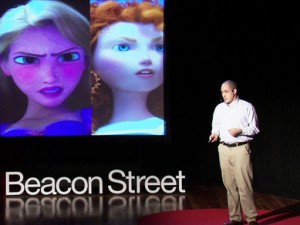
The basis of which I wrote this chapter was the TedX talk done by Colin Stokes, How Movies Teach Manhood. Stokes draws his analysis from Disney Princess movies, and explains that while female empowerment in cinema is on the increase, the idea that males can be masculine and emotional has still not been explicitly shown.

The basis of this chapter was the TedX talk done by Colin Stokes, How Movies Teach Manhood. Stokes draws his analysis from Disney Princess movies, and explains that while female empowerment in cinema is on the increase, the idea that males can be masculine and emotional has still not been explicitly shown.

I think that because Marvel is including children in the target audience, some tangible or visible acknowledgment that masculinity is not only appearance, is necessary. Has Marvel accomplished this with the female characters?

Share

The First Time You Meet the Text

February 27th, 2014

Experience is like that river that can’t be stepped in the same way twice. Just as college discounts and college savings are perpetually in a state of motion, so is a text.

The experience of reading can be split into three sections based on time; the first reading of the text, the aftermath and residue, and the rereading of the text. Each reading is particular, while the general text stays the same. It’s like that line in the song from Pocahontas, “You can’t step in the same river twice”. But instead of just the water flowing and changing, the reader is constantly changing and becoming, and because the reader is constantly changing, their constructions of the same text change as well. After reading a text, the direct effects and impressions begin to fade, but when a text profoundly affects the reader, the relationship that the reader forms with the text will change the reader. It’s like meeting a new person, falling into a deep and complex relationship immediately, and then having to say goodbye to them, because they do not exist without you. There will always be the memory of the experience, and you are changed by that memory from that moment on.

The first reading is just like meeting someone for the first time. And different books inspire different first impressions. The first time I read War and Peace by Leo Tolstoy, I could not put it down and stop reading until I had finished—roughly fifteen hours later. The words on the page pulled my eyes and my mind in to a point where my eyes could not keep up with my mind wanting to ingest every last morsel on the page. When I had finished, it was as though I had donned glasses and every particle of light that hit my eye was refracted by War and Peace.

I read novels quickly, preferring to absorb the novel as rapidly and intensely as possible rather than dragging the experience out over months. This applies especially to nineteenth century novels, mainly Russians works. I’ve been able to read War and Peace, The Brothers Karamazov, and Crime and Punishment in a single sitting because once I’ve stepped into the world I cannot bear to leave it until it had come to fruition.

On the other hand, when I read The Unnamable by Samuel Beckett for the first time, it was necessary for me to put it down and take a day or two before I picked it back up. It took me three separate sittings to finish it because of the physical toll it would take on me due to the overwhelming nature of the novel. His novels have always plainly spelled out the undercurrents of my own thoughts, and watching them be thrust to the surface and spelled out in language made me need to take a step back.

The beauty of these first readings is that when you look back at them, you realize that what struck you in the first reading is what you held as a priority when you first read it. When I spoke with Ilja Wachs, a teacher of nineteenth century literature at Sarah Lawrence College, he related his experiences reading Anna Karenina for the first time. He noted that in his early readings of Anna Karenina, “whenever Levin came in the scene, I’d say ‘Get out of here, I want my Anna!’ Anna was beautiful, Anna was hot, I was in love with Anna, really”.[1] As a young adult, the vibrant and lovely character of Anna was what drew him, and his reading was centralized around Anna. Now when he rereads, “every time Anna comes in the scene I feel depressed, ‘Get out of here, I want my Levin’. I want Levin mowing, I want Levin in the spring. You get there real changes”.[2] As a grown man, now in his 80s, he is no longer attracted to Anna’s tragic beauty; instead he wants the collectivity, universality, and “grounded substantiality”[3] of Levin. “I can no longer stand Anna, now I want Levin on the scene all the time”[…] the way he extracts meaning from work, I mean, I think that’s very fundamental for me, and wasn’t then”.[4]  As his priorities and way of looking at the world changed as he grew older, so did his readings and experience of reading. He compares it to a “wonderful mirror”,[5] reflecting back at you your values. As one changes, so does the readings of the text; the text initially offers a plurality of possible readings, and the reader ascribes to one and reconstructs it for oneself. The reader “relates the different views and patterns to one another [and he] sets the work in motion, and so sets himself in motion, too”.[6] This is why the definition of the text is not in the text itself, but in the experience of the reading and the actualization of the interaction between the text and the reader.


[1] Wachs, Ilja. Personal interview. 18 Apr. 2013.
[2] Wachs, Ilja. Personal interview. 18 Apr. 2013.
[3] Wachs, Ilja. Personal interview. 18 Apr. 2013.
[4] Wachs, Ilja. Personal interview. 18 Apr. 2013.
[5] Wachs, Ilja. Personal interview. 18 Apr. 2013.
[6] Iser, Wolfgang. The Act of Reading. Baltimore: The Johns Hopkins University Press, 1978. 21. Print.


———————————————————————————————————

Marina Manoukian, Sarah Lawrence College

Follow the Campus Clipper on Twitter and Like us on Facebook!

Interested in more deals for students? Sign up for our bi-weekly newsletter to get the latest in student discounts and promotions  and follow our Tumblr and Pinterest. For savings on-the-go, download our printable coupon e-book!

Share

Change your habits, change your self

February 25th, 2014

Consider the following quote, which is commonly attributed to M.K. Gandhi:

“Your beliefs become your thoughts,

Your thoughts become your words,

Your words become your actions,

Your actions become your habits,

Your habits become your values,

Your values become your destiny.”

If there’s anyone who had insight about the importance of thoughts and actions in turning our dreams into reality, it would be Gandhi. The man made non-violent action a habit of his, and his legacy became his radical use of non-violent action to achieve political change.

The above quote acknowledges that thoughts are fundamental in leading us to whatever end goals we have. Without believing that we could achieve anything, we’d be paralyzed. Even rolling out of bed in the morning takes a certain amount of belief––some days require more belief than others, to be sure.

But right now, I’d like to suggest that a way to kick-start the process of shaping your destiny is to take actions that convince yourself that you are already whatever you want to become.

In essence, I’m endorsing the “fake it til you make it” method of achieving change.

By donning a dinosaur suit and acting like a terrifying and ever-powerful T-Rex, you will become exactly that. Image credit: hyperboleandahalf.blogspot.com

According to this interesting article on Brain Pickings, “reverse-engineering psychology” is a fancy way of describing the “fake it til you make it” mantra. It’s a process we can use to change our habits and, eventually, the very essence of who we are.

The article summarizes psychology research and personal anecdotes from the likes of Ben Franklin that suggest something remarkable: our actions inform our beliefs. Of course, believing that you can become a certain way is the first step towards doing it. But the actual process of coming to believe that we are whatever we think we are results from the rationalization that we go through when observing the actions that we take.

Let’s make this idea more concrete by way of an example.

You go to a party where you know there will be tons of interesting people you haven’t met. You’re notorious for being the “quiet one” basically everywhere you go, but you’re dying to change this. So this time, following the “fake it til you make” it mantra, you decide to do something a bit different.

The first step is to hold firmly in your mind whatever you’d like to be: for tonight, you want to be an amicable person who has no problem interacting with others. The second step––which is arguably more crucial because it will make you realize that you already hold the potential to be the aforementioned person––is to act accordingly.

So, perhaps primed by a glass of liquid courage or two (but no more than that––you don’t want your technique to be sloppy), you discard all self-doubt and simply begin colliding with other people. If you act like you are thirsty for good conversation, good conversation is what you’ll get. You move about the room, hopping from one individual or group to another, and by the end of the night you realize that there’s not one person in that room you haven’t introduced yourself to.

After leaving the party, your brain begins to rationalize what just happened. As you ride the train home, your mind replays scenes from the party over and over again. Your brain has to find an explanation for what just happened––that’s what brains do––and it eventually concludes that you’re not so shy after all. In fact, you can be the life of the party. You were the life of the party.

But perhaps you’re convinced that this was just a fluke. The only way to fully convince yourself, then, that you are actually as confident as you acted at the party is to repeat the experience over and over again––in essence, make it a habit of yours. Now that you have this party experience under your belt, it will be much easier to repeat it next time and perform even better.

By continuing to be the life of the party wherever you go, even if you’re just faking confidence at first, it will get easier with time to perform accordingly, and your brain will eventually become convinced that you are the life of the party.

Let’s take a look at a more sober example.

You have a presentation coming up. You’re nervous about it even though you’ve rehearsed it a ton and you clearly know the material inside and out. Before you get up there, stop, breathe, and empty your mind.

When it’s your time to present, turn on your charisma switch. But, wait, how do you do this if you’re convinced that you don’t have a switch? It’s quite simple. You emit confidence through one of the most powerful tools of persuasion that everyone has at their disposal: body language.

You want to basically emulate everything that charismatic people do. Stand up straight. Let your hands rest at your sides rather than clutching them in front of your crotch or your stomach. Gesture freely. Speak loudly and clearly. Make eye contact with your  audience.

If you do this successfully, the audience won’t know the difference, and neither will your own brain after a few minutes. You’ll eventually begin to genuinely feel the confidence that you were only faking at first. You’ll become, in essence, a self-fulfilling prophecy simply by imitating the qualities you’d like to possess.

If you wear this button and act like a doctor, people will likely treat you like one. Warning: This is not a good idea. Becoming a doctor requires a series of actions that do not involve wearing this button.

If you want to be a writer, write. If you want to be an artist, make art. If you want to be a crappy customer service representative, dole out crappy customer service like your life depends on it. If you want to keep getting the same things you’ve always gotten, keep doing the same things you’ve always done.

You already contain the person that you want to be (and all of the people that you don’t want to be) inside of you. It’s just a matter of acting accordingly in order to bring out the qualities, and therefore the people, that you’d like to bring out.

If you change your actions, you will change your habits. If you change your habits, you will change the way you think about yourself. In turn, you will change your life.

Trust me. I’m a doctor.


Amanda Fox-Rouch (Hunter College)

Follow the Campus Clipper on Twitter and Like us on Facebook!

Interested in more deals for students? Sign up for our bi-weekly newsletter to get the latest in student discounts and promotions  and follow our Tumblr and Pinterest. For savings on-the-go, download our printable coupon e-book!

Share

Planning Ahead

February 24th, 2014

The most important thing a traveler can do before a trip is to plan.  Planning beforehand allows for the optimization of options and efficient use of time.  Taking out two minutes of the present can save hours of hardship and disappointment in the future.  Two essential steps of planning are having goals and being able to properly prepare.

Goals

Although sometimes it is fun to mindlessly wander around a new and foreign area, I found that the most rewarding feeling came from checking off something from my to do list.  Having an idea of what to accomplish during a trip creates the sense of fulfillment and duty.  Simple things like taking a picture with the Hachiko statue in Tokyo, spinning the big Cube in Astor place or taking a stroll in the botanical gardens in Singapore can make for a great story down the road!  Even simple things such as using up a coupon booklet can be something to work with.  Unlike those dreaded bus tours, creating a personal itinerary won’t have people staring into the air for hours.

When writing goals, two big questions should which should be asked are what do I like and what interests do I have? 

Preparation

I cannot begin to convey the many hours I have wasted because I made the mistake of traveling without being properly prepared.  When I travelled to Japan, I made many small mistakes which could have been avoided had I properly prepared for the trip.  In fact, I had to walk aimlessly in the humid town of Chiba for three hours because I forgot to print out the address of my hotel.  Had I took ten minutes out of my life to print out a piece of paper before I journeyed to Japan, I would have not only saved three hours of my life but also avoided the blazing heat of the sun.


     With proper preparation and research, savings can be had on many expensive things such as Broadway shows!  Did you know that certain Broadway shows hold lotteries and have discounts on certain days and times?  Another example of how research can help increasing savings while traveling can be seen through the admission fees of the Metropolitan Museum of Art in New York.  Upon entering the museum, many people examine the admission fee and pay $25.  However, did you know that the admission fee is actually a suggested donation?  Small little tidbits of preparation and research can open up amazing new routes and doors for the voyage ahead.


Of course, knowing where to look for information is a very vital part of the planning process.  Although a Google search can provide many possible locations to visit, having a second point of view on an area provides a lot of valuable insight for planning.  Always cross reference and visit more than one page about a certain location in order to get all the details.  Sites such as Yahoo Travel, Yelp, Trip Advisor), or even one of these travel blogs can help you find out if a place is the perfect fit.  By doing this, more developed opinions can be made by using past experiences of other people.


Gary Chen Stony Brook University

Follow the Campus Clipper on Twitter and Like us on Facebook!

Interested in more deals for students? Sign up for our bi-weekly newsletter to get the latest in student discounts and promotions  and follow our Tumblr and Pinterest. For savings on-the-go, download our printable coupon e-book!

Share

Film Critique

February 23rd, 2014

The Film Critique


Now that I’ve discussed the comics, I want to discuss the manifestation of the comics – the movie. Because this piece of writing will be focusing on the impact that “The Avengers” has had on my generation, the progression of thought moves to the film. “The Avengers” was a huge success, and the audience was predominately people who had either limited exposure to the Marvel Universe (those who had seen the origin movies i.e. “Iron Man”), or none at all. So what was the appeal? Was it the beauty of all the actors? The witty dialogue, which in all honesty was a surprise? Or perhaps it was the character development, and a reemergence of an action movie that actually has a workable and dynamic plot line.
            Every facet of this film drew the audience further and further into the storyline. While characters like Iron Man, Thor, or Captain America (played by the actors Robert Downey Jr., Chris Hemsworth, and Chris Evans, respectively) had origin stories already laying down the foundation of their characters. I am ambiguous in the function of “The Hulk” recasting the main actor, but references to the destruction of Harlem, which had occurred in the Edward Norton reincarnation, led me to believe that the first film was also an origin story.

As imagined by the Deviantart creator.

The Black Widow (played by Scarlet Johanson) is relatively new, and had only appeared sporadically within the “Iron Man” trilogy. And HawkEye (played by Jeremy Renner) had an action sequence within the first “Thor.” But aside from those cameos, these character’s were mysterious in the audience didn’t know much about them. The one disappointing aspect of the movie was that I was so drawn in, that I had wished for more character background.

In this point of my analysis, I want to quote Neil deGrass Tyson, “If Thor is strong for mystical reasons, he doesn’t need big muscles. They could make him scrawny and he’d be just as powerful.”

So that raises the question of why, why is it the necessity of have characters like Thor who have both inhuman abilities, and ethereal beauty? I would say it is to set Thor, and by extension Loki (but he will be discussed later when villains are brought up), apart from the other mortal members of the Avenger’s team. But what does this incur in fans? Do little boys look at the muscular Hemsworth who is the hero, and see Hiddlestone, the intellectual villain, and decide that masculinity equates to appearance, instead of intelligence?
____________________________________________________________________________________________

This is written by Francesca Ciervo, Freshman at NYU.

Follow the Campus Clipper on Twitter and Like us on Facebook!

Interested in more deals for students? Sign up for our bi-weekly newsletter to get the latest in student discounts and promotions  and follow our Tumblr and Pinterest.

Share

You not only have to be there, you have to act there.

February 20th, 2014

The idea of participation comes to us at an interesting time, especially since the idea of individuation seems to have flooded the mindsets of all college students. And that’s just the thing; college discounts and college savings won’t just come to you. Participation is required.

When thinking of the readers of a text, there are two discernable readers; the ideal reader that the author conceived of while writing the text, and the plurality of actual readers that encounter the text. However, neither one of these actually exist in a single construction. The ideal reader does not exist outside the mind of the author, and is, in a certain sense, useless. The ideal reader would have the exact same understanding as the author, “and identical code to that of the author”,[1] and would share the intentions of the author as well. If this were the case, the act of reading would be superfluous because any meaning or idea to be conveyed would already exist in the mind of the reader[2]. There would be nothing gained or changed by the act of reading. The other reader that exists is the actual reader of a text, and the experience of this reader is specific to that one reader. One may attempt to generalize texts in regard to how they affect readers, but every reader reads a text at a time, state, and mentality that cannot be replicated, not even within the reader himself. The response and construction of the text that is produced is based not only on the text itself and its possible constructions, but also the different values and moods of the reader. This is why readers can describe two entirely opposing constructions of the same text. Because of this, the phenomenology of reading can only be described by an individual, most often in regards to a specific text; it is much harder to generalize.

It is also in this way that it is somewhat superfluous to try to grasp what the objective world is, behind the veil of sight. If one saw the world as it were, so to say, intended, there would be no point in participating in the world; you’d already know everything. Instead, it seems to be more useful to focus on the relationships created by the participation, just as a text is only as much as a reader constructs it to be. Participation and action are the most important parts of the formula, because if one chooses to exist solely in the world of thought, he/she essentially wants to obtain all the knowledge without the actual action of obtaining. He/she wants to be a god; to pick up a book and know what it is about without going through the actual process of reading it and putting all those letters and words together through one’s own lens.

One’s entire life can be boiled down to the importance of participation. Certainly, if you are spending time with your friends, it is easy to sit back and watch the conversation and exchanges happen around you. You’re there, but you’re more of a spectator than an actor—a spectator in a play that you should be playing in. The best reality is one that is created by you, and creation can only happen through your own actions. One cannot dwell in the realm of thought forever. Otherwise you’ll end up like Hamlet.


[1] Iser, Wolfgang. The Act of Reading. Baltimore: The Johns Hopkins University Press, 1978. 29. Print.
[2] The Act of Reading, 29


———————————————————————————————————

Marina Manoukian, Sarah Lawrence College

Follow the Campus Clipper on Twitter and Like us on Facebook!

Interested in more deals for students? Sign up for our bi-weekly newsletter to get the latest in student discounts and promotions  and follow our Tumblr and Pinterest. For savings on-the-go, download our printable coupon e-book!
Share