This past Saturday marked the last day of the United Nations General Assembly’s Healing Arts Week, an annual series of events organized in appreciation of the arts’ global incorporation in the cultivation of health and wellness. As a student at NYU, I had the privilege of learning about and attending The Launch of the Jameel Arts & Health Lab’s Lancet Global Collection on Arts and Health, which took place last Tuesday, September 22, at the NYU Skirball Center for the Performing Arts.
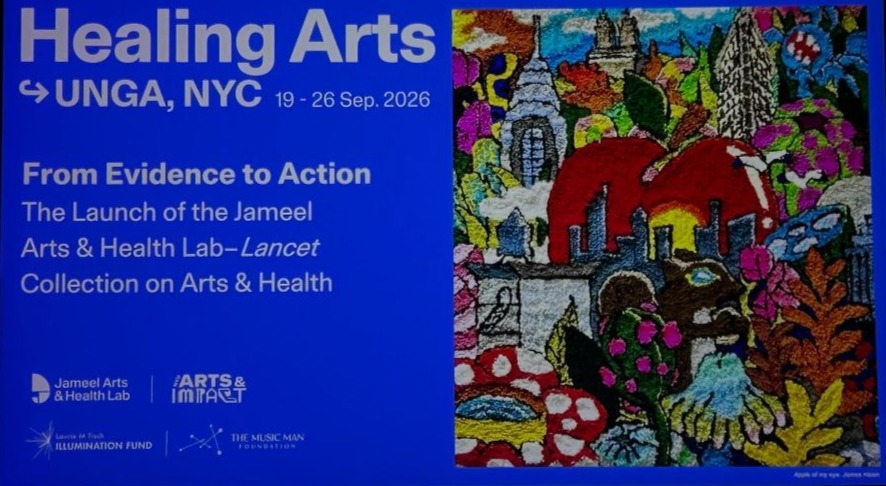
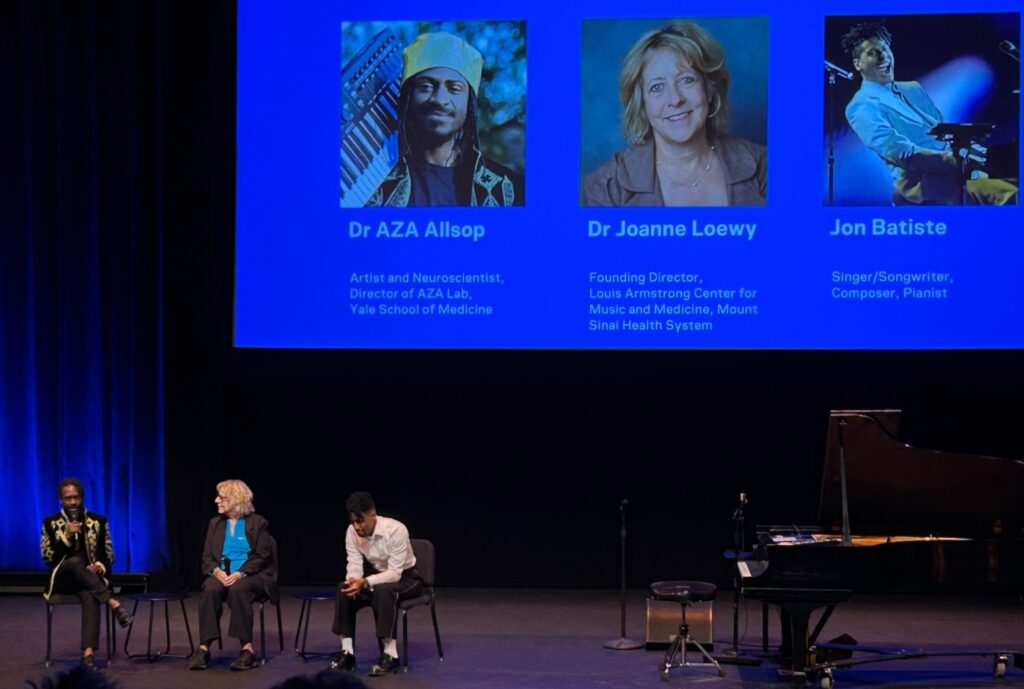
Recently, this idea of expanding the role of artistic practice in supporting mental and physical wellbeing and recovery has become a recurring point of consideration in my day-to-day life. So despite this event being promoted as a “research symposium”, I was drawn to the opportunity to more thoroughly explore and discuss this intersection between art and health research, policy, and practice. Though, it did also help to encourage me that musician Jon Batiste—eight-time Grammy award winner and co-composer for the Pixar movie Soul—was scheduled to perform and join in conversation with artist, neuroscientist, psychiatrist, and professor at Yale School of Medicine, Dr AZA Allsop; founding Director of the Louis Armstrong Center for Music and Medicine at Mount Sinai Health System, Director of the Department of Music Therapy at Mount Sinai Beth Israel, and Professor at Icahn School of Medicine at Mount Sinai, Dr Joanne Loewy.
The event began with NYU Provost Georgina Dopico welcoming the audience and introducing them to the collection’s contributors and the global arts and health movement afoot that is evolving from a discussion of whether the arts can be implemented to health “policy and systems at scale” to how. Following Dopico, Senior Advisor for the Cultural Life Office of the Deputy Mayor for Economic Justice, Sarah Calderón, drew attention to the major questions driving the movement: “Who has access to the systems that make healthy living possible?” and “How does healthy living go from being ‘a privilege’ to ‘a public good’?” Then, to close the program’s opening remarks, Stephen Stapleton, Co-Director of the Jameel Arts & Health Lab, shared about the Lab’s global impact on research—and the collaboration between artists and scientists in a space where they must treat each other as equals—outreach—and encouraging communities to engage with art and health initiatives—policy and increasing opportunities for artists, healthcare professionals, and researchers to improve and expand their practices.
After this, it was time for Batiste, Loewy, and Allsop to take the stage to provide the event’s keynote presentation. Their expertise—and the focal point of their discussion—lay in utilizing Social Music as a Prescription for Maintaining Wellness. Expanded upon in a peer-review paper published by the pair, social music was first theorized by Batiste and refers to, as noted in a press release by Mount Sinai on the paper’s publication, “participatory, culturally rooted musical experiences that foster connection, expression, and collective release.”
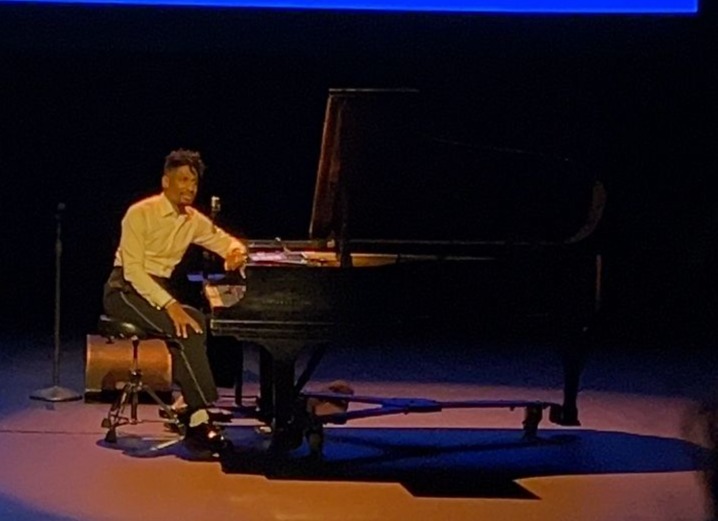
Batiste began sitting at a piano, opening by playing a blues tune because “in it is a sense of play,” and “the connection between the idea of music to transform and music to play is very important.” During his short performance, he invited the audience to join him in singing a song he composed for Soul. It was a beautiful, though brief, moment when members of a community—and one that may be commonly misunderstood as being deeply serious—connected with one another through song. Loewy then took a few moments to speak on the capacity of music to “help people back”, to ground them after life experiences that may be intensely difficult to process. She nodded to Batiste’s “Love Riots” as testaments to the power of social music to uplift and restore the human spirit. Finally, these two researchers sat down with Allsop for a short round of Q&A in the form of a “fireside chat” to round out their understanding of social music and the relationship between the arts and health for the audience.
Unfortunately, I wasn’t able to stay for the entirety of the event—I missed the Lancet Launch Performance and Panel, Performance by the New York Vocal Collective, and closing remarks—but this experience was still as inspiring as it was informative. I’m indescribably grateful for the spontaneous curiosity that encouraged me to buy a ticket. It taught me to view interdisciplinary research and practice in a new light, to nurture a spirit of constant interest, and to seriously consider my own relationship to art and health and role in encouraging others to reframe their understanding of the possible applications and affordances of both.
Most importantly, I learned the importance of undergraduate students getting involved with the events that are being held by their universities despite those opportunities not seeming to directly be relevant to their experiences. This event may have been organized with researchers, artists, and health industry professionals in mind, but the fact that the university still opened it up to undergraduate students is a testament to how we are valued as members of the citywide and global community and are being invited and implored to remain aware of and become involved in the social movements and initiatives taking place beyond our campuses.
Works Cited
“Mount Sinai Study Advances “Social Music” as a Prescription for Better Health Outcomes.” Mount Sinai Health System, 26 Mar. 2026, https://www.mountsinai.org/about/newsroom/2026/mount-sinai-study-advances-social-music-as-a-prescription-for-better-health-outcomes. Press release.
By Lauren Gascon
Lauren Gascon studies Media, Culture, and Communication at NYU and enjoys discussing people’s relationships with each other and themselves. When she’s not on campus, you can find her café hopping, browsing bookstores, or enjoying lunch in one of New York City’s many beautiful parks.
For over 25 years, the Campus Clipper has helped college students in New York City—and later in Boston and Philadelphia—save money and succeed in city life. We offer a digital coupon booklet with discounts on food, clothing, and services, plus an Official Student Guidebook with real advice on how to navigate college life in a big city. Our internship program lets students build skills, earn money, and publish their own e-books. Follow us on Instagram and TikTok @CampusClipper, and sign up for our newsletter to get deals straight to your inbox. To access the digital coupons, scan the QR code on our printed card—available in dorms, student centers, and around campus.