Student Depression: Funny is the Best Medicine

October 26th, 2013

Ever had that fight with your significant other/parent/yourself (I don’t judge) and one of you said something unintentionally hilarious, and, despite your best efforts to scowl in anger, you couldn’t help but crack a smile?

The situation seemed so much less serious when you both lightened up, right? All you had to do was smile and something that could have lasted hours dissipated in minutes.

“They” say that laughter is the best medicine. Who are “they”? People who just don’t understand how bad you feel inside. If they’re happy all the time, how the hell would they know what it’s like to be angry, frustrated, depressed?

It’s the same situation with those people that tell you to take life less seriously; you just know that if they were in your shoes they’d feel your pain.

Well, they do know how it feels, and likely as much as you do, if not more. They’ve found that elusive balance, that secret to the right amount of sad and happy, and at the right intervals.

The only thing “they” have over you is a simple truth: sometimes, humor is the best medicine. Not necessarily the most logical (I’m looking at you, happy pills). But it’s up there.

"Can't resist... the cuteness"

The crux of the matter here is, the best way to tone down the macabre and channel your inner Macarena is to laugh. To actually perform the infamously over-exaggerated LMFAO. To become one with the ROFLCOPTER.

I know, sometimes this task is beyond challenging: it’s downright impossible, especially for those moments when you’re catatonic from despair. One mistake many of us depression fighters make from time to time is believing the idea that happiness means being ecstatic all the time. But just like in the atomic world, everything seeks a balance: positively charged protons need a similar number of negatively charged electrons to create a stable atom; certain atoms’ valence shells strive to abide by the octet rule, and that means gaining or losing (negatively charged) electrons. Basically, for stability, life needs both the pluses and the minuses.

Everyone needs those low points to get enough momentum for the high ones. But if all you get is a series of flaccid bumps, the ride becomes stale, sad, and in serious need of excitement. You need a funny injection.

That’s why, for those brief moments when you actually feel (sort of) good, the best possible thing you can do is capitalize. Bank on the moment. Profit. And for those bad moments? More on this in a bit.

How do we get that funny injected in a timely manner? We don’t have time for a two-hour comedy, we don’t have the patience for feel-good books or articles or tweets. So what’s left to do? Scour YouTube for cat videos? I’ve got a better idea.

In 2000, the Internet was introduced to Pandora Radio. Over the past 13 years, Pandora has acclimated to the needs of its 200 million users quite brilliantly. And it now has the ability to make us laugh.

Just like with your favorite musicians, you can create a Pandora station with your favorite comedians. While music can be a great escape, excellent comedy can bring you way down to serious reality while still seeing it from a hilarious angle, whether you’re listless in bed and are in dire need of a peak, or you’re experiencing that intermittent moment of elation and want to capitalize on it.

Talented comedians have the ability to teach us that even the lowest of lows are sources of humor.

So while you may wallow in bed, moaning with your bottle of gin for love long lost while your cats stare at you in what looks like apathetic curiosity, when you do recover, you’ll be able to view that gutter-licking crevice you momentarily fell into as part of a balanced emotional spectrum. You’ll also take subsequent episodes less seriously.

With all that said, let’s take talk shop. Which comedians? Why would you consider listening to them in the first place? You have questions, I have answers and funny pictures…

Louis C.K.: One of the best comedians alive for the very reason that he turns the most guttural points in life on their heads to create some of the most raw, genuine and human comedy around.

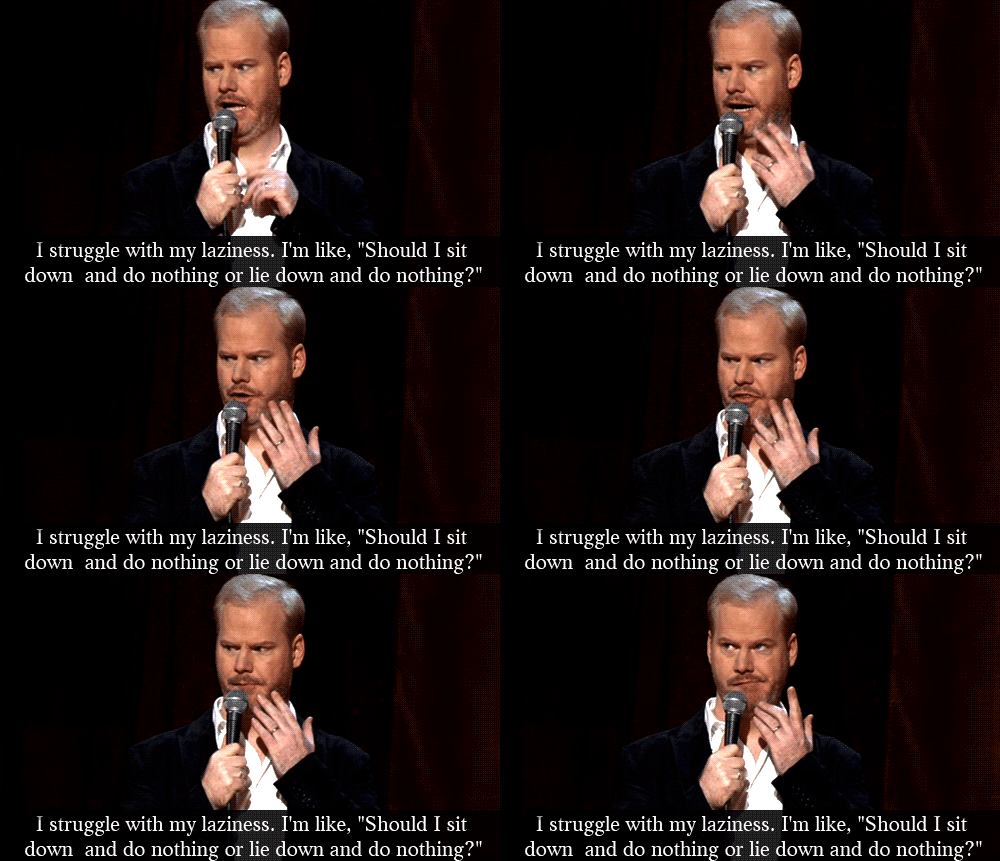
Jim Gaffigan: He ponders on the little things in our day-to-day lives that we don’t give a second thought to, like hot pockets and laziness, and creates lighthearted little diatribes that are spot-on.
Demetri Martin: Embodying the very idea of idiosyncrasy, Demetri uses hilarious puns and nerdy observations to bring to life even the most tepid subjects.

Dane Cook: Can be annoying. But in small doses can produce gol—eh, maybe silver. Or copper. But who else buys a cement truck just so they can put their friends in the empty mixer, and then throws jolly ranchers at them as they tumble around?

Mitch Hedberg: Do you like cheese? Because Mitch is all about shooting off those hit-or-miss one-liners and arbitrary observations, which more often than not convey sheer brilliance. Stand up was a labor of love for Mitch: he’d usually wear sunglasses, close his eyes and hide his face under his hair to help with stage fright.

———————————————————————————————————

Aleksandr Smechov, Baruch College.

Follow the Campus Clipper on Twitter and Like us on Facebook!

Interested in more deals for students? Sign up for our bi-weekly newsletter to get the latest in student discounts and promotions  and follow our Tumblr and Pinterest. For savings on-the-go, download our printable coupon e-book!

Share

Student Depression: The Self-Help Trifecta

October 19th, 2013

Imagine you didn’t know how to breathe. Okay, that’s a bit ludicrous, but let’s say you were born on a planet where breathing was not necessary (for some absurd reason). Suddenly, you get orders from your local planetary travel center to beam to earth, where, if you don’t breathe, you perish.

Earth

"Leaves you breathless, doesn't it?"

So what do you do? You study and practice the art of breathing, because if you slack off you’ll end up a purple, shriveled vegetable (not to take this sinuous example any further than it has to, but for the sake of some viability, you use a breathing apparatus when you sleep). In a matter of weeks, breathing begins to feel more and more natural, and in six months’ time you’re better at breathing than most people on earth. And then, satisfied with your abilities, you disconnect your nightly breathing apparatus, in turn shriveling up into a purple corpse.

Pruple Vegetable

"They were found huddled together like that... a bittersweet end"

What a waste, huh? Breathing was never an innate ability for you; when you suddenly stopped there was no muscle memory to kickstart the process.

It’s (sort of) the same with self-help material. You don’t grow up in an environment that requires self-help to survive, but once you reach adulthood you’re faced with a plethora of dilemmas, challenges and life goals that would benefit immensely from motivational literature.

While you may take six months to become a self-help master, once you stop studying and practicing the material, what you learn effectively “dies.”

For the millennial attention span, lifelong commitment seems intimidating, to put it ever so lightly. That’s why the material fed into your brain, just like the oxygen going into your lungs, must not be overly complex, and must be easy to take in.

“Hey!” you say.

“Hey,” I say back.

“Hey… Yeah, well, I’m all for learning how to improve my life situation and all, but there’s like so many books out there and some contradict others and some say the same stuff over and over and over and some are so abstract they’re just words!”

“You’re right.”

“He- wait, what? I am?”

“You are.”

“Oh. Ok, cool.”

Indeed, there is a plethora of material out there. But there’s no need to complicate matters by taking it all in as dogma. That’s why I’ve gathered a teeny list here for you that you can easily inhale. Just don’t take it for granted or you’ll end up looking like this guy:

Grimace

"Grimace stopped breathing a long time ago..."

1. Mind Power into the 21st Century | John Kehoe

mind power into the 21st century
Not many books back up their material with quantum physics. Ok, quantum physics lite. But the exercises work, and they work extraordinary well. The best part? They’re simple and easily inhalable. Here’s an excerpt on how to best visualize your goals:

“Two conditions for a successful visualization: 1) Always visualize your goal as if it is actually happening to you right now. Make it real in your mind; make it detailed. Enter the role and become it in your mind. 2) Visualize your goal at least once a day, each and every day. There is power in repetition.”

2. The Power of Now | Eckhart Tolle

Power of Now
Ok, remember when you (well, I) mentioned that some self-help books seem to contradict each other? The Power of Now is the perfect example. Tolle is all about placing yourself in present moment. That includes cutting off your wandering mind.

Funny, Mind Power is all about thinking your way to a better life, and Power of Now is all about abdicating thought. It’s two radically different approaches to a clutter-free mind. Why do they work so well together?

Sometimes you need a hiatus from working your mind, even if all you’re doing is positive thinking. Tolle is great for this.

Some quotes:

“In today’s rush we all think too much, seek too much, want too much and forget about the joy of just Being.”

“The past has no power over the present moment.”

“The primary cause of unhappiness is never the situation but thought about it. Be aware of the thoughts you are thinking. Separate them from the situation, which is always neutral. It is as it is.”

3. Self-Esteem Affirmations | Louise Hay

Self-Esteem Affirmations
Yes, Mind Power has great affirmations. In comparison, Hay’s lines seem to grind cheese:

“I am in harmony with nature. I bless this planet with love.” (taken from her website)

Don’t groan. Hold it, just for a second. Hay is a perfect bridge from the thought-powered Mind Power and the relatively thought-free teachings of The Power of Now (Tolle’s angle is objectively observing your thoughts rather than utilizing them). Hay’s audio book is meant to be heard before sleep, or used as white noise while going about quotidian duties. She’s the fundamental in-between, and her semi-subliminal audio material is a great addition to the other two’s “extremes.”

There you have it, no need to sift through dozens of self-help resources. These fundamental materials cover a wide area, perfect for us college students who need a chameleon approach to working around the anxieties of our Mobius-strip-like lives, our variegated needs always, always demanding an alternative way of going about the situation.

Stay Tuned.

———————————————————————————————————

Aleksandr Smechov, Baruch College.

Follow the Campus Clipper on Twitter and Like us on Facebook!

Interested in more deals for students? Sign up for our bi-weekly newsletter to get the latest in student discounts and promotions  and follow our Tumblr and Pinterest. For savings on-the-go, download our printable coupon e-book!

Share

Student Depression: Preparing for the Winter Blues

October 5th, 2013
Winter is Coming

"Luckily, he won't be around to experience it"

Winter is coming. (Thanks to elenagance for the awesome intro idea!)

And shuffling along with it, dragging their undying limbs, are Seasonal Affect Disorder (SAD) and general winter blues, creeping up on unsuspecting college students nationwide. How do you fight these nefarious stalkers? Read on, fellow depression fighters, read on…

First, let’s dig into why some students may feel depressed during wintertime.

Less sun, shorter days, the inability to spend time in the sunlight due to the cold; all these factors somehow contribute to seasonal depression, whether it’s a disorder like SAD, or vanilla melancholy that just happens to spike during the dead season.

Here’s a quick and handy list of things you can do to triumphantly chop those blues to bits.

Sleep: Sleep is like a mini vacation you take every night. Do it. It helps scurry the stressors that plague seasonal depression and gets you feeling fresh. If you can’t take a real vacation somewhere closer to the equator, at least get well rested in your claustrophobic dorm room. This also means less alcohol and coffee.

Sleep is Good

"Sleeping on books helps you absorb knowledge"

Outdoor Exercise: Bundle up and go for a jog, or do indoor exercises near a sunny window. Just get that sweet, precious sunlight to penetrate your shriveled pores.

Light Therapy Box:  “Sounds a tad pricy,” you say; “looks like it’s just a regular ol’ lamp,” you say. Popsugar Fitness suggests this reasonably-priced light box, and if you can throw down $60 for a game, you can likely afford a decent light box. When nature offers nothing but clouds, gloom and doom, the machine that can shine brightly in your face is your friend.

Force Yourself Outside: Cooped up in your room, you begin to feel miserable, trapped, and despondent. You plunge into a downward spiral of self-pity and self-loathing, and the very idea of seeing someone while in this state or facing the unsheltered world makes you wary and weak, and so you remain in your pocket of darkness. Your original excuse of having too much work inverts itself and now you really can’t do any work because you’re moping in bed, practically paralyzed from grief. The moral of this diatribe? Get your ass outdoors before it falls into darkness.

Friends: While they can sometimes be the biggest instigators of unproductivity, positive friends are great propagators of a sense of well-being. Friends serve as a great distraction when you’re feeling on the verge of depression, and can quickly get you out of your sulk-status. You have them, why not use them?

Best Friends

"They may be happy now, but wait until the one on the right has to go home"

Prose Therapy: Write down what plagues you. Similar to the way I reified SAD and general depression as White Walkers, you can reify your own internal monsters as evil beasts or pestering insects or Tea Party activists or whatever you wish. Characterizing concepts makes it more fun to deal with them and makes them out to be less serious and more surmountable.

Imagination

The list is just shy of a lucky seven points: the final suggestion, which encompasses not only seasonal blues but general depression, will be taking up next week’s entire post. Get your lap napkins and sporks ready, because we’ll be tackling diets!

———————————————————————————————————

Aleksandr Smechov, Baruch College.

Follow the Campus Clipper on Twitter and Like us on Facebook!

Interested in more deals for students? Sign up for our bi-weekly newsletter to get the latest in student discounts and promotions  and follow our Tumblr and Pinterest. For savings on-the-go, download our printable coupon e-book!

Share

Student Depression: Stave of the Sleeplessness

September 30th, 2013

What causes your sleeplessness, whether it’s your anxiety or insomnia, is insignificant. Meaning that similar to parsing out depression, the causes are multiple and interconnected; instead of aiming for individual symptoms, tackle the problem as a whole. To illustrate the point, let’s say someone has a lung disease and by consequence they develop a severe cough. Giving them cough medicine might mitigate that particular symptom, but it won’t eradicate the disease as a whole.

Similarly, don’t go shooting in the dark for causes when you should instead be concentrating on snoozing in the dark.

Pad Pun

"A bad pun deserves another bad pun"

You’re throwing your life cycle out of whack by evading sleep. Getting back on track means finding ways to get a reasonable amount of rest.

Reasonable doesn’t have to mean eight hours. Get real, you’re in college, there are bound to be red-eye nights you’ll have to brave for purposes of edumacation, and nights when you simply can’t shut off your brain.

What you need is an arsenal, a tool belt that can be used to stave of that menacing sleep-disruption wolf.

Insomnia Wolf

"Why not stay up one more hour? Class doesn't start till seven in the morning anyway"

And that’s just what I’ve got for you today. Read it and sleep!

Bad Pun 2

"Please, no more puns, I'm begging you"

No Sleep Aids on Weekdays: Forget ZzzQuil, it’s a rip-off anyway. The last thing you need is to pop twice the regular dosage and sleep for 16 hours straight on a weekday. If you need to catch up on some sleep over the weekend, get some generic Benadryl, it’s the same thing but cheaper.

Get a Better Mattress: This costs way too much for an average college student. Better yet, invest in a decent pillow. Most of the sleepless nights I’ve had I can attribute to a cheap pillow causing neck pain or general discomfort. Think an $80 pillow is out of your budget? It’s hundreds less than a mattress and alleviates much of the frustration of falling asleep on an uncomfortable bed.

Rock Pillow

"Like sleeping on a bed of rocks"

Organize Your Tomorrow: You got an elephant-load of work to finish tomorrow and not enough hours in a day to possibly fit everything in. At least, not in your head. Write out tomorrow’s schedule hour-by-hour. You’ll be surprised how much more manageable things look when they are systematized in front of your eyes.

Write Down Your Dreams: Jot down your dreams in the morning. John Kehoe suggests you don’t do this immediately, and instead let the dream gestate in your mind as you slowly awaken, so as to recall specific details. Writing out freaky or weird dreams are not just conversation fodder—they can give you story ideas, facilitate your creative writing and give you a reasonable incentive to go to sleep at an appropriate time.

Make a Lullaby Playlist: It doesn’t have to be ambiance or nursery rhymes. It just has to be slow and soothing. I’ve gone through the trouble of compiling a short playlist just for you:

This Lullaby – Queens of the Stone Age

A Thousand Kisses Deep – Leonard Cohen

Aldrig Ensam – Jonathan Johansson

Beautiful World – Rage Against the Machine

No Coffee or Other Stimulants: Does this even need to be on the list? Even if you’re cramming, don’t facilitate with coffee and get your circuitry fried in the process. If you have to, cram until you fall asleep naturally.

Take a Shower: Unless you’re collapsing into bed after a workout, getting into bed after being out all day is just asking to feel like you’re sleeping in a pig trough. Take a shower, wash off that grease; you’ll wash off some stress in the process.

Do a Little Work: Ripping your hair out over the myriad tasks waiting to take you apart piece by piece tomorrow? Do a few minutes of each task before going to sleep. It gives you a head start and peace of mind.

Hug Something: Hug your partner, hug your pillow, hug your mangy stuffed animal you haven’t cleaned since you were a kid. It’s occupying your hands so you won’t flop around like an agitated fish all night, trying to get the perfect position. I suggest a plush Cthulhu.

Cthulhu

"Hug me while I quietly devour your soul"

———————————————————————————————————

Aleksandr Smechov, Baruch College.

Follow the Campus Clipper on Twitter and Like us on Facebook!

Interested in more deals for students? Sign up for our bi-weekly newsletter to get the latest in student discounts and promotions  and follow our Tumblr and Pinterest. For savings on-the-go, download our printable coupon e-book!


Share

Student Depression: You Snooze You Lose

September 22nd, 2013

Our last post left us dangling on the subject of balance; specifically, balance as the centripetal force behind helping students overcome depression.

But before moving on, a brief side note on my use of the word “depression.”

Personally, I prefer to use the word’s blanket term connotation, which includes everything from “feeling sad” and “negative,” all the way down to more harrowing stuff like “I’m going to kill myself and nothing’s changing my mind.” Am I being inaccurate by covering such broad grounds with a single word?

depression blanket term

"Depression can be an effective blanket term"

Using “depression” to cover such an immense range of emotion can be a double-edged sword. But the sword is definitely proportionally challenged. As in, one half, the half that has the drawbacks of blanketing “depression,” is so dull you can’t even cut butter with it. The beneficial half can split atoms.

depression as a blanket term is a super sharp sword

"He uses the dull edge to make his morning toast"

Maybe that’s a bit of a hyperbole. But what if you feel unnaturally sad, just for a day or two every few weeks or once a month? Just intermittent sadness, not over an extended period of time, not overly extreme to the point of suicide, but something that stops you in your tracks and prevents you from moving on. “I feel kind of depressed, but I’m not actually depressed, otherwise, I’d feel like this every day, and to a much more frightening degree.” This might pop into your head after such an episode, and you might chuck any notions of depression out the window, either for reasons of being hard on yourself (“Why should I call myself depressed when others are suffering more than I am?”), dismissal (“It only comes around sometimes, so it’s probably nothing”), pride (“I’m stronger than that, I just have my weak moments”), embarrassment (“What will others say if I tell them I’m depressed? Will they be more awkward around me?”), or anything else that causes you to toss out the notion that you may need to do something about this soon.

I aim to use “depression” in the less clinical sense and focus instead on the semantics of the word itself: “sluggish in growth or activity”, “low in spirits”, and “sunk below the surrounding region.” Obviously, not all of these pertain to psychology, but nonetheless they are less restricting and more associable for students who don’t consider themselves technically “depressed”

And the great thing about looking at the word semantically is that it helps reach a wider audience. Students will more willingly accept help and advice when they feel less judged and pressured by strict definitions and connotations, in turn preventing more severe symptoms from developing in the future.

So yeah, I lied, that wasn’t a very brief side note. Here’s a picture to make it all better.

gorilla on a unicycle

"Why does this even need a caption?"

… And back to reality we go.

Tragically, ironically (tragonically?), college life is a recipe of unbalance, rife with owlish sleep schedules, late night face-stuffing (junk food, pills, whatever your preferred poison), massive procrastination,  last-minute rush-a-thons, self-consciousness, quarter-life crises (that’s the plural for crisis, fyi), and a whole load of other scale-dislodging activities.

One of the biggest, baddest and meanest wolves in the pack is the disruption of a balanced sleep schedule.

sleep deprivation insomnia wold

"His icy mission: keep you awake as long as possible"

As not to be a conventionalist-luddite-person-thing, let’s just get the studies showing how sleep deprivation can temporarily help major depression out of the way. Yes, the subject is well documented, proven to work for the duration of time that the person doesn’t go back to sleep, and it seems like a perfect provisional remedy for students who need to brave entire nights anyway.

I wouldn’t suggest you go actively experimenting with this method, however.

Despite the soundness of the data, this is not a self-administered procedure: it’s done in a controlled clinical setting. And yeah, there’s that whole relapse thing after you go back to sleep the next night. Temporary fixes like not sleeping, along with over-caffeinating yourself, taking uppers, last-minute cramming and other get-shit-done-quick equivalents for maintaining productivity without having to actually work on yourself are so prevalent that they’ve become the only way most students know how to operate in college.

shake weight is the get-rich equivalent of fat burning devices

"Helps you get washboard abs in only two weeks!"

Tragonically, these insta-fixes leave out the necessary work that goes into long-term self-development, and serve little purpose when it comes to overcoming depression further down the road.

“What about insomnia?” you ask. After all, while sleep deprivation can be intentional, insomnia is a condition that is not voluntarily discarded whenever the insomniac wishes.

Regardless of whether your lack of sleep is intentional or not, the point is if you’re not sleeping, you’re going to have a hard time maintaining balanced, organized life in college. The goal of this post is not to determine whether you can or can’t control your sleeping habits, it’s to acknowledge that not sleeping will throw your already busy college life out of whack and make it harder for you, in the long term, to perform at your best.

I’m getting dangerously close to my weekly word limit here (also, I have to sleep), so watch out for next week’s post for a plethora of ingenious ways to help yourself go to sleep. Sleep is one of the most essential steps in physiologically tackling depression and getting on the road to an all-around well-rounded life. Dig it!

———————————————————————————————————

Aleksandr Smechov, Baruch College.

Follow the Campus Clipper on Twitter and Like us on Facebook!

Interested in more deals for students? Sign up for our bi-weekly newsletter to get the latest in student discounts and promotions  and follow our Tumblr and Pinterest. For savings on-the-go, download our printable coupon e-book!

Share

Sweet Asian Fusion at Just Sweet Dessert House

September 18th, 2013

One banana. One Twinkie. Whipped cream. All stuffed in a sweet, buttery crepe and smothered in Nutella. This, my friends, is the Heart Breaker. A swirl of creamy vanilla, chocolate hazelnut, and fresh banana in one bite—your heart might actually break, and this is just dessert.

Just Sweet Dessert House, a few blocks away from Union Square and only a few steps away from both New School and NYU dorms, is located on the corner of 12th Street and 3rd Ave. Adorned with bright and colorful letters spelling out “Just Sweet,” Just Sweet Dessert House stands out among the various surrounding shops. With roomy outdoor seating, a prime spot in Manhattan’s East Village, and a collaborative menu filled with Asian infused dishes ranging from savory dumplings to sweet crepes, Just Sweet Dessert House is a great spot to sit and have a bite or grab a bubble tea on the go!

I took my trip to the “house” after a long day of classes, no sleep, and no lunch. I made my way to the lovely east end of downtown Manhattan and was greeted with the friendly faces of Just Sweet’s staff. I was quickly handed a menu, seated, and greeted by my server. There was no waiting and no being ignored. As I looked over a fairly large dessert menu and a lunch menu with at least fifteen options to choose from, I glanced around the restaurant. Fun music was playing at an appropriate volume, and the interior was just as bright and energetic as the signs outside. In addition, there was a wide range of people dining: a student working on her laptop, a young girl, still in her school uniform, accompanied by her mother, and a group of twenty somethings sipping on ice cold bubble tea.
“It’s interesting; I see a lot of personality here. Plus NYU basically embodies diversity. I meet folks from all walks of life,” said William Wong, owner of Just Sweet, as he sat at my table for a brief Q&A. And it’s true; Just Sweet seems to meet the needs of just about everyone.

I continued to look down at my menu. . . my dessert menu. While I needed real food, I couldn’t help but look at all of the delectable dessert options—crepes, ice cream, pancakes, and the well-known Korean-style shaved ice, an item featured on the Cooking Channel program hosted by Kelsey Nixon, a finalist in season four of the Next Food Network Star. So I started with bubble tea while I continued to decide on my lunch. I ordered a Mango Peach tea and my friend joining me for lunch ordered the classic Thai iced tea. Both drinks came out great. The tapioca was firm and not falling apart, the flavors blended perfectly and the iced tea wasn’t too strong, but tasty and refreshing. In fact, the owner buys fresh tea leaves for his beverages, so refreshing is an understatement. Even better, the drinks came in cute glass mason jars, a final glimpse of the season as summer begins to fade.

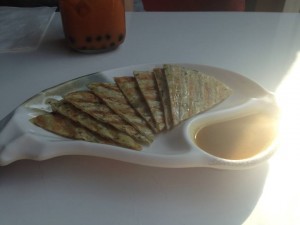
Finally we ordered our food: scallion pancakes, pork and shrimp dumplings, and for dessert, the Heart Breaker crepe. Everything came out in a timely fashion. The pancakes seemed to be made out of phyllo dough and were crisped and covered in scallions. They were precut, so the dish was perfect for sharing, and were matched with a light curry sauce, which was not terribly spicy, but a nice flavorful and cultural addition to add to the classic Korean dish. Then came the dumplings, recommended by the owner himself. The dumplings are homemade, and boy, you can tell. The dough was fresh and thick to hold in the mixture of pork and shrimp. Everything was so filling that by the end of the meal, my companion and I weren’t sure if we could handle the Heart Breaker, dreamed up by the owner’s love of Twinkies growing up. But we endured, and while we couldn’t finish the entire plate, we did our best to indulge on a dish made for the ultimate sweet tooth. We were stuffed and happy.

Just Sweet Dessert House is a friendly, inexpensive, quaint Korean-American restaurant that has a lot to offer. They even take NYU Campus Cash! Upon leaving, everyone waved us goodbye and never stopped smiling. The atmosphere was relaxed and the food was great. While I may have to wait a couple weeks to try another Heart Breaker, there’s a full menu of desserts waiting to be tasted, and on another stressful day of school and work, a nice place to sit and a tasty dessert is just what I need.

———————————————————————————————————

Daniela Bizzell, Eugene Lang College, The New School University.

Follow the Campus Clipper on Twitter and Like us on Facebook!

Interested in more deals for students? Sign up for our bi-weekly newsletter to get the latest in student discounts and promotions  and follow our Tumblr and Pinterest. For savings on-the-go, download our printable coupon e-book!
Share

Student Depression: The First Step Is…

September 13th, 2013

As any college student who’s had experience with any degree of depression can attest, no matter how mild or severe the symptoms, exact origins are mighty difficult to pinpoint. Many students who suffer any degree of depression may at some point attempt to hit that single bullseye, hone in and demarcate a single reason for all their ills. This usually results in systematically missing the mark every single time.

depression bullseye

"Depression has many causes"

Here’s the cold water: there’s more than one bullseye. Way more.

These causes operate in an integrated, latticed network. One cause may be the direct result of another, and this second cause in turn sustains the initial cause, as influencing others.

the complicated network of depression

"Specifically, a latticed network of causes"

For example, financial difficulties make you focus less on schoolwork and more on ruminating and worrying over how to obtain money, resulting in less time spent studying and getting good grades. In turn, poor grades may further facilitate your vexations about getting a decent job after college, influencing self-defeating tendencies like laziness and general hopelessness that steadily eat away you.

These interdependencies bind to form a net that swoops students up and dangles them above a wide ocean of possibilities, isolating them from a liberating and opportunistic life.

This is special kind of net. You can’t simply cut across the bottom and drop down into a depression-free life: you need to hit multiple points at once, and work these points on a continuous basis. Eventually, the net will begin to unravel, and ultimately it will unwind.

the net that holds you from opportunity

Once you relinquish the delimiting thoughts and anxieties that held you prisoner, not only will you feel free to travel along any path you wish, you will also understand the methods for conquering the nets that may come your way in the future.

As you might have inferred from my long-winded metaphor (don’t worry, I have plenty to dish out), tackling depression requires you to address multiple facets of your life, not just one.

Let’s say you’re running to the end zone (which we can think of as the end depression zone) and there are several players all ganging up on you and forcing you out of bounds. These five intimidating foes are all your anxieties, fears, insecurities, etc. They constitute depression. You can picture how difficult it would be to get past this blockade. Imagine now that there are several players on your side, and they easily take down these irksome opponents, clearing you a path to your goal.

end-depression zone

"The end (depression) zone"

Who are these mysterious allies? What keeps them going? Where did they come from? How can you harness their kickass presence to clear a path for yourself?

The vague, astute-monk-atop-the-mountain response would be but a single word: You.

wide mountain monk

"Vague aphorisms are his favorite"

Of course, we’re all in the market for more practical and fleshed out explanations in today’s light-speed world, and so a single word answer to anything is usually met not with deep insight but unfathomable frustration.

befuddled depressed students react like this to wise vague aphorisms

"ME?!"

You can relax. If I wanted to create the world’s shortest self-development guide I’d type “YOU” on a single page, bind it and title it “The Secret of Living the Best Life Possible.” I’m giving up that million-dollar book idea to offer enough real-world examples, wacky metaphors, fun exercises and challenges, personal insight and visuals to make your head spin.

Let’s get you dizzy!

The First Step is…

The first step to healing is frequently touted as acknowledgement. Now, touted is a bit strong since in, let’s say an AA meeting, acknowledgement is far more than just a suggestion—it’s a mandatory step on the path to recovery.

Depression, in a way, is the brain’s acknowledgement of the culmination of distress you’ve experienced thus far. This “acknowledgement” is certainly felt, and is accompanied by a deeply isolating sensation. There may be cases of depressed students who refuse to acknowledge their situation due to embarrassment, fear, social pressure, or pride. But they certainly feel it.

Besides, if you’re reading this, you’ve done a whole load of acknowledgement already.

And so I’d rather begin with something more suitable for the topic at hand: honesty and assessment.

You can call this your first step, not that there is any systematic process to healing yourself (at least in this guide).

These two factors are codependent and work synergistically. Honesty is used to correctly assess yourself, and assessing yourself brings out your self-honesty.

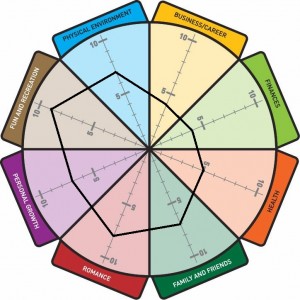
Both are immediately put into play when you fill out the wheel of life, a widely used life-assessment tool:

assess your life with the wheel of life

Filling it out my first time, my wheel looked something like this:

Aleksandr Smechov's original wheel

"I wouldn't keep this as a spare tire..."

Try putting that on a car. You’d probably end up a ditch in the first few minutes. Here are the minimum requirements for a functional wheel: sevens or above all around, with as few deviations of one point as possible, and no deviation of two points or more.

Would you put your wheel on a Ferrari 641?

ferarri 641 requires balanced wheels only

Anything less than nines all around will send this beast spinning out of control. When you have a great wheel, results are exponentially faster. You can imagine a unicycle in traffic, too, if that’s your thing.

unicycle to the max

"Nearly as fast as the Ferrari"

And so this brings us back to our team of allies and the question I posed for them: How can you harness their kickass presence to clear a path for yourself?

By becoming well-rounded, by having a functional wheel to brave your unicycle with (I guess we’re sticking to that metaphor). As you may have by now guessed, balance is the goal of this guide, and helping you achieve it is my mission.

Stay tuned!

———————————————————————————————————

Aleksandr Smechov, Baruch College.

Follow the Campus Clipper on Twitter and Like us on Facebook!

Interested in more deals for students? Sign up for our bi-weekly newsletter to get the latest in student discounts and promotions  and follow our Tumblr and Pinterest. For savings on-the-go, download our printable coupon e-book!

Share

Frozen Delight at Orange Leaf

September 13th, 2013

Tucked away in the heart of Gramercy Park, a brightly designed yogurt shop sits on the corner of 20th St and 3rd Ave. While the neighborhood is relatively quiet, one step inside Orange Leaf and one is met with an array of exuberant color and energetic, lively music, immediately creating a fun, spirited atmosphere to enjoy a sweet cup of yogurt.

When I walked into Orange Leaf on a warm Friday afternoon, I was met with a swirl of orange and pink tiles. Michael Jackson was playing in the background and a giant, flat-screen television was behind the counter showing pictures of happy customers and all of the different flavors Orange Leaf has to offer. Even better, I was greeted with smiles: all of the staff seemed genuinely happy. Cutting up fresh strawberries and offering tastes of various flavors of yogurt was done with enthusiasm. I’ve been to my fair share of frozen yogurt shops and have seen my fair share of emotionless faces who clearly hate their job; this was not the case with Orange Leaf. The many windows let in a ton of natural sunlight and brightened everything up a bit. I was comfortable, happy, and excited to try the product.

Like many frozen yogurt shops, there were sixteen different flavors to choose from. I chose to get a wide variety, in order to look at the shop through a thorough lens. A friend joined me on my froyo excursion, so between the two of us we were able to get six different flavors. One of the best aspects of Orange Leaf is the optional cup divider. I had never seen cup dividers before, but they are amazing! If you’re a frequent froyo consumer, you know the difficulty in choosing what flavors will blend together the best. You can’t get Coconut and Peanut Butter or Mango and Coffee without the yogurts blending together to make a multi-colored mess that tastes like a bunch of foods that were thrown into a blender. With the dividers, one has three separated sections, with no unnecessary combining of flavors. Just pop one in and you’re all set! Altogether we tried Watermelon, Pomegranate, Chocolate Raspberry, Peanut Butter, Wedding Cake, and of course the classic Tart. All of the flavors tasted great and were incredibly accurate to their name! Topped with both regular and sour gummy worms, peanut butter cups, chocolate chips, and fruit, I was very satisfied and was given a really great first impression.

Compared to other froyo places I’ve visited, Orange Leaf is intimate yet energetic and definitely a nice change in scenery from the 16 Handles or Pinkberry franchises I seem to see on every street corner. Whether it’s their Ounce Card, giving you a money-back point for every yogurt purchased, or the Ipad sitting in the store allowing customers to register for a rewards card or to begin following Orange Leaf on Twitter or Facebook, this yogurt shop seems to stand out. Convenience and quality are definitely priorities.

My first visit will definitely not be my last; I would highly recommend a visit to Orange Leaf. Wedding Cake flavored froyo—need I say more?

Mother and son duo!


Yum!


Friendly Staff!

———————————————————————————————————

Daniela Bizzell, Eugene Lang College, The New School University.

Campus Clipper Blogger

Follow the Campus Clipper on Twitter and Like us on Facebook!

Interested in more deals for students? Sign up for our bi-weekly newsletter to get the latest in student discounts and promotions  and follow our Tumblrand Pinterest. For savings on-the-go, download our printable coupon e-book!

Share

The Things I Miss The Most

September 5th, 2013

I’ve been out of New York City for almost a week now (with many more to go), and I’ve realized I miss a lot of things I wasn’t expecting.

CITY SOUNDS

My college is pretty much in the middle of nowhere, so the only thing you hear is students talking, partying, playing their instruments. And crickets. I honestly miss the sound of people going places, the subway rumbling beneath the sidewalk and the soles of other New Yorkers’ shoes scurrying off to start their days. I miss being able to hear the fireworks from Coney Island (every Friday night until autumn hits) from my house. I miss the constant buzz of excitement, the sense that things are always happening.

Coney Island

GRAFFITI/STREET ART

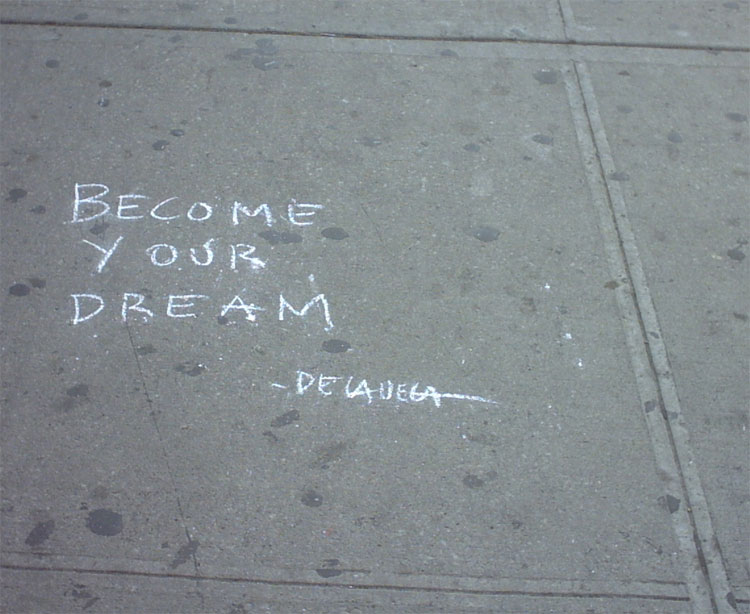
 There is an amazing street artist of the name De La Vega that puts his creative stamp on the city. The first time I saw his work was on the sidewalk by my high school, on the Upper East Side. It was a very simplistic chalk drawing of a fish with the words: BECOME YOUR DREAM written in bold letters.

SINGLE-FOOD STORES

I know this probably sounds weird, but when you have to eat all your meals in a single dining hall, you realize how unique NYC food is. While I do miss the bagels and the pizza, one of things I miss the most is actually all the stores that sell only one item. S’MAC (East 33rd Street or East 12th Street), for example, sells only mac and cheese. (I promise it will be the best mac and cheese you’ve ever tasted.) Wafels & Dinges (trucks located around the city, one stationary cart on the Great Lawn in Central Park, new café in the East Village) sells only waffles with a variety of delicious toppings to smother them in. If you’ve never tried a Liége wafel with spekuloos, you haven’t really lived. And, my personal favorite, Pommes Frites (2nd Ave between 7th and St. Mark’s) serves only french fries with a menu full of interesting and strange sauces to dip them in (try the pomegranate teriyaki mayo, one of the best/weirdest). Savor these!


COOL SUBWAY STATIONS

I’ve visited cities with subway stations that are clearly cleaner than the ones we have in New York City. But none have been more creative or alive. A lot of the street performers/musicians are actually painfully talented in the way only the undiscovered can be. But people set aside, the stations themselves have a lot of personality. On the NQR train platform at Herald Square, for example, there are green pipes that hang from the ceilings. If you put your hands over different holes, different sounds come out. Just a little something fun to do while waiting for the train. My favorite of these stations is, of course, Grand Central. But not for the constellation-covered ceiling or the analog clocks or even the shops. I love Grand Central for the whisper gallery. There are four columns, and when you speak into one of them, the person standing at the opposite column can hear what you say.

Whisper Gallery, Grand Central

BEING SELF-RELIANT WITH TRANSPORTATION

As intimidating as the MTA subway and bus system may seem, you will eventually learn to navigate them like a native. I really miss being able to hop on a train and go anywhere, all by myself. (Up in Vermont, where I am, I have to rely on friends with cars.)

THE BENCHES IN CENTRAL PARK

The benches in Central Park have the most lovely, funny, and witty engravings on them. These are for and by your fellow New Yorkers. Read them all.

Central Park, Upper West Side


—————————————————————————————————————————-

Katie Yee, Bennington College

Follow the Campus Clipper on Twitter and Like us on Facebook!

Interested in more deals for students? Sign up for our bi-weekly newsletter to get the latest in student discounts and promotions  and follow our Tumblr and Pinterest. For savings on-the-go, download our printable coupon e-book!

Share

Student Depression: You’re Definitely Not Alone

September 5th, 2013

I wanted it to be a productive day. I really, badly wanted the day to mean something. I didn’t want it go to waste the way it did.

But what could I do? I was depressed.

signs of depression

It was the spring before my senior year in college, a quiet weekday morning; warm, with soft sunshine pouring in through the blinds and a wafting smell of rose hips from the tea brewing in the kitchen. It was the proper setting to get some work done.

And I certainly planned well for the occasion, writing out a plethora of tasks, things I needed to read and write, jobs to apply to, rooms to clean.

I was 21. I had my own one-bedroom, a loving and supportive girlfriend, a passion for the arts, and a summer devoid of distraction and devoted to my own self-betterment.

You can contemplate my confusion several minutes later, when I ended up wallowing in my bed, drinking heavily and sobbing into my arms. How did I go from a highly motivated student to an absolute wreck, wanting to melt into some gutter and vanish out of existence, forgotten forever?

Misery is never solely triggered by a single event, but that single event is a catalyst. My neighbor’s music turned out to be my trigger. But he was never the one who loaded the gun.

No, that one was on me.

I was situated at my desk, tea in hand, ready to get my work underway, when on the other side of my wall my neighbor turned on some salsa music, driving pumping bass into the living.

But it wasn’t the music that made me shout at my wall until my voice turned hoarse; it was the culmination of angst, anger, anxiety, frustration, hatred, helplessness and exhaustion that had accreted within me over the past three years in college.

These emotions, released by my sudden expenditure, quickly leeched my energy until I was a husk of my former self.

I was so tired after shouting so much that I slunk into bed, depressed and apathetic. The drinking that followed did little to numb how I felt.

I tried to get up and write, but my mind would put up an impenetrable blockade, my body would become limp and what sparse energy I had remaining would drain out of me, seemingly gone forever.

When the day was over, I looked back and thought to myself, “What good came out of this? And why does this keep happening to me? Why can’t I just get things done?”

I shook my head, cursing myself, attributing the heavy lethargy to laziness.

But I wasn’t lazy. When I was emotionally stable, I could work 10 hours straight without breaking a sweat. It took several more similar occurrences to see that I was harboring some signs of depression.

I wasn’t alone: as of 2011, according to a nationwide survey by the Nation Institute of Mental Health, 30% of students reported they were so depressed “that it was difficult to function.” In 2012, Healthline.com stated that 44% of college students in America “report having symptoms of depression.”

Depression is a global epidemic: an estimated 350 million people suffer from it, and medicine doesn’t seem to be helping as much as it should: as of 2011, the antidepressant intake rate has increased by 400% from 1988, yet depression among students continues to rise steadily.

signs of depression

Of course, correlation does not equal causation. Student depression can be attributed to a vast number of causes. But this does nothing change the fact that depression is a major problem affecting millions of students.

As I slowly learned, however, there are many ways to help curb depression, on your own and with the help of others, without the aid of antidepressants. There are myriad exercises, materials, and techniques that can aid you in your quest to conquer mental cloudiness, apathy, sadness and a whole other slew of depression symptoms.

I effectively helped myself in half a year. I know you can do it in even less time.

The material that follows is a series of signposts intended to help guide those seeking a way to eliminate the misery constantly inhibiting their creative potential.

If you genuinely wish to reach a new plateau of mental freedom, a state of mind that will allow you to get a grasp on the chaotic years of student life and the trials of transitioning into adulthood, then this material will be a suitable diving board into a less stressful student career.

Time and time again, personal experience has shown me how difficult it is to help those who do not actively seek treatment on their own, and without the constant urging of others.

By seeking out this material, you are taking a giant leap forward: you are putting responsibility and your fate in your own hands.

———————————————————————————————————

Aleksandr Smechov, Baruch College.

Follow the Campus Clipper on Twitter and Like us on Facebook!

Interested in more deals for students? Sign up for our bi-weekly newsletter to get the latest in student discounts and promotions  and follow our Tumblr and Pinterest. For savings on-the-go, download our printable coupon e-book!

Share