Posts Tagged ‘self help books’

Confident Achievement: On Overcoming Imposter Syndrome Without Stretching Yourself Too Thin

Tuesday, August 11th, 2026

Regardless of what we like to call the thing that motivates us, many, if not most, undergraduate students experience the arbitrary pressure to be or become someone extraordinary. Yet, despite the accolades we accumulate, the colleges we were accepted into, or the jobs we’ve held, it may never feel like we’re qualified enough to lay claim to any of it or like we’re even on our way to reaching a point when we will be.

Either we let this sense of inadequacy hold us back or propel us into a cycle of working harder, committing to more, and, ultimately, burning out quicker. This only helps to reinforce our fears that we are not capable of achieving our goals, will not find success or stability, cannot surpass the condition of our current phase in life, or even that we may regress.

As a student in New York City, I am no stranger to imposter syndrome, that deep-seated doubt in my skills and accomplishments. That relentless anxiety that I will be exposed as a fraud. However, as an intensely reflective personality, I like to think that I’ve come to understand a bit more about the source of my insecurities and a lot more about how I, personally, cope with them better. So let me offer you a few tidbits that I gained in my first two years of university so that you too can begin deciphering how you cope best with this “syndrome.”

Firstly, I decided to work on building my confidence beyond academia, my career, and the aesthetics. Since the virtual world has become a major part of my daily life, this required reframing my relationship with digital content. I’m sure many of us can relate to being envious of the successful lives we scroll across online or being discouraged by not seeing a radical change in our lives after indulging in an inspirational book, talk, social media post, or film.

However, one day, I watched a YouTube video on the idea that our personalities are starting to feel borrowed, and the suggestion that stuck with me involved using the media we consume as real inspiration. Now, I set dates to actually try the interesting recipes, crafts, or activities I saved on Instagram. I make time to journal about the insights I glean from the inspirational quotes, short-form videos, and carousels that fill my social media feeds.

I read Oliver Burkeman’s Meditations for Mortals while grabbing breakfast at Mudspot Restaurant in the East Village

By implementing aspects of the content that strikes me into my habits and approach to living, I am gradually coming to believe that I am as interesting and capable as the creators that I envied seem to be. Not only this, but I am also learning to act more attuned to my personal goals, interests, and personality by making the experiences that I’m virtually witnessing my own. This leads me to my next couple tips.

This past January, I was introduced to the idea of “doing less and achieving more” by an episode of The Psychology of Your 20s podcast. After listening, I decided to reflect upon which of my goals are truly mine, which are not suitable for the chapter of life I am currently living in, and which are optimal to prioritize now. Following the host’s advice, I listed fifteen life goals that would allow me to find fulfillment free from external rewards, teach me to enjoy the challenges that expand my skillset, and not only positively impact myself but others as well. Then, I drew a line beneath the first three—an indication that they must be seen through, or at least that my real desire for them be worn out—before I proceed to fulfill any of the goals listed beneath them.

Taking this idea a step further, I took the advice of Oliver Burkeman, author of Meditations for Mortals, and started breaking up my daily to-do lists into “must do,” “should do,” “could do,” and “done” lists. With my “must-dos” never exceeding three tasks, I aim to complete them first, and I make sure to write down every productive task I complete during the day so that even if I wasn’t able to complete all of my “must-dos,” I’m able to visualize the totality of my success that day, including those tasks that weren’t written down at the start. This practice has helped me end my days feeling accomplished without feeling drained because I can say that I made time to work toward my goals or just keep my life in order, even if the steps I took were small or unplanned.

Now, your journey to feeling more confident may not begin with reassessing how you plug in to the wide, digital world. But really my first step to overcoming imposter syndrome was to define what fulfillment meant for me. It will take time for self-assurance to transform from self-doubt, and there will still be moments when your confidence falters. But you shouldn’t try to force that transformation by over-working yourself. Aligning your approach to life with your goals, interests, and daily ability will kindly reward you by slowly exchanging your pursuit of being extraordinary for the belief that you already are.


Looking to add a bit of sweetness to your day? Take inspiration from us and try Fluffy Fluffy Dessert Cafe with this coupon!

By Lauren Gascon 

Lauren Gascon studies Media, Culture, and Communication at NYU and enjoys discussing people’s relationships with each other and themselves. When she’s not on campus, you can find her café hopping, browsing bookstores, or enjoying lunch in one of New York City’s many beautiful parks.


For over 25 years, the Campus Clipper has helped college students in New York City—and later in Boston and Philadelphia—save money and succeed in city life. We offer a digital coupon booklet with discounts on food, clothing, and services, plus an Official Student Guidebook with real advice on how to navigate college life in a big city. Our internship program lets students build skills, earn money, and publish their own e-books. Follow us on Instagram and TikTok @CampusClipper, and sign up for our newsletter to get deals straight to your inbox. To access the digital coupons, scan the QR code on our printed card—available in dorms, student centers, and around campus.

Share

Student Depression: The Self-Help Trifecta

Saturday, October 19th, 2013

Imagine you didn’t know how to breathe. Okay, that’s a bit ludicrous, but let’s say you were born on a planet where breathing was not necessary (for some absurd reason). Suddenly, you get orders from your local planetary travel center to beam to earth, where, if you don’t breathe, you perish.

Earth

"Leaves you breathless, doesn't it?"

So what do you do? You study and practice the art of breathing, because if you slack off you’ll end up a purple, shriveled vegetable (not to take this sinuous example any further than it has to, but for the sake of some viability, you use a breathing apparatus when you sleep). In a matter of weeks, breathing begins to feel more and more natural, and in six months’ time you’re better at breathing than most people on earth. And then, satisfied with your abilities, you disconnect your nightly breathing apparatus, in turn shriveling up into a purple corpse.

Pruple Vegetable

"They were found huddled together like that... a bittersweet end"

What a waste, huh? Breathing was never an innate ability for you; when you suddenly stopped there was no muscle memory to kickstart the process.

It’s (sort of) the same with self-help material. You don’t grow up in an environment that requires self-help to survive, but once you reach adulthood you’re faced with a plethora of dilemmas, challenges and life goals that would benefit immensely from motivational literature.

While you may take six months to become a self-help master, once you stop studying and practicing the material, what you learn effectively “dies.”

For the millennial attention span, lifelong commitment seems intimidating, to put it ever so lightly. That’s why the material fed into your brain, just like the oxygen going into your lungs, must not be overly complex, and must be easy to take in.

“Hey!” you say.

“Hey,” I say back.

“Hey… Yeah, well, I’m all for learning how to improve my life situation and all, but there’s like so many books out there and some contradict others and some say the same stuff over and over and over and some are so abstract they’re just words!”

“You’re right.”

“He- wait, what? I am?”

“You are.”

“Oh. Ok, cool.”

Indeed, there is a plethora of material out there. But there’s no need to complicate matters by taking it all in as dogma. That’s why I’ve gathered a teeny list here for you that you can easily inhale. Just don’t take it for granted or you’ll end up looking like this guy:

Grimace

"Grimace stopped breathing a long time ago..."

1. Mind Power into the 21st Century | John Kehoe

mind power into the 21st century
Not many books back up their material with quantum physics. Ok, quantum physics lite. But the exercises work, and they work extraordinary well. The best part? They’re simple and easily inhalable. Here’s an excerpt on how to best visualize your goals:

“Two conditions for a successful visualization: 1) Always visualize your goal as if it is actually happening to you right now. Make it real in your mind; make it detailed. Enter the role and become it in your mind. 2) Visualize your goal at least once a day, each and every day. There is power in repetition.”

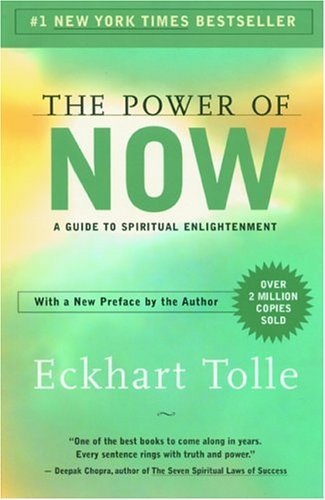
2. The Power of Now | Eckhart Tolle

Power of Now
Ok, remember when you (well, I) mentioned that some self-help books seem to contradict each other? The Power of Now is the perfect example. Tolle is all about placing yourself in present moment. That includes cutting off your wandering mind.

Funny, Mind Power is all about thinking your way to a better life, and Power of Now is all about abdicating thought. It’s two radically different approaches to a clutter-free mind. Why do they work so well together?

Sometimes you need a hiatus from working your mind, even if all you’re doing is positive thinking. Tolle is great for this.

Some quotes:

“In today’s rush we all think too much, seek too much, want too much and forget about the joy of just Being.”

“The past has no power over the present moment.”

“The primary cause of unhappiness is never the situation but thought about it. Be aware of the thoughts you are thinking. Separate them from the situation, which is always neutral. It is as it is.”

3. Self-Esteem Affirmations | Louise Hay

Self-Esteem Affirmations
Yes, Mind Power has great affirmations. In comparison, Hay’s lines seem to grind cheese:

“I am in harmony with nature. I bless this planet with love.” (taken from her website)

Don’t groan. Hold it, just for a second. Hay is a perfect bridge from the thought-powered Mind Power and the relatively thought-free teachings of The Power of Now (Tolle’s angle is objectively observing your thoughts rather than utilizing them). Hay’s audio book is meant to be heard before sleep, or used as white noise while going about quotidian duties. She’s the fundamental in-between, and her semi-subliminal audio material is a great addition to the other two’s “extremes.”

There you have it, no need to sift through dozens of self-help resources. These fundamental materials cover a wide area, perfect for us college students who need a chameleon approach to working around the anxieties of our Mobius-strip-like lives, our variegated needs always, always demanding an alternative way of going about the situation.

Stay Tuned.

———————————————————————————————————

Aleksandr Smechov, Baruch College.

Follow the Campus Clipper on Twitter and Like us on Facebook!

Interested in more deals for students? Sign up for our bi-weekly newsletter to get the latest in student discounts and promotions  and follow our Tumblr and Pinterest. For savings on-the-go, download our printable coupon e-book!

Share