Posts Tagged ‘mind power’

College in Less Than Four Years: An Interview with Poe

Thursday, July 9th, 2026

For many of us heading into our first year of college, discovering that we have the opportunity to graduate in three years or less may be cause for celebration. It would mean less money spent, less time enduring classes, professors, or classmates we may not enjoy, and less time waiting for our turn to break out into our chosen career field. Then, for others of us, the decision is not so obvious, and deciding whether or not it’s worth it to stick out all four years of undergrad may become one of the first major dilemmas in our professional lives. You may find yourself wondering if entering the workforce early might mean cutting short your enjoyment of your young life. If time is “relative” and “of the essence,” how do you determine how to spend it best? Well, to help those uncertain university students with such an uncommon opportunity answer this question better, I sought the wisdom of my friend Poe, an economics student at NYU who will be graduating in his junior year of college.

Poe taking a break from his busy life as a student to enjoy a simple pleasure, lunch at IKEA

When I asked Poe about his motivation for finishing college in three years, he shared about a set of circumstances belonging to a small portion of the international student population. He explained that, “as a passport holder of Taiwan, [he has] to enroll in mandatory military service for one year…Serving in the military would push [him] back one year in college, meaning that while others spend the standard four years to enter the workforce, [he] would have to spend five.” As a result, Poe opted to “graduate one year early,” which would allow him to “fulfill [his] service obligation while also not lagging behind [his] peers.

However, while what he described as “fear of failure,” or even, the fear of falling behind, may have been his initial motivator, it is not what has ultimately allowed him to make it this far. When asked which of his qualities he believes helped to see himself through to his graduation year, he noted his perseverance.

Completing 128 credits in the span of three years is a considerably daunting task, especially when you’re still standing at the start of your freshman year. Poe’s approach to mapping out his semesters began with an empty Google spreadsheet, which he has been using to keep track of “all the courses [he] needs to take…[across] the three years [he’s been] in school.” For Poe, “planning it out visually [made] it less intimidating and more achievable.” He then proceeded to turn his academic planning into scholastic success by studying “at least three days early” and “always [listening] in class,” and through all of the time he spent balancing classes, studying, and working, he learned the skill of persistence. 

I asked Poe how he attempts to cope with burnout as a working student with a full course load, and he shared this bit of insight: ”You are your greatest enemy.” From his philosophy courses he came to understand that “while there are external factors that affect your mindset, how that factor ultimately affects you is up to your own interpretation.” In other words, when you face disappointments or find your plans to have been derailed, you can beat yourself up and stew in the letdown, “or you can think about it as a chance for improvement. It’s all about the mindset.”

In this same vein, Poe admitted that as an early-graduating student, “you definitely will have to make sacrifices.” These could be your social life, hobbies, or time alone to rest, but balancing everything is possible; “it just depends on how strong your mind is at disciplining yourself,” and he is no stranger to life testing the strength of his mind.

He described for me his most challenging semester—when he had received his first F on a midterm. Afterwards, “[he] felt like everything was lost and had no motivation to continue.” Then, he remembered to not be his own enemy, and he gave himself a break to indulge in activities he enjoyed—like visiting parks, hiking, and working out. Apparently, this also included watching Pixar’s Hoppers, from which he offered the quote, “It’s hard to be mad when you’re part of something big”—a reminder “that in the grand scheme of things, we are just one of trillions of creatures on earth, all just trying our best.”

He offers this unique piece of advice to students looking to earn their degree early: “Take one or two philosophy classes… It will change your perspective on life, society, and purpose… If you really listen in class and ask yourself the same questions the philosophers asked, you will gain a better understanding of yourself as a person and how to navigate the world.” And, clearly, the opportunities he took to look beyond his major focus bolstered his overall focus to earn his degree.


Looking to get out of the books and indulge more in the things you enjoy? Check out this 10% student discount at Garlic New York Pizza Bar!

By Lauren Gascon 

Lauren Gascon studies Media, Culture, and Communication at NYU and enjoys discussing people’s relationships with each other and themselves. When she’s not on campus, you can find her café hopping, browsing bookstores, or enjoying lunch in one of New York City’s many beautiful parks.


For over 25 years, the Campus Clipper has helped college students in New York City—and later in Boston and Philadelphia—save money and succeed in city life. We offer a digital coupon booklet with discounts on food, clothing, and services, plus an Official Student Guidebook with real advice on how to navigate college life in a big city. Our internship program lets students build skills, earn money, and publish their own e-books. Follow us on Instagram and TikTok @CampusClipper, and sign up for our newsletter to get deals straight to your inbox. To access the digital coupons, scan the QR code on our printed card—available in dorms, student centers, and around campus.

Share

Student Depression: The Self-Help Trifecta

Saturday, October 19th, 2013

Imagine you didn’t know how to breathe. Okay, that’s a bit ludicrous, but let’s say you were born on a planet where breathing was not necessary (for some absurd reason). Suddenly, you get orders from your local planetary travel center to beam to earth, where, if you don’t breathe, you perish.

Earth

"Leaves you breathless, doesn't it?"

So what do you do? You study and practice the art of breathing, because if you slack off you’ll end up a purple, shriveled vegetable (not to take this sinuous example any further than it has to, but for the sake of some viability, you use a breathing apparatus when you sleep). In a matter of weeks, breathing begins to feel more and more natural, and in six months’ time you’re better at breathing than most people on earth. And then, satisfied with your abilities, you disconnect your nightly breathing apparatus, in turn shriveling up into a purple corpse.

Pruple Vegetable

"They were found huddled together like that... a bittersweet end"

What a waste, huh? Breathing was never an innate ability for you; when you suddenly stopped there was no muscle memory to kickstart the process.

It’s (sort of) the same with self-help material. You don’t grow up in an environment that requires self-help to survive, but once you reach adulthood you’re faced with a plethora of dilemmas, challenges and life goals that would benefit immensely from motivational literature.

While you may take six months to become a self-help master, once you stop studying and practicing the material, what you learn effectively “dies.”

For the millennial attention span, lifelong commitment seems intimidating, to put it ever so lightly. That’s why the material fed into your brain, just like the oxygen going into your lungs, must not be overly complex, and must be easy to take in.

“Hey!” you say.

“Hey,” I say back.

“Hey… Yeah, well, I’m all for learning how to improve my life situation and all, but there’s like so many books out there and some contradict others and some say the same stuff over and over and over and some are so abstract they’re just words!”

“You’re right.”

“He- wait, what? I am?”

“You are.”

“Oh. Ok, cool.”

Indeed, there is a plethora of material out there. But there’s no need to complicate matters by taking it all in as dogma. That’s why I’ve gathered a teeny list here for you that you can easily inhale. Just don’t take it for granted or you’ll end up looking like this guy:

Grimace

"Grimace stopped breathing a long time ago..."

1. Mind Power into the 21st Century | John Kehoe

mind power into the 21st century
Not many books back up their material with quantum physics. Ok, quantum physics lite. But the exercises work, and they work extraordinary well. The best part? They’re simple and easily inhalable. Here’s an excerpt on how to best visualize your goals:

“Two conditions for a successful visualization: 1) Always visualize your goal as if it is actually happening to you right now. Make it real in your mind; make it detailed. Enter the role and become it in your mind. 2) Visualize your goal at least once a day, each and every day. There is power in repetition.”

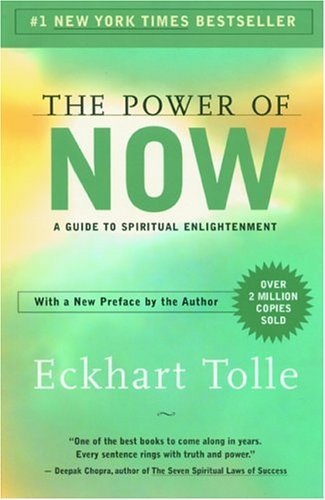
2. The Power of Now | Eckhart Tolle

Power of Now
Ok, remember when you (well, I) mentioned that some self-help books seem to contradict each other? The Power of Now is the perfect example. Tolle is all about placing yourself in present moment. That includes cutting off your wandering mind.

Funny, Mind Power is all about thinking your way to a better life, and Power of Now is all about abdicating thought. It’s two radically different approaches to a clutter-free mind. Why do they work so well together?

Sometimes you need a hiatus from working your mind, even if all you’re doing is positive thinking. Tolle is great for this.

Some quotes:

“In today’s rush we all think too much, seek too much, want too much and forget about the joy of just Being.”

“The past has no power over the present moment.”

“The primary cause of unhappiness is never the situation but thought about it. Be aware of the thoughts you are thinking. Separate them from the situation, which is always neutral. It is as it is.”

3. Self-Esteem Affirmations | Louise Hay

Self-Esteem Affirmations
Yes, Mind Power has great affirmations. In comparison, Hay’s lines seem to grind cheese:

“I am in harmony with nature. I bless this planet with love.” (taken from her website)

Don’t groan. Hold it, just for a second. Hay is a perfect bridge from the thought-powered Mind Power and the relatively thought-free teachings of The Power of Now (Tolle’s angle is objectively observing your thoughts rather than utilizing them). Hay’s audio book is meant to be heard before sleep, or used as white noise while going about quotidian duties. She’s the fundamental in-between, and her semi-subliminal audio material is a great addition to the other two’s “extremes.”

There you have it, no need to sift through dozens of self-help resources. These fundamental materials cover a wide area, perfect for us college students who need a chameleon approach to working around the anxieties of our Mobius-strip-like lives, our variegated needs always, always demanding an alternative way of going about the situation.

Stay Tuned.

———————————————————————————————————

Aleksandr Smechov, Baruch College.

Follow the Campus Clipper on Twitter and Like us on Facebook!

Interested in more deals for students? Sign up for our bi-weekly newsletter to get the latest in student discounts and promotions  and follow our Tumblr and Pinterest. For savings on-the-go, download our printable coupon e-book!

Share