Posts Tagged ‘family life’

Managing Family Life in Your Early Twenties

Wednesday, October 28th, 2026

With the holidays coming up, many of us will be taking a break from school to go home and see our loved ones. Whether it be a train ride or a cross country flight, traveling back home can come with a lot of reflection, especially as we get older. When I left for college, I was only an hour away by car. But now, as a graduate student, I’m in a whole other state which is two hours away by plane. The distance means I’m seeing my family a lot less than I used to, and planning my trip back home for Thanksgiving has made me realize just how much my relationship with my family has changed over the years. 

When I went to college, it was definitely an adjustment to live on my own for the first time and be more independent than ever. My sister was someone I always went to when I was stressed or having a bad day, and I could always count on my parents to support me and help me grow as a person. No longer living under the same roof meant I had to figure things out for myself and discover my own identity outside of my family, at least to a certain extent. For the first month of college, I felt like I no longer had my usual support system of friends and family back home, and adjusting to a whole new environment on my own was something I’d never really had to navigate. I was determined to “make it on my own” and became so immersed in finding my own direction that I didn’t keep up with calls to my family or come home as often I thought I would, and it was exhausting balancing this new independence with my life back home. However, I quickly realized that our support systems don’t have to change just because we move someplace new. I still needed my family, even if our mode of communication was different, and I realized that finding my own independence went hand in hand with staying connected to my family. Just giving my mom a quick call before class or updating my dad after an exam helped me stay grounded during this transition period, and the love and support I felt from them made it possible for me to grow into myself as an individual. 

When I moved to graduate school I was reminded of my experience in college, though I knew that leaving for New York City would come with its own set of experiences that would help me grow as a person. I felt a need to get out of the midwest for a while and experience independence on a whole new scale. At first, it was easy to get swept up in the excitement and fast-paced environment of the city, and for my first month in New York I didn’t reach out to my family nearly as much as I’d initially wanted to. I think I needed that time for myself just to get acquainted with a place so unlike my home back in Wisconsin, though I was quickly reminded of the importance of balance when it comes to our support systems. Though I was making new friends and doing things I’d never done before, calling my parents and sister or updating my aunt and uncle became more crucial than ever. Just like in college, they were able to ground me and remind me of the person I’d grown into over the years, as well as the person I wanted to become. 

A pic from my first day in NYC!

Now, almost three months after moving to New York, I’ve been able to maintain a nice balance between family life and personal life. I call my mom every weekend and FaceTime my sister at least once a week, and it’s been really rewarding to update them on my life while still feeling that independence within myself. Moving has allowed me to grow on my own time and in a space where I feel like I’m free to do so, and staying consistently connected with my family has really helped with that process. There is still a lot of work to be done as I continue into my twenties, but I look forward to having my family with me through that process, however far away they may be!


Looking to treat yourself after a long day? Head over to Andiamo Pizza for 20% off!

By Katrina Kallas

Katrina Kallas is a first-year graduate student at The New School, studying creative writing with a concentration in fiction. Originally from Wisconsin, they enjoy writing about relationships, friendships, and personal values. In their free time, they write fictional stories on a variety of topics and hope to publish a novel after they graduate. 


For over 25 years, the Campus Clipper has helped college students in New York City—and later in Boston and Philadelphia—save money and succeed in city life. We offer a digital coupon booklet with discounts on food, clothing, and services, plus an Official Student Guidebook with real advice on how to navigate college life in a big city. Our internship program lets students build skills, earn money, and publish their own e-books. Follow us on Instagram and TikTok @CampusClipper, and sign up for our newsletter to get deals straight to your inbox. To access the digital coupons, scan the QR code on our printed card—available in dorms, student centers, and around campus.

Share

At the Dining Table: Chapter 1 – Creating Community and Unity in new Spaces

Monday, July 12th, 2021

In the center of my yellow house in Chicago’s north side sits a large wooden table. My parents bought the table, riddled with holes and cracks, from an Amish farm in Wisconsin. Over the past 26 years of owning it, it has seen family dinners, rushed science projects, conflict, resolution, and divorce. 

Growing up in a Mexican-American household, my parents made sure we understood one thing: unity. In the age of cellphones, reality television, and the internet, it is easy to ignore reality and constantly distract yourself through entertainment. As a result, values have changed family dinners are no longer regularly practiced. This is where my wooden table comes into play. 

Fridays were for everyone, not just family. Fridays were for lessons on politics, religion, culture, and music. Fridays were for bowls of gumbo made by my Uncle Andrew and his brother Chris, two Cajun men that my parents met long before I was born. Over bowls of mussels simmered in a butter, shallot, and white wine sauce, I quietly listened to conversations on how things “used to be.” I even learned about my father’s immigration story, following his father from Mexico City to Chicago at the age of eight. It is around the wooden table that my dad told us of the meals he shared with his family: small bowls of rice and beans, pigeons caught from the street and stuffed, and on special occasions, mole — a labor-intensive dish made from a plethora of ingredients like hand-peeled almonds, bread, avocado leaf, and chocolate that were all simmered into a thick sauce. 

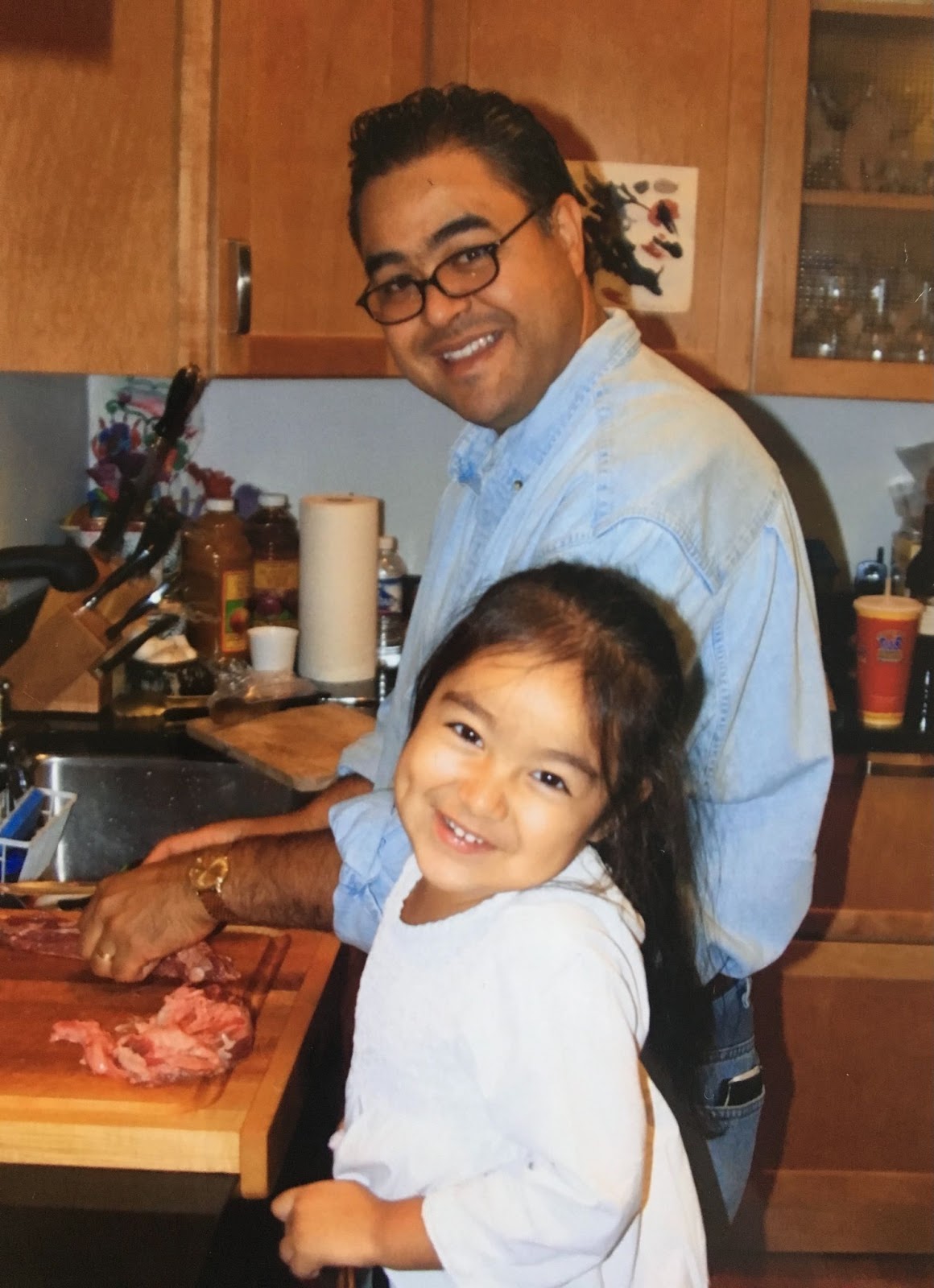
My father and I preparing Friday night dinner.

On these Friday nights, my parents exposed me to community—not one you are born into, but one you establish for yourself. Sitting in the black wooden chairs around our table was the community my mother and father created over time: It was with the help of experiences and long-lasting memories that built this sense of community. They ranged from childhood on the gang-ruled southside, law school in Wisconsin, and having to blend in with the affluent, white neighborhood they tried their best to blend into. 

Essentially, unity came with community. The people sitting at my table with a range of skin colors and accents, as well as coming from diverse places they called “home”, became my aunts and uncles. They would stay by my side as I became old enough to cook the Friday night meals by myself, and held my hand as the meals slowly stopped. 

In the end, some things are not made to last forever. The teenage love my parents once held for each other grew cold and moldy, sitting in the back of the refrigerator waiting to be thrown out. Along with the expiration of their marriage, our Friday nights became but a whisper of the values they instilled in my brothers and me planted into the back of our minds. 

Ultimately, moving away from home is hard. You leave the people that know you best and are forced to find your own community — your chosen family. I saw my father do this as he left the house and the wooden table, searching again for a stronger sense of family after walking away from the one he already had. I saw it again as my brothers left for college, searching for a community far away from home and parental guidance. Then I experienced it for myself, packing my bags to cross the pond, where I hoped to find some connection back to my life in Chicago in an unknown city.

Using what I learned around that hole-riddled, brown, wooden table, I created my own community almost 4,000 miles away from home. Over bowls of rice made with seasonings I smuggled in through my luggage, my roommates and I came to love each other, like how my parents loved the neighbors they took in as family. With the right amount of food, I am sure you can find your community, too. 

Start building your community today over some delicious empanadas from Gourmet Empanadas on Avenue B!


By: Allegra Ruiz

Allegra Ruiz is a junior at New York University and she is from Chicago. She studies English and is minoring in Creative Writing. In her free time, she enjoys journaling, reading books and essay collections, and cooking for her roommates. Currently, she lives quietly in New York. 

For over 20 years, the Campus Clipper has been offering awesome student discounts in NYC, from the East Side to Greenwich Village. Along with inspiration, the company offers students a special coupon booklet and the Official Student Guide, which encourages them to discover new places in the city and save money on food, clothing, and services.  

At the Campus Clipper, not only do we help our interns learn new skills, make money, and create wonderful e-books, we give them a platform to teach others. Check our website for more student savings and watch our YouTube video showing off some of New York City’s finest students during the Welcome Week of 2015.

Share

When Home Is Where the Heart Isn’t: Moving Back in with Your Parents

Saturday, June 16th, 2012

There’s no place like home—and good thing, because it’s hard enough dealing with just one of them. The dream life after college varies among students, but these dreams often have one goal in common: never live with parents again. Study results vary, but anywhere from a mere 20-47% of graduates actually achieve this goal right away, hence why we have been dubbed “Boomerang Kids” and “The Lost Generation.”

After having lived on campus and away from home, many students struggle with moving back in with their family, whether just for the summer or for who-knows-how-long after graduation. They might have to share a car or deal with the fact that what was once their bedroom is now the guest room. They might have to take care of pets and siblings. They might have to pay attention to how many possibly-inappropriate “That’s what she said” jokes they make (or maybe that’s just me). They might have to participate in housekeeping that goes beyond the fend-for-yourself methods that worked with roommates. They might have to actually have pants on as they walk around the house.

There are good things about moving back home too, though. Most students won’t have to buy their own groceries, don’t have to pay rent (though there are plenty who do), and won’t have to live with roommates anymore. The opportunity to save money is often enough incentive to make the big move back to the mothership.

Whatever your at-home responsibilities include, family life can often get frustrating and can affect your feelings towards the people you love. The sense of independence that you gained in college might start to feel restricted by watchful eyes of a parent, guardian, or even siblings. When you move back home, how can you make sure both you and your parents keep your sanity?

Of course, our parents aren’t all the same, and these guidelines won’t work with everyone, but the main point to remember is that compromise is crucial to solving many problems. Let’s face it: if you hate moving home, you’d probably only do it if you have to, in which case your parents are doing you a favor. Therefore, you should try to meet them eye-to-eye on issues that concern them (or that they think concern them).

The Problem: You feel weird having friends over.
First, you might want to establish a policy on having friends over (particularly if you want to drink alcohol, do drunken cartwheels, smash bottles, do body shots, etc.). If your parents’ guidelines are not something that you agree with, deal with it. Though the people invited might be your trustworthy friends, the location is still not your own and you have to respect the property of others. Find another place to meet up with people, whether someone else’s house, a public park, or a bar.

The Problem: Your parents want to set a curfew.
Tell them or leave a note before you go out about when they can expect you back. Be honest about where you are going, and assure them that you will be responsible. If you end up staying out later than expected, call them to let them know. Establish beforehand if a text will suffice (no one ever feels comfortable drunkenly calling the ‘rents, but spell check always helps in texts).

The Problem: Your room is now a guest room and feels impersonal.
Explain that you need a place to call home and a room to call your room. Ask them if they wouldn’t mind if you personalized your room a little bit. Offer to change it back before you leave (if you ever do!), just as if you were living in an apartment or dorm room.

The Problem: The nagging never stops.
If your parents constantly assign you tasks or complain about what you haven’t done, ask them to write a list for you ahead of time. That way, they will get an idea of the number of things they are asking of you and you will have all their requests in one spot so that you don’t forget them. This might also enable you to discuss the demands and negotiate them.

The Problem: Your family is simply driving you crazy.
Get out of the house. Rather than spending every minute either at home or with friends (though they can be a great source of sanity), consider getting a job, even if it is not your “dream job” or on the path towards it. In terms of your resumé, future employers would rather see you that you worked anywhere than nowhere. This will also get you out of the house, keep you busy, and maybe even earn you some money so that you can work towards affording your own place (if you’re not already being charged rent).

The Problem: You have no money or car and feel trapped in the house.
Again, get a job. Save money. Maybe babysit a neighbor that you don’t need a car to drive to or find a person or mode of public transportation that can bring you to your job. Ask your parents for loans, but be sure to respect their contributions, keep track of them, and pay them back.

The Problem: Your relationship with your parents is deteriorating.
As they grow up, many children start to realize the potential for their parents to be friends as well as guardians. But once parents start to pick up the roles of “Mom” and “Dad” full-time again, it is important to keep the “friend” role going too. Talk to each other about how your days are going, fill your dinnertime with conversation, and hang out—whether that means watching TV or a movie, washing the cars in the driveway, going shopping, exercising, or even just going to the grocery store together. Helping out around the house will help to bring friendliness back into your relationship as well, since it will encourage more of a mutual we-are-in-this-together relationship and less of a predator-prey, all-you-do-is-live-under-my-roof-and-eat-my-food relationship. Personally, I like to set aside time right when I get home from work to do things around the house so that I can get it done and move on.

The Problem: It doesn’t look like you will ever get out of there.
Stay positive. Set a potential move-out date, get an idea of where you’d want to move to, do research, and get yourself excited with ideas for your independent home. Also, remember that you are not alone. There are millions of others in the same situation as you, like Sabrina.

Even if you do manage to achieve an orderly parent-child relationship, both you and your parents are probably still looking forward to the day that you move out. Know that it will come, but remember that it will not happen by itself. Work towards it, have patience, keep the peace in the meantime, and residential independence will be in your grasp soon enough.

Help the family save money (and appreciate you more!) by offering to pick up the groceries with this discount coupon!

Carina, New York University. Read my blog and check out my Twitter!

Click here to download the Campus Clipper iTunes App!

Follow Campus Clipper on Twitter or keep current by liking us on Facebook.

Interested in more deals for students? Sign up for our bi-weekly newsletter to get the latest in student discounts and promotions  and follow our Tumblr and Pinterest. For savings on-the-go, download our printable coupon e-book.

Share